Dumbbell Shoulder Press Strength Standards
The Intermediate dumbbell shoulder press standard is 65 lb (29 kg) per dumbbell for men and 31 lb (14 kg) for women (estimated 1RM at 180 / 140 lb bodyweight). All values represent weight per dumbbell with strict form — no leg drive. Compare your lift by bodyweight and age below.
Configure Your Bodyweight & Unit
Male Dumbbell Shoulder Press Standards (lb/dumbbell)
StrengthRegimen standards for 180 lb bodyweight — per dumbbell — strict press (no leg drive)
| Strength Level | Per Dumbbell (180 lb BW) | BW Ratio |
|---|---|---|
| Beginner | 32 lb | 0.18x |
| NoviceYou | 47 lb | 0.26x |
| Intermediate | 65 lb | 0.36x |
| Advanced | 85 lb | 0.47x |
| Elite | 106 lb | 0.59x |
How much should I Dumbbell Shoulder Press? (lb/dumbbell)
Assess Your Dumbbell Shoulder Press
Enter the weight per dumbbell and reps completed to estimate your 1RM and strength level
Enter the weight of one dumbbell — not the combined weight of both hands
Pressing 50 lb/dumbbell × 8 reps with strict form equals an estimated 1RM of 63 lb per dumbbell.
At 180 lb (Male), that is 0.35× your bodyweight per arm, which falls within the Novice range. Epley-based estimate — accuracy is reasonable for compound pressing but decreases above 10 reps.
Shareable Dumbbell Shoulder Press Strength Card
Dumbbell Shoulder Press Strength Spectrum
Rep-Max & Training Zone Table (LB/dumbbell)
Per-dumbbell loads based on your 63 lb estimated 1RM — strict press form
| Target | % of 1RM | Per Dumbbell | Programming |
|---|---|---|---|
| 1RM (Max) (1 rep) | 100% | 63 lb | 1 × 1 rep — use spotter |
| 3RM (3 reps) | 90.9% | 57 lb | 3–5 × 3 reps |
| 5RM (5 reps) | 85.7% | 54 lb | 3–5 × 5 reps |
| 8RM (8 reps) | 78.9% | 50 lb | 3–4 × 8 reps |
| 10RM (10 reps) | 75% | 47 lb | 3–4 × 10 reps |
| 12RM (12 reps) | 71.4% | 45 lb | 3 × 12 reps |
| 15RM (15 reps) | 66.7% | 42 lb | 2–3 × 15 reps |
Complete Dumbbell Shoulder Press Reference Chart (LB/dumbbell)
Per-dumbbell standards across bodyweights for Male lifters in lb
| BW (lb) | Beginner | Novice | Intermediate | Advanced | Elite |
|---|---|---|---|---|---|
| 120 | 22 | 31 | 43 | 56 | 71 |
| 130 | 23 | 34 | 47 | 61 | 77 |
| 140 | 25 | 36 | 50 | 66 | 83 |
| 150 | 27 | 39 | 54 | 71 | 89 |
| 160 | 29 | 42 | 58 | 75 | 94 |
| 170 | 31 | 44 | 61 | 80 | 100 |
| 180 | 32 | 47 | 65 | 85 | 106 |
| 190 | 34 | 49 | 68 | 89 | 112 |
| 200 | 36 | 52 | 72 | 94 | 118 |
| 210 | 38 | 55 | 76 | 99 | 124 |
| 220 | 40 | 57 | 79 | 103 | 130 |
| 230 | 41 | 60 | 83 | 108 | 136 |
| 240 | 43 | 62 | 86 | 113 | 142 |
| 250 | 45 | 65 | 90 | 118 | 148 |
| 260 | 47 | 68 | 94 | 122 | 153 |
| 270 | 49 | 70 | 97 | 127 | 159 |
| 280 | 50 | 73 | 101 | 132 | 165 |
| 290 | 52 | 75 | 104 | 136 | 171 |
| 300 | 54 | 78 | 108 | 141 | 177 |
About the Dumbbell Shoulder Press
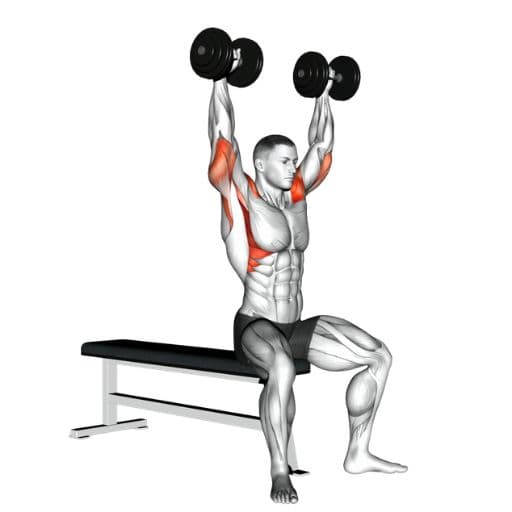
The dumbbell shoulder press (also called the dumbbell overhead press) is a compound upper-body exercise. The lifter holds a dumbbell in each hand at shoulder height and presses both overhead to full lockout, then lowers them under control. Independent arm paths require greater stabilizer activation than the barbell overhead press. The exercise can be performed seated (with back support) or standing (with greater core demand). All benchmarks use weight per dumbbell — not combined load.
All benchmarks on this page represent weight per dumbbell (one hand) with strict pressing form — no leg drive, full range of motion from shoulder height to overhead lockout. The illustration shows a seated variation; standing eliminates back support and typically allows 5–10% less weight at lower experience levels.
Dumbbell Shoulder Press vs. Barbell Overhead Press
At the intermediate level for a 180 lb male: dumbbell shoulder press 65 lb per dumbbell (combined total 130 lb) vs barbell overhead press 133 lb total barbell weight. The combined dumbbell total is approximately 97% of the barbell OHP — near-parity because seated back support roughly offsets the dumbbell stabilization cost. This pattern holds from novice through elite (97–102%), while beginners can press proportionally more with dumbbells (113%) due to the barbell’s higher skill floor.
Per-dumbbell load is roughly half your barbell OHP. If your barbell OHP is 133 lb, expect each dumbbell to be around 65 lb. Dumbbells offer greater range of motion and expose left-right imbalances. The barbell allows heavier absolute loading and is the standard competition lift. Use each exercise’s dedicated standards page for accurate comparison.
Dumbbell Shoulder Press Level Definitions
All example weights are per dumbbell at 180 lb male / 140 lb female bodyweight. Based on StrengthLevel.com community data (2.1M lifts) with a 5–12% strict-form discount.
New to dumbbell overhead pressing or has trained inconsistently for less than a few months. The primary challenge is learning to stabilize two independent dumbbells overhead — each arm must balance and press its own load without the fixed bar path of a barbell. Strength gains at this stage come primarily from neurological adaptation and developing the pressing groove.
Has trained the dumbbell shoulder press regularly for several months with a structured program. The pressing pattern is becoming consistent, and the lifter can maintain a stable overhead lockout without excessive torso lean or asymmetric arm extension. Linear progression is still effective — adding 2.5–5 lb per session or week is typical.
Roughly 1–2 years of consistent, structured overhead pressing training. The lifter has solid pressing form with strict no-leg-drive technique, controlled eccentric, and symmetric lockout. At this level, the combined dumbbell total (2× per-dumbbell) approximately equals a barbell overhead press 1RM. Periodized programming is typically needed for continued progress.
Multiple years of dedicated overhead pressing with sophisticated programming. Pressing 85+ lb dumbbells per hand requires exceptional shoulder stability, triceps strength, and core control. The lifter handles heavy dumbbells safely — cleaning them into position, maintaining strict form under near-maximal loads, and controlling the eccentric without dropping. Gains are slow and require intentional effort.
Exceptional dumbbell pressing strength achieved after many years of dedicated training. Pressing 100+ lb dumbbells per hand with strict form requires elite-level shoulder and triceps development, outstanding overhead stability, and mastery of the dumbbell clean-to-press sequence. This level is competitive among serious strength athletes and experienced bodybuilders.
Dumbbell Shoulder Press FAQ
How does the dumbbell shoulder press compare to the barbell overhead press?
Both exercises target the same primary muscles — anterior deltoids, lateral deltoids, and triceps — but they differ in loading convention, stability demand, and range of motion. The barbell OHP uses total barbell weight (bar + plates), while the dumbbell press is measured per dumbbell.
At the StrengthRegimen intermediate level for a 180 lb male: dumbbell shoulder press 65 lb per dumbbell (combined total 130 lb) vs barbell OHP 133 lb total. The combined dumbbell total is approximately 97% of the barbell OHP at this level. This near-parity exists because the seated back support (used by many dumbbell pressers) roughly offsets the stabilization cost of independent arms. At the beginner level, dumbbells are proportionally easier (113% of OHP) because the barbell overhead press has a higher skill floor — rack position, bar path, and wrist alignment all require more practice.
Dumbbells offer a greater range of motion (they can descend below ear level, unlike a barbell which stops at the top of the head) and help identify and correct left-right imbalances. The barbell allows heavier absolute loading and is the standard competition lift for overhead pressing.
Do these standards apply to seated, standing, or both?
These standards are based on StrengthLevel.com’s “Dumbbell Shoulder Press” dataset (2.1M lifts), which combines both seated and standing submissions. Gravitus confirms this: “Seated and standing presses are logged together here.” The standards therefore represent a blend of both variations.
StrengthLevel also maintains a separate “Seated Dumbbell Shoulder Press” page (629K lifts) with slightly higher standards: at 180 lb male intermediate, seated is 76 lb vs 71 lb general (~7% more). The seated variation benefits from back support, which removes core and standing balance demands and allows slightly heavier loading. Standing eliminates back support, requiring more core stability and typically reducing load by approximately 5–10%.
If you train exclusively seated, you may score slightly above these standards. If you train exclusively standing, you may score slightly below. Either variation is valid for comparison — just be consistent when tracking your progress over time.
What form mistakes inflate dumbbell shoulder press numbers?
The most common form breakdowns that artificially inflate your pressing weight are:
- Leg drive: Using a quick knee dip to generate upward momentum. This effectively converts the strict press into a push press, allowing 15–25% more weight.
- Excessive back arch: On the seated variation, leaning back excessively turns the shoulder press into a high-incline chest press, recruiting more pectoral muscle.
- Partial range of motion: Not pressing to full lockout or not lowering the dumbbells back to shoulder height. Partial reps at the top of the movement can handle significantly more weight.
- Asymmetric pressing: One arm locking out well before the other, with the weaker arm never reaching full extension. Both arms should reach lockout simultaneously.
- Bouncing out of the bottom: Using stretch reflex and momentum at the turnaround point instead of a controlled reversal.
For valid comparison against these standards, press with no leg drive, controlled eccentric, full range of motion, and symmetric lockout. If seated, keep your back firmly against the bench with minimal arch.
How does the dumbbell shoulder press compare to the dumbbell bench press?
Both are compound dumbbell pressing exercises measured per dumbbell, but the shoulder press uses 65–76% of the dumbbell bench press load at novice through elite levels. The bench press is stronger because the pectoralis major (the primary bench press mover) is a much larger muscle than the deltoids, and the supine position provides a more mechanically advantageous pressing angle.
At the StrengthRegimen intermediate level for a 180 lb male: dumbbell shoulder press 65 lb per dumbbell vs dumbbell bench press 94 lb per dumbbell (69% ratio). If your dumbbell shoulder press approaches or exceeds your dumbbell bench press, you are likely using excessive back arch on the shoulder press (turning it into an incline press) or not benching through full range of motion.
How do I safely test or assess my dumbbell shoulder press?
Unlike barbell lifts, the dumbbell shoulder press has no rack to re-rack to when a rep fails. This makes heavy singles riskier. For safe assessment:
- Recommended approach: Use a 3–8 rep set with strict form and calculate your estimated 1RM using this tool. This is safer and provides a sufficiently accurate estimate for a compound pressing movement.
- If testing a true 1RM: Have a spotter stand behind you and assist at the elbows or wrists if you stall. On a seated press, the bench back provides a reference point for the spotter.
- Bail-out technique: If you fail mid-rep, lower the dumbbells to your shoulders (controlled), then either lower them to your thighs one at a time or carefully place them on the floor beside you. Never drop heavy dumbbells from overhead without warning.
- Getting into position: For heavy sets, use the “kick-up” technique — start with dumbbells on your thighs and use a controlled leg kick to bring them to shoulder height. This is often the most challenging part of a heavy dumbbell shoulder press set.
The Gravitus community median is 50 lb per dumbbell for 10 reps (men) and 25 lb for 10 reps (women). These are practical working-set benchmarks if you prefer a rep-based comparison rather than an estimated 1RM.
Disclaimer
These are training benchmarks for self-assessment, not clinical standards. All values represent one dumbbell (per hand) with strict pressing form — no leg drive, full range of motion, controlled eccentric. Standards are derived from StrengthLevel.com community data (2.1M lifts, 621K qualifying) with a graduated strict-form discount of 5–12%, cross-validated against Gravitus real workout data (28K users) and FitnessVolt model estimates. The dataset includes both seated and standing submissions. The 1RM prediction formula (Epley) is reasonably accurate for compound pressing movements at 1–10 reps but loses precision above 10 reps. Individual results will vary with technique, range of motion, seated vs standing variation, and training background. Consult a qualified professional before attempting high-intensity overhead pressing.
Related Standards
- Overhead Press (Barbell)Standing barbell strict press — total barbell weight
- Dumbbell Bench PressPer-dumbbell flat bench press standards
- Dumbbell Lateral RaisePer-dumbbell lateral raise — isolation shoulder
- Incline DB Bench PressPer-dumbbell incline press at 30°
- Dumbbell CurlPer-dumbbell standing biceps curl