Dumbbell Lateral Raise Strength Standards
The Intermediate dumbbell lateral raise standard is 29 lb (13 kg) per dumbbell for men and 17 lb (8 kg) for women (estimated 1RM at 180 / 140 lb bodyweight). All values represent weight per dumbbell with strict form — no momentum, no swinging. Compare your lift by bodyweight and age below.
Configure Your Bodyweight & Unit
Male Dumbbell Lateral Raise Standards (lb/dumbbell)
StrengthRegimen standards for 180 lb bodyweight — per dumbbell — strict form — shoulder isolation
| Strength Level | Per Dumbbell (180 lb BW) | BW Ratio |
|---|---|---|
| Beginner | 9 lb | 0.05x |
| NoviceYou | 16 lb | 0.09x |
| Intermediate | 29 lb | 0.16x |
| Advanced | 43 lb | 0.24x |
| Elite | 59 lb | 0.33x |
How much should I Dumbbell Lateral Raise? (lb/dumbbell)
Assess Your Dumbbell Lateral Raise
Enter the weight per dumbbell and reps completed to estimate your 1RM and strength level
Enter the weight of one dumbbell — not the combined weight of both hands
Raising 15 lb/dumbbell × 10 reps with strict form equals an estimated 1RM of 20 lb per dumbbell.
At 180 lb (Male), that is 0.11× your bodyweight per arm, which falls within the Novice range. Epley-based estimate — less precise for isolation exercises than for compound lifts.
Shareable Dumbbell Lateral Raise Strength Card
Dumbbell Lateral Raise Strength Spectrum
Rep-Max & Training Zone Table (LB/dumbbell)
Per-dumbbell loads based on your 20 lb estimated 1RM — strict standing form
| Target | % of 1RM | Per Dumbbell | Programming |
|---|---|---|---|
| 1RM (Max) (1 rep) | 100% | 20 lb | Not recommended — shoulder risk |
| 5RM (5 reps) | 85.7% | 17 lb | 3 × 5 reps |
| 8RM (8 reps) | 78.9% | 16 lb | 3–4 × 8 reps |
| 10RM (10 reps) | 75% | 15 lb | 3–4 × 10 reps |
| 12RM (12 reps) | 71.4% | 14 lb | 3 × 12 reps |
| 15RM (15 reps) | 66.7% | 13 lb | 2–3 × 15 reps |
| 20RM (20 reps) | 60% | 12 lb | 2 × 20 reps |
Complete Dumbbell Lateral Raise Reference Chart (LB/dumbbell)
Per-dumbbell standards across bodyweights for Male lifters in lb
| BW (lb) | Beginner | Novice | Intermediate | Advanced | Elite |
|---|---|---|---|---|---|
| 120 | 6 | 11 | 19 | 29 | 40 |
| 130 | 7 | 12 | 21 | 31 | 43 |
| 140 | 7 | 13 | 22 | 34 | 46 |
| 150 | 8 | 14 | 24 | 36 | 50 |
| 160 | 8 | 14 | 26 | 38 | 53 |
| 170 | 9 | 15 | 27 | 41 | 56 |
| 180 | 9 | 16 | 29 | 43 | 59 |
| 190 | 10 | 17 | 30 | 46 | 63 |
| 200 | 10 | 18 | 32 | 48 | 66 |
| 210 | 11 | 19 | 34 | 50 | 69 |
| 220 | 11 | 20 | 35 | 53 | 73 |
| 230 | 12 | 21 | 37 | 55 | 76 |
| 240 | 12 | 22 | 38 | 58 | 79 |
| 250 | 13 | 23 | 40 | 60 | 83 |
| 260 | 13 | 23 | 42 | 62 | 86 |
| 270 | 14 | 24 | 43 | 65 | 89 |
| 280 | 14 | 25 | 45 | 67 | 92 |
| 290 | 15 | 26 | 46 | 70 | 96 |
| 300 | 15 | 27 | 48 | 72 | 99 |
About the Dumbbell Lateral Raise
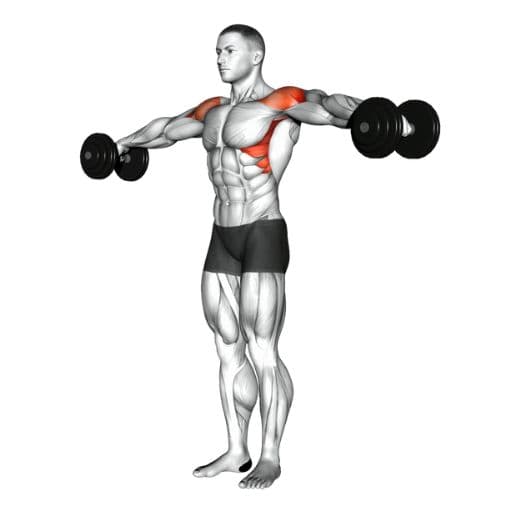
The standing dumbbell lateral raise is an isolation exercise targeting the lateral (middle) deltoid. The lifter stands upright holding a dumbbell in each hand at the sides, raises both dumbbells simultaneously outward in a wide arc until the upper arms are approximately parallel to the floor, then lowers them under control. The slight elbow bend remains fixed throughout. It is one of the most popular shoulder isolation exercises for developing shoulder width and the V-taper aesthetic.
All benchmarks on this page represent weight per dumbbell (one hand) with strict standing form. The lateral raise is one of the most commonly cheated exercises in any gym — using momentum can inflate loads by 30–50%. These standards assume no trunk sway, no hip drive, and a controlled 2-second concentric and eccentric.
Lateral Raise vs. Overhead Press — Understanding the Relationship
The overhead press (OHP) is a compound movement where the anterior deltoids, lateral deltoids, and triceps all contribute to pressing a barbell overhead. The lateral raise isolates the lateral deltoid with a long lever arm and no triceps contribution. Campos et al. (2020, J Hum Kinet 75) found that medial deltoid activation was similar between the lateral raise (30.3% MVIC) and shoulder press (27.9% MVIC) at 60% 1RM — no significant difference. However, the OHP allows much heavier absolute loading because multiple muscle groups share the work. At the StrengthRegimen intermediate level for a 180 lb male: lateral raise 29 lb per dumbbell vs OHP 133 lb total barbell (the lateral raise is approximately 22% of the OHP load per dumbbell).
Do not compare lateral raise and overhead press numbers directly — they measure different things. The OHP tests compound pressing strength; the lateral raise tests isolated abduction strength. Both contribute to shoulder development from different angles. If you train both, use each exercise’s dedicated standards page.
Dumbbell Lateral Raise Strength Levels Explained
What each strength level means for the standing dumbbell lateral raise with strict form — no momentum, full range of motion to shoulder height, and a consistent slight elbow bend throughout. All values are per-dumbbell weight relative to bodyweight.
Beginner
Male 0.05× BW • Female 0.04× BWCan perform a standing dumbbell lateral raise through a controlled range of motion with very light dumbbells. For a 180 lb male this is approximately 9 lb per dumbbell. The primary challenge is raising the dumbbells in a wide arc without momentum — most beginners instinctively swing the weight up using a hip thrust or lean. Maintaining a consistent slight elbow bend and raising to shoulder height without shrugging are the key skills being developed.
Focus: Focus on strict form with 3 × 12–15 reps using very light dumbbells (5–10 lb). Practice a controlled 2-second up, 2-second down tempo. Keep the torso completely still — if your body sways, the weight is too heavy. Prioritize reaching full shoulder height over adding load.
0–6 months of consistent training
Novice
Male 0.09× BW • Female 0.07× BWReliable strict lateral raise form with moderate loads. For a 180 lb male this is approximately 16 lb per dumbbell. The lifter can consistently raise to shoulder height without trunk sway, maintain a fixed slight elbow bend throughout each rep, and control both the concentric and eccentric phases. The mind-muscle connection with the lateral deltoid is developing.
Focus: Progress by adding 2.5 lb per dumbbell when all prescribed reps are completed with strict form across every set. Work primarily in the 10–12 rep range with 3–4 sets. Begin incorporating tempo variations (3-second eccentric) to strengthen the lateral deltoid through the full ROM.
6–12 months of structured shoulder training
Intermediate
Male 0.16× BW • Female 0.12× BWSolid lateral deltoid isolation maintained with strict technique. For a 180 lb male this is approximately 29 lb per dumbbell. Represents the typical level of a dedicated lifter with 1–2 years of consistent shoulder work who includes lateral raises in every shoulder session. At this load, maintaining strict form becomes genuinely challenging — the temptation to use momentum is significant.
Focus: Periodize across 8–15 reps. Progress requires intentional overload — small weight increments, drop sets, partial reps after failure, or controlled cheat-then-slow-negative sets. Consider adding cable lateral raises for varied resistance curves. Monitor shoulder comfort — the supraspinatus is under increasing stress at higher loads.
1–2+ years of consistent training
Advanced
Male 0.24× BW • Female 0.17× BWUpper-tier strict lateral raise strength. For a 180 lb male this is approximately 43 lb per dumbbell. Maintaining truly strict form — no momentum, full ROM to shoulder height, consistent elbow angle, controlled eccentric — at this load is very difficult. Very few recreational lifters achieve this level without some degree of body english. Shoulder width and deltoid development are visually prominent.
Focus: Structured mesocycles with planned intensity variations. Balance direct lateral deltoid volume with compound pressing. Prioritize rotator cuff health and shoulder mobility work. Consider mechanical drop sets (strict → slight cheat → partials) and cable lateral raises for constant-tension overload. Manage supraspinatus and infraspinatus recovery carefully.
3–5+ years of dedicated shoulder training
Elite
Male 0.33× BW • Female 0.23× BWExceptional strict lateral raise strength. For a 180 lb male this is approximately 59 lb per dumbbell with strict isolation form — no momentum, full ROM, controlled tempo. This level requires years of dedicated lateral deltoid training, excellent shoulder joint integrity, and the ability to maintain isolation under very heavy (for this exercise) loads. Shoulder health and rotator cuff resilience are the primary limiting factors beyond raw deltoid strength.
Focus: Prioritize shoulder joint longevity and calculated long-term progression. Very small increases over multi-month training blocks. Many elite lifters supplement strict raises with cable and machine lateral raises for safer high-intensity work. Strategic deloads are essential to prevent rotator cuff overuse.
5+ years of serious strength training
Dumbbell Lateral Raise FAQ
How do lateral raises compare to the overhead press for shoulder development?
The overhead press (OHP) is a compound movement that recruits the anterior deltoids, lateral deltoids, triceps, and upper chest. The lateral raise is an isolation exercise that targets the lateral (middle) deltoid with minimal contributions from other muscles. Campos et al. (2020, J Hum Kinet 75, DOI: 10.2478/hukin-2020-0033) found that medial deltoid activation was similar between the lateral raise (30.3% MVIC) and shoulder press (27.9% MVIC) at 60% 1RM in 13 trained men — no significant difference between the two exercises for the lateral deltoid specifically.
However, the OHP also produced significantly higher anterior deltoid activation (33.3% vs 21.2% MVIC), while the lateral raise produced significantly higher posterior deltoid activation (24% vs 11.4% MVIC). Both exercises are valuable: the OHP for overall shoulder strength and the lateral raise for isolated lateral deltoid width. At the StrengthRegimen intermediate level for a 180 lb male: lateral raise 29 lb/dumbbell vs OHP 133 lb total barbell — the lateral raise is approximately 22% of OHP load (per dumbbell).
Why does momentum matter so much for lateral raises?
The lateral raise has the longest effective lever arm of any common dumbbell exercise — the arm is nearly fully extended, placing the load far from the shoulder joint. This means even a small amount of initial momentum (a hip thrust, trunk lean, or upward surge) can drastically reduce the demand on the lateral deltoid and allow significantly heavier weights.
In practice, a lifter who can strict-raise 25 lb per dumbbell may “cheat-raise” 40+ lb by using body english. This 30–50% inflation is why StrengthRegimen applies a 20–27% strict-form discount below StrengthLevel.com community data. If you can pass the “wall test” (standing with your back against a wall so your trunk cannot sway), your form is likely strict enough for valid comparison against these standards.
Is it safe to test a 1RM on dumbbell lateral raises?
No — testing a true 1RM on a lateral raise is not recommended. At maximal loads with extended arms, the supraspinatus tendon (which initiates the first 0–30° of abduction) is under extreme stress, and the shoulder capsule and rotator cuff are in a vulnerable position. The risk of acute rotator cuff strain or impingement is substantial.
The 1RM shown in this tool is an estimate derived from a multi-rep set using the Epley formula, not a recommendation to attempt a single-rep maximum. Use working sets of 8–15 reps for assessment — this is how the lateral raise is predominantly trained (SL workout data shows 3×10 is the most popular scheme at 19% for men and 24% for women, followed by 3×12 at 13–14%). The estimated 1RM is a reference number for comparison, but it should never be tested directly.
How high should I raise the dumbbells?
Raise until your upper arms are approximately parallel to the floor (roughly 90° of shoulder abduction). This is the standard range of motion for comparing against these benchmarks. Stopping short of shoulder height (a very common error) reduces the effective load on the lateral deltoid and inflates the weight you can handle.
Raising above shoulder height shifts activation toward the upper trapezius and increases subacromial impingement risk in susceptible individuals. There is no benefit for lateral deltoid development beyond approximately shoulder height. Maintain a slight elbow bend (approximately 15–20°) — the angle at the top should be the same as at the bottom. If the elbows straighten at the bottom and bend at the top, you are likely compensating for excessive weight.
How does the dumbbell lateral raise compare to the dumbbell curl for load?
Both are per-dumbbell isolation exercises, but the lateral raise uses 50–66% of the dumbbell curl load (increasing with experience level). The lateral raise is lighter because: (1) the arm is nearly extended, creating a much longer moment arm than the bent-arm curl; (2) the lateral deltoid is a smaller muscle than the biceps brachii; and (3) the supraspinatus and rotator cuff muscles, which assist in abduction, are relatively small stabilizers.
At the StrengthRegimen intermediate level for a 180 lb male: lateral raise 29 lb/dumbbell vs dumbbell curl 49 lb/dumbbell (59% ratio). If your lateral raise weight approaches or exceeds your strict curl weight, you are almost certainly using momentum or excessive body english on the lateral raise.
Disclaimer
These are training benchmarks for self-assessment, not clinical standards. All values represent one dumbbell (per hand) with strict standing form — no momentum, no trunk sway, full range of motion to shoulder height. Standards are derived from StrengthLevel.com community data (1.21M lifts, 315K qualifying) with a strict-form discount of 20–27%, cross-validated against FitnessVolt model estimates; individual results will vary with technique, range of motion, tempo, and training background. The 1RM prediction formula is less accurate for isolation exercises than for compound lifts, and testing a true 1RM on a lateral raise is actively discouraged due to supraspinatus tendon and rotator cuff vulnerability. Individual results will vary. Consult a qualified professional before attempting high-intensity resistance training.