Incline Dumbbell Fly Strength Standards
The Intermediate incline dumbbell fly standard is 49 lb (22 kg) per dumbbell for men and 24 lb (11 kg) for women (estimated 1RM at 180 / 140 lb bodyweight, 30° incline). Compare your lift by bodyweight and age below.
Configure Your Bodyweight & Unit
Male Incline Dumbbell Fly Standards (lb/dumbbell)
StrengthRegimen standards for 180 lb bodyweight — per dumbbell — 30° incline — isolation
| Strength Level | Per Dumbbell (180 lb BW) | BW Ratio |
|---|---|---|
| Beginner | 16 lb | 0.09x |
| NoviceYou | 31 lb | 0.17x |
| Intermediate | 49 lb | 0.27x |
| Advanced | 70 lb | 0.39x |
| Elite | 95 lb | 0.53x |
How much should I Incline Dumbbell Fly? (lb/dumbbell)
Assess Your Incline Dumbbell Fly
Enter the weight per dumbbell and reps completed to estimate your 1RM and strength level
Enter the weight of one dumbbell — not the combined weight of both hands
Flying 30 lb/dumbbell × 10 reps on a 30° incline equals an estimated 1RM of 40 lb per dumbbell.
At 180 lb (Male), that is 0.22× your bodyweight per arm, which falls within the Novice range. Epley-based estimate — less precise for isolation exercises than for compound lifts.
Shareable Incline Dumbbell Fly Strength Card
Incline Dumbbell Fly Strength Spectrum
Rep-Max & Training Zone Table (LB/dumbbell)
Per-dumbbell loads based on your 40 lb estimated 1RM — 30° incline
| Target | % of 1RM | Per Dumbbell | Programming |
|---|---|---|---|
| 1RM (Max) (1 rep) | 100% | 40 lb | Not recommended — shoulder risk |
| 5RM (5 reps) | 85.7% | 34 lb | 3 × 5 reps |
| 8RM (8 reps) | 78.9% | 32 lb | 3–4 × 8 reps |
| 10RM (10 reps) | 75% | 30 lb | 3–4 × 10 reps |
| 12RM (12 reps) | 71.4% | 29 lb | 3 × 12 reps |
| 15RM (15 reps) | 66.7% | 27 lb | 2–3 × 15 reps |
| 20RM (20 reps) | 60% | 24 lb | 2 × 20 reps |
Complete Incline Dumbbell Fly Reference Chart (LB/dumbbell)
Per-dumbbell standards across bodyweights for Male lifters in lb
| BW (lb) | Beginner | Novice | Intermediate | Advanced | Elite |
|---|---|---|---|---|---|
| 120 | 11 | 20 | 32 | 47 | 64 |
| 130 | 12 | 22 | 35 | 51 | 69 |
| 140 | 13 | 24 | 38 | 55 | 74 |
| 150 | 14 | 26 | 41 | 59 | 80 |
| 160 | 14 | 27 | 43 | 62 | 85 |
| 170 | 15 | 29 | 46 | 66 | 90 |
| 180 | 16 | 31 | 49 | 70 | 95 |
| 190 | 17 | 32 | 51 | 74 | 101 |
| 200 | 18 | 34 | 54 | 78 | 106 |
| 210 | 19 | 36 | 57 | 82 | 111 |
| 220 | 20 | 37 | 59 | 86 | 117 |
| 230 | 21 | 39 | 62 | 90 | 122 |
| 240 | 22 | 41 | 65 | 94 | 127 |
| 250 | 23 | 43 | 68 | 98 | 133 |
| 260 | 23 | 44 | 70 | 101 | 138 |
| 270 | 24 | 46 | 73 | 105 | 143 |
| 280 | 25 | 48 | 76 | 109 | 148 |
| 290 | 26 | 49 | 78 | 113 | 154 |
| 300 | 27 | 51 | 81 | 117 | 159 |
About the Incline Dumbbell Fly
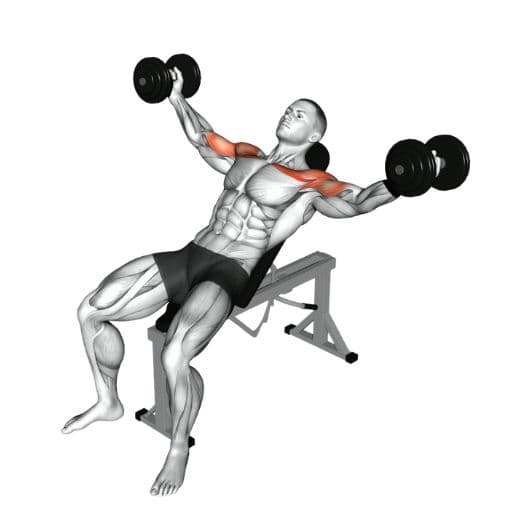
The incline dumbbell fly is an isolation exercise performed on a bench set to approximately 30 degrees. The lifter holds a dumbbell in each hand with arms extended above the upper chest, then lowers the dumbbells in a wide arc with a slight, fixed elbow bend until the handles reach approximately upper-chest height, and returns them along the same arc. The extended lever arm and fixed elbow angle isolate the pectoralis major with minimal triceps contribution — unlike the incline dumbbell bench press, which is a compound movement involving elbow extension.
All benchmarks on this page represent the weight of one dumbbell (per hand) on a 30° incline bench. If you fly 30 lb in each hand, enter 30 lb — not 60 lb. This is an isolation exercise — loads will be significantly lower than for the Incline Dumbbell Bench Press.
Incline Fly vs. Incline Press — Understanding the Difference
The incline dumbbell fly and the incline dumbbell bench press target similar muscles but use fundamentally different mechanics. The fly keeps the elbows in a fixed slight bend, creating a long lever arm that isolates the pectoralis major with minimal triceps contribution. The press involves full elbow flexion and extension, recruiting the triceps to share the load. At StrengthRegimen’s intermediate level, the incline fly is approximately 63% of the incline press per dumbbell (49 vs 77 lb for a 180 lb male).
Do not use these standards interchangeably. If your fly weight is close to your press weight, you are likely bending the elbows too much and performing a press-fly hybrid rather than a true isolation fly. Strict fly form uses a wide, sweeping arc — the motion should resemble hugging a large tree trunk, not pushing a weight overhead. Film yourself from the side to verify.
Incline Dumbbell Fly Strength Levels Explained
What each strength level means for the incline dumbbell fly with strict isolation form — fixed elbow angle, controlled arc, and consistent range of motion on a 30° incline bench. All values are per-dumbbell weight relative to bodyweight.
Beginner
Male 0.09× BW • Female 0.05× BWCan perform the incline dumbbell fly with very light dumbbells through a controlled range of motion. For a 180 lb male this is approximately 16 lb per dumbbell. The main challenge is learning to keep the elbow angle fixed (slight bend, approximately 15–20°) and lowering the dumbbells in a wide arc rather than pressing them. Most beginners instinctively bend the elbows excessively, turning the fly into a wide-grip press.
Focus: Focus on learning the movement pattern with very light dumbbells (8–15 lb). Practice a controlled 2–3 second eccentric, keeping the elbows in a fixed slight bend throughout. Lower until you feel a stretch across the upper chest, then reverse. Aim for 3 × 12–15 reps. Do not go heavy — the shoulder is in a vulnerable position with extended arms.
0–6 months of consistent training
Novice
Male 0.17× BW • Female 0.10× BWConsistent fly form with moderate loads. For a 180 lb male this is approximately 31 lb per dumbbell. The lifter can maintain a fixed elbow angle throughout the entire set, lower the dumbbells to a full stretch without losing control, and bring them together at the top using pectoralis contraction rather than pressing.
Focus: Progress by adding 2.5–5 lb per dumbbell when all prescribed reps are completed with strict form. Work in the 8–12 rep range. Emphasize the mind-muscle connection with the upper chest during the concentric. Consider pausing briefly at the top (squeeze) to reinforce pec activation.
6–12 months of structured chest training
Intermediate
Male 0.27× BW • Female 0.17× BWSolid isolation strength maintained with strict technique. For a 180 lb male this is approximately 49 lb per dumbbell. Represents the typical level of a dedicated gym-goer with 1–2 years of consistent chest training who includes flies in their routine. The lifter has good pec isolation and can distinguish between fly and press at this load.
Focus: Periodize across 8–15 reps. Progress requires intentional overload — small increments, controlled tempo variations, or peak contraction holds. Consider alternating between incline flies and cable crossovers for varied resistance curves. Monitor shoulder comfort carefully at these loads.
1–2+ years of consistent training
Advanced
Male 0.39× BW • Female 0.26× BWUpper-tier incline fly strength. For a 180 lb male this is approximately 70 lb per dumbbell. Maintaining true isolation form (arms nearly straight) at this load is extremely challenging. The shoulder joint is under significant stress at the stretched position. Very few recreational lifters achieve this level with strict fly form — most who claim higher numbers are doing a press-fly hybrid.
Focus: Structured mesocycles with planned intensity variations. Balance direct fly volume with compound pressing. Prioritize shoulder health and rotator cuff prehabilitation. Consider using cables for heavier isolation work — the constant tension profile is easier on the shoulder joint at advanced loads.
3–5+ years of dedicated chest training
Elite
Male 0.53× BW • Female 0.35× BWExceptional incline fly strength. For a 180 lb male this is approximately 95 lb per dumbbell with strict isolation form. This level requires years of dedicated pectoralis development, excellent shoulder joint integrity, and the ability to maintain a fixed slight elbow bend with heavy dumbbells at full stretch. Shoulder health is the primary limiting factor beyond raw muscle strength.
Focus: Prioritize shoulder joint health and calculated long-term progression. Very small increases over multi-month training blocks. Many elite lifters transition to cables for heavier isolation work due to better tension curves and reduced shoulder stress. Strategic deloads are essential.
5+ years of serious strength training
Incline Dumbbell Fly FAQ
What is the difference between an incline fly and an incline press?
The incline dumbbell fly is an isolation exercise: the elbow angle stays fixed in a slight bend (~15–20°) throughout, and the arms move in a wide arc. The pectoralis major does virtually all the work. The incline dumbbell press is a compound movement: the elbows flex at the bottom and extend at the top, recruiting the triceps significantly alongside the chest and anterior deltoids.
Because of the longer lever arm and minimal triceps contribution, the fly uses substantially less weight than the press. At the StrengthRegimen intermediate level, the incline fly is approximately 63% of the incline press per dumbbell. If your fly weight approaches your press weight, you are likely bending the elbows too much and converting the movement into a press-fly hybrid.
Is it safe to test a 1RM on incline dumbbell flies?
No — testing a true 1RM on a fly is not recommended. At the bottom of the fly, the shoulder joint is in a stretched position with the arms nearly fully extended, creating a very long moment arm. Under maximal load, this puts extreme stress on the shoulder capsule, rotator cuff tendons, and anterior ligaments.
The 1RM shown in this tool is an estimate derived from a multi-rep set using the Epley formula, not a recommendation to attempt a single-rep maximum. Use working sets of 8–15 reps for assessment — this is how the incline fly is predominantly trained (SL workout data shows 3×10 is the most popular scheme at 21%, followed by 3×12 at 13%). The estimated 1RM is a useful reference number for comparison, but it should never be tested directly.
How consistent are these standards given the small dataset?
These standards are based on 221,548 community lifts (20,252 qualifying results) from StrengthLevel.com, cross-validated against FitnessVolt model estimates. While substantially smaller than the bench press dataset (11M+ lifts), this is a meaningful sample — especially for male lifters (18,764 qualifying results). The female dataset is smaller (1,488 qualifying), so female standards should be interpreted with greater caution.
All community data is self-reported. Technique variability is higher for the fly than for pressing movements — the boundary between a strict fly and a press-fly hybrid is subjective. StrengthRegimen applies a larger strict-form discount (13–30% below SL) to account for this, but the standards should still be treated as practical training benchmarks, not scientific population norms.
What bench angle should I use?
These standards assume a 30-degree incline, which is the most commonly studied angle in peer-reviewed research (Trebs et al. 2010, Rodríguez-Ridao et al. 2020) and balances upper pectoralis emphasis with practical load capacity.
A steeper incline (40–45°) shifts more emphasis to the anterior deltoids and typically reduces the weight that can be flown. A shallower incline (15–20°) moves closer to a flat fly pattern. Results from different angles are not directly comparable. If your gym bench only adjusts in fixed increments (e.g., 30° and 45°), use whichever is closest to 30°. Be consistent across assessments.
How do I know if I’m doing a fly or a press-fly hybrid?
The key distinction is elbow angle. In a strict fly, the elbows maintain a slight, fixed bend (approximately 15–20°) throughout the entire range of motion — the angle at the bottom should be the same as at the top. In a press-fly hybrid, the elbows bend significantly at the bottom (60–90°+) and straighten at the top, which recruits the triceps and allows heavier weight.
Self-test: If your arms would form a large “hugging” arc when viewed from the side, it’s a fly. If the motion looks more like a wide-grip press with a diagonal bar path, it’s a hybrid. Film yourself from the side. If the dumbbells move in a straight or angled line rather than an arc, you’re pressing, not flying. Use lighter weight and widen the arc.
Disclaimer
These are training benchmarks for self-assessment, not clinical standards. All values represent one dumbbell (per hand) on a 30° incline bench. Standards are derived from StrengthLevel.com community data (222K lifts, 20K qualifying) with a strict-form discount, cross-validated against FitnessVolt model estimates. The female dataset is smaller (1,488 qualifying results) — interpret with greater caution. The 1RM prediction formula is less accurate for isolation exercises than for compound lifts, and testing a true 1RM on a fly is actively discouraged due to shoulder joint vulnerability. Individual results will vary with bench angle, technique, elbow angle, and training background. Consult a qualified professional before attempting high-intensity resistance training.