Bench Press Calculator
Estimate your bench press one-rep max from a submaximal set, then explore rep-max loads, percentage-based training tables, plate breakdowns, and a progressive warm-up ramp — all derived from published prediction equations.
Enter Weight & Reps
Your Bench Press 1RM Estimate
A Training Max is a percentage of your estimated 1RM used as the basis for programming working sets. Common in frameworks like 5/3/1, where 85–90% is a typical starting point. This is a programming convention, not a scientific universal.
Estimated Training Loads by Rep Target
Based on your estimated 1RM of 216 lb (inverse Epley)
| Target | %1RM | Load |
|---|---|---|
| 1RM(1 rep) | 100% | 215 lb |
| 2RM(2 reps) | 93.8% | 205 lb |
| 3RM(3 reps) | 90.9% | 195 lb |
| 5RM(5 reps) | 85.7% | 185 lb |
| 8RM(8 reps) | 78.9% | 170 lb |
| 10RM(10 reps) | 75% | 160 lb |
| 12RM(12 reps) | 71.4% | 155 lb |
| 15RM(15 reps) | 66.7% | 145 lb |
Estimated loads are derived from the inverse Epley formula and rounded to the nearest practical loading increment (5 lb). Plate loading assumes a standard 45 lb bar. These are estimates — actual rep performance varies with fatigue, technique, and individual factors.
Training Load Reference Table
Common training percentages of your estimated 1RM (216 lb)
Loads are rounded to the nearest practical increment (5 lb) and assume a 45 lb bar. Actual training percentages depend on your programming method and recovery capacity.
Load the Bar
Enter any target weight to see the plate breakdown per side.
About the Bench Press
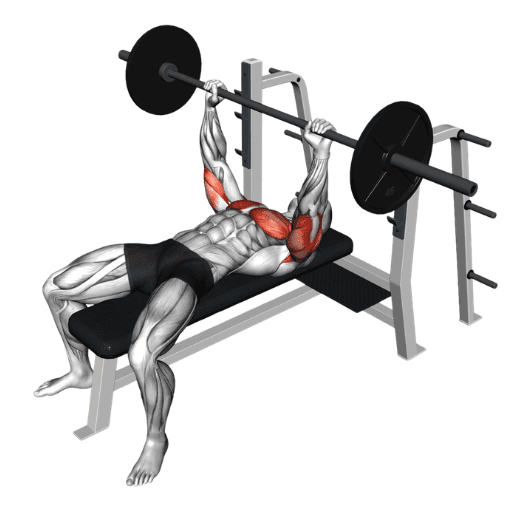
The barbell bench press is a compound upper-body pressing movement and one of the three competitive lifts in powerlifting. It primarily targets the pectoralis major (chest), anterior deltoids (front of the shoulder), and triceps brachii (back of the upper arm). The movement is performed lying supine on a flat bench, unracking a loaded barbell at arm’s length, lowering it to the chest, and pressing it back to lockout.
Because the bench press is performed with standardized equipment and a well-defined range of motion, it is one of the most commonly tested and tracked exercises in strength training. This makes it particularly well-suited for 1RM estimation — several of the prediction equations used in this calculator were originally validated using bench press data.
How This Calculator Works
This calculator estimates your one-rep max (1RM) from a submaximal set, then derives training loads using standard inverse formulas. Here’s how each piece works and where the estimates are most reliable.
1RM Prediction Formulas
Epley (1985)
1RM = weight × (1 + reps / 30). One of the most widely used prediction equations in strength training. The formula is a linear model that assumes a fixed relationship between load and reps. It tends to be a good general-purpose estimator across a range of rep counts.
Brzycki (1993)
1RM = weight × 36 / (37 − reps). This formula produces estimates close to Epley for low rep ranges (1–6) and diverges at higher reps. It becomes mathematically undefined at 37 reps (division by zero), which this calculator guards against.
Lander (1985)
1RM = 100 × weight / (101.3 − 2.67123 × reps). A regression-based formula that uses a linear decay in percentage as reps increase. Its behavior diverges from the other formulas at very high rep counts.
Mayhew et al. (1992)
1RM = 100 × weight / (52.2 + 41.9 × e−0.055×reps). Uses an exponential decay model. It tends to produce conservative estimates compared to Epley and Brzycki. Originally validated using bench press data.
Accuracy & Best Use
All 1RM prediction equations are population-level regression models. They predict the average 1RM for a group that can lift a given weight for a given number of reps — not your specific 1RM. Individual variation depends on training experience, muscle fiber distribution, technique proficiency, and fatigue state.
Most accurate range: 1–10 repetitions. The formulas were generally developed and validated within this range for compound barbell movements.
Progressively less accurate: Above 10 reps, the relationship between load and reps becomes more variable. Cardiovascular and muscular endurance factors introduce additional error. Above 15 reps, treat estimates as rough approximations.
Bench press context: The bench press is one of the most-studied exercises for 1RM prediction. Several of these formulas (particularly Mayhew) were originally derived from bench press datasets, which means the bench press may be one of the exercises where these equations perform comparatively well.
Rep-Max & Percentage Loads
The rep-max table uses the inverse Epley formula to estimate the weight you can lift for a target number of reps: load = 1RM / (1 + reps / 30). These are derived estimates, not independently validated predictions — they inherit the assumptions and limitations of the original Epley model.
Percentage-based loads are straightforward arithmetic: a given percentage of your estimated 1RM. They are useful as references for programs that prescribe loads as percentages (e.g., “5 sets of 3 at 85%”). The accuracy of these values depends entirely on the accuracy of the underlying 1RM estimate.
Training Max: A Training Max is a programming convention — not a scientific concept. It is typically set at 85–90% of your estimated 1RM and used as the basis for calculating working sets. The purpose is to build in a conservative margin that accounts for estimation error and day-to-day performance variation. It is commonly associated with Jim Wendler’s 5/3/1 program but is used in many other contexts.
Plate Loading & Warm-Up Ramp
The plate calculator uses a greedy algorithm: starting from the largest available plate, it fits as many of each size as possible per side. Available plates are {45, 35, 25, 10, 5, 2.5} lb or {25, 20, 15, 10, 5, 2.5, 1.25} kg. If the target weight cannot be achieved exactly with available plates, the calculator shows the closest achievable weight.
The warm-up ramp generates a progressive series of sets from the empty bar up to your working weight. Percentages (40%, 60%, 75%, 90%) and rep counts (8, 5, 3, 2) decrease as the weight increases. This is a general template — not a prescription. Individual warm-up needs vary based on age, training history, joint health, and the specific session.
All weights are rounded to the nearest practical loading increment (5 lb or 2.5 kg) since partial plates are not available in most gym settings.
Transparency: This calculator uses published, peer-reviewed prediction equations applied to the bench press. The formulas, rounding methods, and calculation logic are fully described above. No proprietary algorithms, hidden adjustments, or unpublished datasets are used. All estimates are approximations — they do not replace actual 1RM testing under appropriate supervision.
Frequently Asked Questions
How accurate is a bench press 1RM calculator?
1RM prediction equations are most accurate for 1–10 reps and become less reliable at higher rep counts. For the bench press specifically, studies show prediction errors typically in the range of 5–10% for moderate rep counts. The actual error for any individual depends on factors like training experience, technique consistency, and fatigue state. Treat the estimate as a useful starting point for programming — not as a guaranteed maximal lift.
Which 1RM formula is best for bench press?
There is no single 'best' formula. Epley, Brzycki, Lander, and Mayhew all produce similar results for low rep counts (1–6) and diverge at higher reps. Some studies have found Mayhew slightly more accurate for the bench press since it was originally derived from bench press data, but the differences between formulas are generally smaller than the inherent prediction error. This calculator uses Epley as the primary estimate because it is the most commonly referenced, while showing all four for comparison.
What is a Training Max and why should I use one?
A Training Max (TM) is a percentage of your estimated 1RM — typically 85–90% — used as the base for programming working sets. It builds in a conservative margin that accounts for estimation error and natural day-to-day variation in strength. The concept is most commonly associated with Jim Wendler's 5/3/1 program but is used across many programming approaches. It is a practical programming tool, not a scientific concept.
Should I actually test my 1RM on bench press?
That depends on your goals and experience level. Competitive powerlifters regularly test 1RM as part of their sport. For general strength training, estimating from a submaximal set of 3–5 reps is a practical alternative that carries less injury risk. If you do test a true 1RM, use a competent spotter, a properly set-up bench with safety pins or arms, and a sensible attempt selection strategy.
How do I use the rep-max table for training?
The rep-max table estimates the weight you can lift for a target number of reps. For example, if your estimated 1RM is 225 lb, your estimated 5RM is approximately 196 lb. This is useful for auto-regulating training: if a program calls for a 'heavy set of 5,' the table gives you a starting reference. Adjust based on how the weight actually moves on the day.
Why does the plate calculator sometimes show a different weight than I entered?
Standard weight plates come in fixed denominations (45, 35, 25, 10, 5, 2.5 lb or their metric equivalents). Not every target weight can be loaded exactly with these plates. When the target is between available increments, the calculator shows the closest achievable weight using the available plates.
What is the difference between the bench press calculator and the bench press standards?
This calculator answers 'what are my estimated numbers?' — it computes 1RM, rep-max loads, percentage-based loads, and plate breakdowns from a submaximal set. The Bench Press Standards page answers 'how strong am I relative to population benchmarks?' — it compares your performance to bodyweight-ratio-based strength levels. They complement each other: estimate your 1RM here, then check where it falls on the standards page.
Disclaimer
This bench press calculator provides estimates based on published 1RM prediction equations (Epley, Brzycki, Lander, Mayhew). All calculated values are approximations intended for informational and training-planning purposes only. They do not constitute medical or professional training advice. Actual maximal strength varies based on training experience, technique proficiency, fatigue state, body composition, and many other individual factors. Never attempt a true one-rep max without appropriate supervision, spotting, and safety equipment. Consult a qualified professional before beginning a new exercise program or performing max-effort lifts.