Lat Pulldown Strength Standards
The Intermediate Lat Pulldown benchmark is 162 lb for a 180 lb man and 98 lb for a 140 lb woman (estimated 1RM, strict form on a standard 1:1 machine). Compare your performance by bodyweight, sex, and age.
Configure Your Bodyweight & Unit
Male Lat Pulldown Standards (lb)
StrengthRegimen standards for 180 lb bodyweight
| Strength Level | Stack Weight (180 lb BW) | Bodyweight Ratio |
|---|---|---|
| Beginner | 90 lb | 0.50x |
| Novice | 126 lb | 0.70x |
| IntermediateYou | 162 lb | 0.90x |
| Advanced | 216 lb | 1.20x |
| Elite | 279 lb | 1.55x |
How much should I be able to Lat Pulldown? (lb)
Assess Your Lat Pulldown
Enter the stack weight you pulled and how many reps you completed to see your estimated 1RM and strength level
Weight selected on the machine stack (standard 1:1 lat pulldown station)
Pulling 162 lb × 5 reps equals an estimated One-Rep Max (1RM) of 189 lb.
At a bodyweight of 180 lb (Male), you are pulling 1.05× your bodyweight, which falls within the Intermediate range according to StrengthRegimen standards. Note: Rep-based 1RM estimates for cable exercises may underestimate actual maximal strength by a few percent (Pérez-Castilla et al., 2021).
Shareable Lat Pulldown Strength Card
Lat Pulldown Strength Spectrum
Personalized Rep-Max & Training Zone Table (LB)
Working weights based on your 189 lb Estimated 1RM
| Target | % of 1RM | Stack Weight | Programming |
|---|---|---|---|
| 1RM (Max) (1 rep) | 100% | 189 lb | 1 × 1 rep (Max Test) |
| 2RM (2 reps) | 93.8% | 177 lb | 3–4 × 2 reps |
| 3RM (3 reps) | 90.9% | 172 lb | 4–5 × 3 reps |
| 5RM (5 reps) | 85.7% | 162 lb | 4–5 × 5 reps |
| 8RM (8 reps) | 78.9% | 149 lb | 3–4 × 8 reps |
| 10RM (10 reps) | 75% | 142 lb | 3–4 × 10 reps |
| 12RM (12 reps) | 71.4% | 135 lb | 3 × 12 reps |
| 15RM (15 reps) | 66.7% | 126 lb | 2–3 × 15 reps |
Complete Lat Pulldown Reference Chart (LB)
Stack weight standards across bodyweights for Male lifters in lb
| BW (lb) | Beginner | Novice | Intermediate | Advanced | Elite |
|---|---|---|---|---|---|
| 120 | 60 | 84 | 108 | 144 | 186 |
| 130 | 65 | 91 | 117 | 156 | 202 |
| 140 | 70 | 98 | 126 | 168 | 217 |
| 150 | 75 | 105 | 135 | 180 | 233 |
| 160 | 80 | 112 | 144 | 192 | 248 |
| 170 | 85 | 119 | 153 | 204 | 264 |
| 180 | 90 | 126 | 162 | 216 | 279 |
| 190 | 95 | 133 | 171 | 228 | 295 |
| 200 | 100 | 140 | 180 | 240 | 310 |
| 210 | 105 | 147 | 189 | 252 | 326 |
| 220 | 110 | 154 | 198 | 264 | 341 |
| 230 | 115 | 161 | 207 | 276 | 357 |
| 240 | 120 | 168 | 216 | 288 | 372 |
| 250 | 125 | 175 | 225 | 300 | 388 |
| 260 | 130 | 182 | 234 | 312 | 403 |
| 270 | 135 | 189 | 243 | 324 | 419 |
| 280 | 140 | 196 | 252 | 336 | 434 |
| 290 | 145 | 203 | 261 | 348 | 450 |
| 300 | 150 | 210 | 270 | 360 | 465 |
About the Lat Pulldown
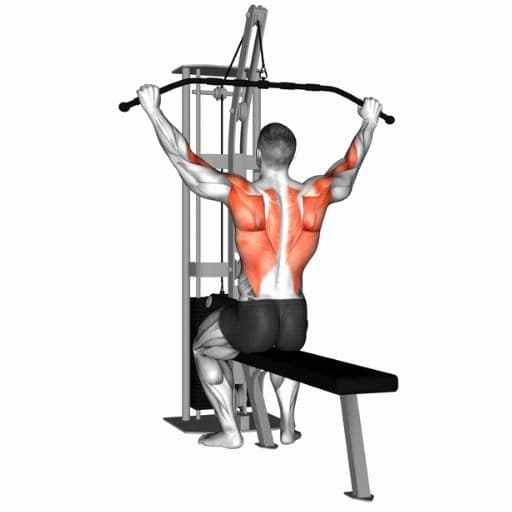
The seated cable lat pulldown is a machine-based compound upper-body pulling exercise performed on a dedicated lat pulldown station. The lifter sits with thigh pads secured, grips a wide lat bar with a pronated (overhand) grip, and pulls the bar from full arm extension to the upper chest. It is one of the most commonly used exercises for developing latissimus dorsi width and upper-back strength. Biomechanically, it combines shoulder extension and adduction with elbow flexion—recruiting the latissimus dorsi as the primary mover, with significant contribution from the biceps brachii, teres major, rhomboids, and lower trapezius as synergists and stabilizers.
The lat pulldown is widely used as a primary back-width builder and as a pull-up progression tool. When performed on a standard 1:1 dedicated station, the stack weight approximately equals the handle resistance. These standards assume strict form with a controlled eccentric and full range of motion.
Lat Pulldown vs. Pull-Up
Do not treat these exercises as interchangeable. The lat pulldown and the pull-up share the same primary muscle groups, but differ in stabilization demands, body position, and loading mechanics. A lat pulldown 1RM that approaches your bodyweight suggests the foundation for performing pull-ups is developing, but does not guarantee pull-up capability. Use each exercise’s standards independently.
Understanding Lat Pulldown Machine Numbers
Not all lat pulldown machines are created equal. Pulley ratio, cable routing, and friction all affect how much resistance the handle delivers for a given stack weight.
1:1 Pulley Ratio (Standard)
Dedicated lat pulldown stations typically use a single pulley that redirects the cable without mechanical advantage. Stack weight ≈ handle resistance. These standards assume a 1:1 machine.
2:1 Pulley Ratio (Functional Trainers)
Many functional trainers and cable crossover machines route the cable through two pulleys, creating a 2:1 ratio. A 100 lb stack selection delivers only ~50 lb at the handle. Using a 2:1 machine with these standards will make your numbers appear significantly inflated.
Friction & Maintenance
Cable drag, bearing quality, guide rod lubrication, and cable routing all add unmeasured friction. Well-maintained machines feel lighter; worn or dry machines can add 5–15% of effective resistance. Track your progress on the same machine for consistency.
Pulley Ratio & Effective Handle Resistance
| Machine Type | Pulley Ratio | Stack Weight Selected | ~Handle Resistance |
|---|---|---|---|
| Dedicated Lat Pulldown | 1:1 | 150 lb | ≈ 150 lb |
| Functional Trainer (dual pulley) | 2:1 | 150 lb | ≈ 75 lb |
| Cable Crossover (high pulley) | Varies | 150 lb | 75–150 lb |
Lat Pulldown Testing Standards
To ensure your numbers are directly comparable to these benchmarks, execute reps according to this standard.
Seated Setup
Sit with thigh pads secured snugly against your upper thighs, feet flat on the floor. Grip the wide lat bar with a pronated (overhand) grip, hands placed slightly wider than shoulder width. Start with arms fully extended overhead, slight backward lean (10–15°).
Pull to Chest
Pull the bar smoothly to your upper chest / clavicle region by driving your elbows down and back. Squeeze your shoulder blades together at the bottom. Your torso should remain upright or with a slight lean — no excessive swinging or jerking.
Controlled Return
Return the bar to full arm extension under control — do not let the weight stack slam or drop. Maintain tension throughout the eccentric phase. Each rep should take approximately 2–3 seconds for the lowering (eccentric) portion.
Valid Counted Rep
- • Bar touches or comes within 1–2 inches of the upper chest
- • Arms fully extend at the top of each rep (controlled, no momentum)
- • Torso remains upright or with slight lean (≤15°)
- • Weight stack does not slam or rest between reps
Invalid / Disallowed
- • Excessive body lean or “body English” to initiate the pull
- • Partial reps (bar only reaches chin or forehead level)
- • Using momentum, kipping, or jerking motions
- • Behind-the-neck pulldowns (different exercise)
Strength Level Benchmarks
Stack-weight benchmarks for the seated cable lat pulldown relative to bodyweight.
Beginner
Male 0.50× BW • Female 0.30× BWAble to perform a controlled lat pulldown with proper grip, upright torso, and full range of motion. Strength at this stage is primarily limited by motor learning and grip endurance. The lifter is developing the mind-muscle connection with the lats.
Focus: Focus on controlled 2-second eccentrics, full arm extension at the top, and pulling to the upper chest. Prioritize form and full ROM over load. Work in the 10–15 rep range.
0–6 months of consistent upper-body training
Novice
Male 0.70× BW • Female 0.50× BWSolid foundation in vertical pulling. You can handle moderate stack weights for working sets with consistent form, no excessive body lean, and full ROM. Grip is no longer the primary limiting factor.
Focus: Use linear progression, adding weight when you can complete all prescribed sets and reps with clean form. Work across 8–12 reps. Begin incorporating grip-width variations for development.
6–12 months of structured training
Intermediate
Male 0.90× BW • Female 0.70× BWPulling close to bodyweight on a standard 1:1 machine with strict form. This represents a solid training base and typically correlates with the foundation needed for bodyweight pull-ups.
Focus: Periodize between heavier 5–8 rep sets and higher-volume 10–15 rep sets. Consider introducing weighted pull-ups or chin-ups as a complementary vertical pull.
1–2+ years of consistent training
Advanced
Male 1.20× BW • Female 0.90× BWPulling above bodyweight for estimated 1RM on a standard machine. This level indicates strong lat development and typically correlates with solid weighted pull-up performance. Requires sustained, structured upper-body training.
Focus: Progress is planned in 4–8 week mesocycles. Balance lat pulldown volume with rows, pull-ups, and deadlift variations. Monitor shoulder health and grip fatigue across pulling sessions.
3–5+ years of dedicated upper-body training
Elite
Male 1.55× BW • Female 1.15× BWExceptional vertical pulling strength on a cable machine. Typically seen in competitive strength athletes, advanced bodybuilders, and athletes with years of heavy pulling volume. Very few recreational lifters reach this level with strict form on a standard 1:1 machine.
Focus: Prioritize shoulder joint longevity, strategic deloads, and maintaining pulling strength across multiple exercises. Small, calculated increases over multi-month training blocks.
5+ years of serious strength training
How These Standards Are Derived
Sources, calculation methods, and limitations for every number on this page.
1. Data Sources & Classification
These are StrengthRegimen-derived training benchmarks, not peer-reviewed population norms. They are informed by:
- Community self-reported data from StrengthLevel.com, which aggregates 1,057,884+ user-submitted lat pulldown results. These are self-reported numbers, not laboratory-measured data.
- Cross-reference sources including griffin.fitness, calculator.academy, and bellsofsteel.com community standards, all showing convergent bodyweight-ratio patterns for the lat pulldown.
- General coaching conventions for cable-based upper-body pulling exercises, adjusted conservatively for strict form.
StrengthRegimen multipliers are set slightly conservative relative to StrengthLevel.com because: (1) StrengthLevel data is self-reported estimated 1RM that likely includes some overestimation from loose form, momentum, or inflated rep counts; and (2) StrengthRegimen specifies strict form (no torso swing, full ROM, controlled eccentric).
The five-tier classification system (Beginner through Elite) mirrors the framework used across StrengthRegimen tools and is informed by the strength classification models discussed in coaching literature (Kilgore & Rippetoe’s Practical Programmingand ExRx.net conventions), adapted for cable-machine pulling exercise.
2. Bodyweight Ratio Methodology
Standards are expressed as stack weight ÷ bodyweight. This normalizes performance across body sizes, allowing a 130 lb lifter and a 220 lb lifter to be compared on a relative basis.
Limitation: We use a single set of bodyweight ratios across all bodyweight classes. In practice, lighter lifters tend to achieve higher ratios while heavier lifters pull greater absolute loads. Bodyweight-class-specific standards may improve granularity in the future.
Important: A bodyweight ratio on the lat pulldown is NOT equivalent to the same ratio on a pull-up or barbell row. A 0.90× BW lat pulldown, a 0.90× BW pull-up (i.e., nearly full bodyweight), and a 0.90× BW barbell row represent very different levels of difficulty — the three should never be directly compared.
3. 1RM Estimation — Epley Formula & Cable Exercise Limitations
When you enter a multi-rep set, the tool estimates your 1RM using the Epley formula:
Cable exercise research: Pérez-Castilla, Suzovic, Domanovic, Fernandes & García-Ramos (2021) validated repetitions-to-failure equations for the lat pull-down 1RM in 23 subjects (12 men, 11 women). Mayhew and Wathen equations produced acceptable accuracy with high correlations (r ≥ 0.96), though they systematically underestimated actual 1RM by 2–7 kg.
The Epley formula is applied for consistency with other StrengthRegimen tools. It may slightly underestimate your true lat pulldown 1RM based on the available evidence, unlike free-weight exercises where overestimation is more common at high rep counts.
Recommendation: For the most accurate assessment, use sets of 10 reps or fewer. The tool displays a warning when reps exceed 10 because prediction accuracy decreases at higher rep counts regardless of the specific equation used.
4. Age Scaling
The “By Age” table applies gradual scaling factors based on the general pattern of neuromuscular force output across the lifespan: peak strength between ages 20–30, with gradual decline thereafter. For example: 0.92× at age 40, 0.84× at age 50, 0.74× at age 60.
Limitation: These age multipliers are generalized — they are NOT derived from lat pulldown-specific longitudinal data. The age-related strength decline pattern is well-documented across resistance exercises, but the specific rate of decline may differ between cable and free-weight exercises, and between upper and lower body. Treat age-adjusted values as approximate guides.
Transparency: The multipliers, calculation methods, data sources, and limitations described above are the complete methodology. No proprietary algorithms, hidden adjustments, or unpublished datasets are used. Where evidence is limited (particularly for cable-machine-specific performance norms), we state so explicitly rather than presenting uncertain values as established facts.
Grip Width, Pull-Up Progression & Programming
How grip variations, programming, and complementary exercises optimize lat pulldown training.
Grip Width & Variations
Wide Pronated Grip (Default)
Hands placed 1.5× shoulder width apart with palms facing away. Maximizes lat width recruitment and is the standard grip used for these benchmarks. This is the grip that should be used when comparing to these standards.
Close / Neutral Grip
Hands closer together, often with a V-bar or neutral-grip attachment. Increases biceps involvement and may allow slightly higher loads. Results with this grip should not be directly compared to wide-grip standards.
Supinated (Underhand) Grip
Palms facing toward you, shoulder-width apart. Significantly increases biceps brachii recruitment and may feel easier at a given weight. This is effectively a different exercise for comparison purposes.
Single-Arm Pulldown
Performed one arm at a time using a D-handle attachment. Useful for addressing left-right imbalances. Loads are not comparable to two-arm standards — expect roughly 40–50% of your two-arm weight per side.
Programming & Pull-Up Progression
Hypertrophy Range (8–15 Reps)
The lat pulldown is ideal for high-rep back work because the machine eliminates grip and stabilization as limiting factors before the lats fatigue. 3–4 sets of 8–15 reps with controlled eccentrics and full ROM.
Progressive Overload on Machines
Weight stacks increase in fixed increments (typically 10–15 lb jumps). When the next pin is too heavy, progress by adding reps at the current weight, slowing the eccentric, or adding a pause at the contracted position before increasing load.
Pull-Up Progression
When your lat pulldown 1RM approaches bodyweight on a 1:1 machine, you likely have the strength foundation for unassisted pull-ups. Introduce band-assisted pull-ups or negatives alongside your pulldown work to build the stability and skill components.
Shoulder health note: The lat pulldown places the shoulder in a position of overhead flexion and adduction under load. If you experience anterior shoulder pain or impingement symptoms, try narrowing your grip slightly, ensuring you are not flaring your elbows excessively forward, or reducing the range of motion slightly at the very top of the movement. Chronic shoulder pain warrants professional evaluation before continuing heavy vertical pulling.
Disclaimer
The Lat Pulldown strength standards on this page are practical training benchmarks intended for self-assessment and educational use. Because cable machines vary in pulley ratio, friction, stack calibration, and cable routing, always use the same equipment for tracking long-term progress. These standards assume a standard 1:1 dedicated lat pulldown station. Consult a qualified professional before beginning a new exercise program or attempting maximum lifts.