Bench Press Strength Standards
Compare your bench press one-rep max against strength standards based on bodyweight, training experience, and age. Enter your numbers to find your strength level.
Configure Your Bodyweight & Unit
Male Bench Press Standards (lb)
StrengthRegimen standards for 180 lb bodyweight
| Strength Level | 1RM Target (180 lb BW) | Bodyweight Ratio |
|---|---|---|
| Beginner | 90 lb | 0.50x |
| NoviceYou | 180 lb | 1.00x |
| Intermediate | 225 lb | 1.25x |
| Advanced | 270 lb | 1.50x |
| Elite | 360 lb | 2.00x |
How much should I be able to Bench Press? (lb)
Assess Your Bench Press
Enter the weight you lifted and how many reps you completed to see your estimated 1RM, strength level, and training zones
Total barbell weight pressed (including the 45 lb bar)
If you have not tested a true 1RM, enter a submaximal set (e.g., 5 reps) and the Epley formula will estimate it. Maximal lifting should only be attempted with proper warmup, a spotter or safety equipment, and sound technique.
Lifting 185 lb × 5 reps equals an estimated One-Rep Max (1RM) of 216 lb.
At a bodyweight of 180 lb (Male), you are pressing 1.2× your bodyweight, which falls within the Novice range according to StrengthRegimen standards.
Shareable Bench Press Strength Card
Personalized Rep-Max & Training Zone Table (LB)
Exact working weights & plate loading based on your 216 lb Estimated 1RM
| Rep Max | % of 1RM | Working Weight (lb) | Recommended Sets | Training Zone |
|---|---|---|---|---|
1RM (Max) | 100% | 216 lb | 1 × 1 rep (Max Test) | Maximal Strength |
2RM | 94% | 203 lb | 3–4 × 2 reps | Maximal Strength |
3RM | 91% | 196 lb | 4–5 × 3 reps | Heavy Strength |
5RMYour Set | 86% | 185 lb | 4–5 × 5 reps | Strength & Power |
8RM | 79% | 171 lb | 3–4 × 8 reps | Hypertrophy (Muscle) |
10RM | 75% | 162 lb | 3–4 × 10 reps | Hypertrophy (Muscle) |
12RM | 71% | 154 lb | 3 × 12 reps | Muscle & Volume |
15RM | 67% | 144 lb | 2–3 × 15 reps | Muscular Endurance |
Complete Bench Press Reference Chart (LB)
1RM standards across bodyweights for Male lifters in lb
| Bodyweight (lb) | Beginner (0.50x BW) | Novice (1.00x BW) | Intermediate (1.25x BW) | Advanced (1.50x BW) | Elite (2.00x BW) |
|---|---|---|---|---|---|
| 120 lb | 60 lb | 120 lb | 150 lb | 180 lb | 240 lb |
| 130 lb | 65 lb | 130 lb | 163 lb | 195 lb | 260 lb |
| 140 lb | 70 lb | 140 lb | 175 lb | 210 lb | 280 lb |
| 150 lb | 75 lb | 150 lb | 188 lb | 225 lb | 300 lb |
| 160 lb | 80 lb | 160 lb | 200 lb | 240 lb | 320 lb |
| 170 lb | 85 lb | 170 lb | 213 lb | 255 lb | 340 lb |
| 180 lb(You) | 90 lb | 180 lb | 225 lb | 270 lb | 360 lb |
| 190 lb | 95 lb | 190 lb | 238 lb | 285 lb | 380 lb |
| 200 lb | 100 lb | 200 lb | 250 lb | 300 lb | 400 lb |
| 210 lb | 105 lb | 210 lb | 263 lb | 315 lb | 420 lb |
| 220 lb | 110 lb | 220 lb | 275 lb | 330 lb | 440 lb |
| 230 lb | 115 lb | 230 lb | 288 lb | 345 lb | 460 lb |
| 240 lb | 120 lb | 240 lb | 300 lb | 360 lb | 480 lb |
| 250 lb | 125 lb | 250 lb | 313 lb | 375 lb | 500 lb |
| 260 lb | 130 lb | 260 lb | 325 lb | 390 lb | 520 lb |
| 270 lb | 135 lb | 270 lb | 338 lb | 405 lb | 540 lb |
| 280 lb | 140 lb | 280 lb | 350 lb | 420 lb | 560 lb |
| 290 lb | 145 lb | 290 lb | 363 lb | 435 lb | 580 lb |
| 300 lb | 150 lb | 300 lb | 375 lb | 450 lb | 600 lb |
About the Bench Press
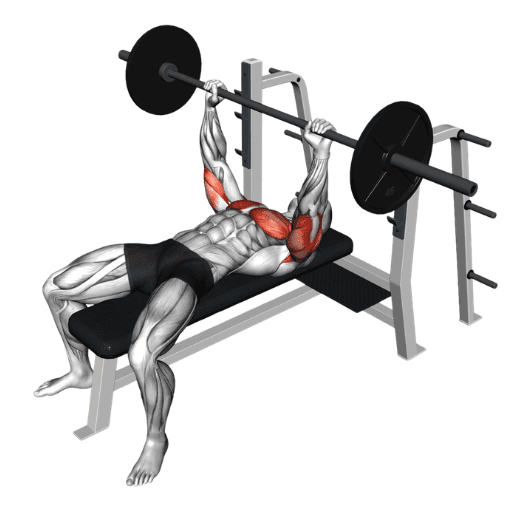
The barbell bench press is one of the most widely performed and measured upper-body strength exercises. It involves pressing a loaded barbell from chest level to full arm extension while lying on a flat bench. Biomechanically, it combines horizontal shoulder adduction and shoulder flexion with elbow extension—recruiting the pectoralis major (sternal and clavicular heads), anterior deltoids, and triceps brachii as prime movers, while the rotator cuff, latissimus dorsi, and scapular retractors stabilize the shoulder girdle.
In both clinical strength testing (NSCA) and competitive powerlifting (IPF), the flat barbell bench press serves as the primary upper-body pushing benchmark. For a valid comparison against these standards, repetitions should be performed raw (without bench shirts), lowering the bar to touch the lower chest and pressing to full elbow lockout while keeping the head, upper back, and glutes in contact with the bench.
What Each Strength Level Means
Here is how to interpret your strength classification, typical training experience, and what it takes to progress from one tier to the next.
Beginner
1–6 Months TrainingYou have mastered basic barbell stability and can press a loaded barbell through a full range of motion with proper control.
Training Focus: Rapid weekly strength gains come primarily from nervous system coordination and learning proper scapular retraction and bar path.
Novice
6–12 Months TrainingYou have built a solid foundation of upper-body pressing strength—benching your own bodyweight (for men) or half your bodyweight (for women).
Training Focus: Simple linear progression (adding 2.5–5 lb or 1.25–2.5 kg every 1–2 weeks) is still effective while you build chest, shoulder, and tricep muscle mass.
Intermediate
1–3 Years TrainingThe community benchmark for a dedicated gym lifter. Reaching Intermediate shows consistent multi-year training and strong upper-body hypertrophy.
Training Focus: Adding weight to the bar now requires structured periodization (heavy strength days paired with lighter volume/hypertrophy sessions) and targeted accessory lifts.
Advanced
3–5+ Years TrainingStandout gym strength. You are pressing 1.5× bodyweight (men) or over 1.1× bodyweight (women), placing you among the strongest lifters in most commercial gyms.
Training Focus: Progress is measured over multi-week training blocks. Managing joint recovery, nutrition, sleep, and weak-point sticking zones is essential.
Elite
5+ Years Dedicated TrainingExceptional competitive powerlifting strength—pressing double your bodyweight (men) or nearly 1.5× bodyweight (women).
Training Focus: Typically achieved by competitive strength athletes with optimized biomechanics, years of specialized peaking cycles, and meticulous technique.
Methodology & Data Sources
Every benchmark on this page is calculated using transparent formulas and established coaching conventions. Here is a step-by-step breakdown of how each number is derived.
1. Relative Strength & Bodyweight Ratios
How we normalize bench press strength across different body sizes
Absolute weight lifted only tells half the story—a 200 lb bench press is much more impressive at 150 lb bodyweight than at 250 lb bodyweight. To create a fair comparison, we express strength as a Bodyweight Ratio:
Bodyweight Ratio = Estimated 1-Rep Max (1RM) ÷ Your Bodyweight| Category | Beginner | Novice | Intermediate | Advanced | Elite |
|---|---|---|---|---|---|
| Male Lifters | 0.50× BW | 1.00× BW | 1.25× BW | 1.50× BW | 2.00× BW |
| Female Lifters | 0.30× BW | 0.50× BW | 0.75× BW | 1.10× BW | 1.45× BW |
2. One-Rep Max (1RM) Estimation — The Epley Formula
Safely predicting your maximum strength from a 2 to 12 repetition set
Testing a true 1-Rep Max requires a spotter and carries higher joint stress. When you enter a multi-rep set (for example, 185 lb × 5 reps), our tool estimates your 1RM using Boyd Epley's (1985) linear prediction equation:
Estimated 1RM = Weight Lifted × (1 + Repetitions ÷ 30)- Best Accuracy (1–10 Reps): Comparative studies (LeSuer et al., 1997, JSCR) show high accuracy (r > 0.95) for bench press sets of 10 reps or fewer.
- Higher Rep Sets (11+ Reps): Above 10 repetitions, muscular endurance fatigues the lifter before true maximal force is tested, making estimates slightly less precise.
3. Classification Framework & Age Scaling
Where our experience tiers and age multipliers come from
Our five experience classifications (Beginner through Elite) are informed by the strength standards frameworks popularized in Dr. Lon Kilgore & Mark Rippetoe's Practical Programming for Strength Training and ExRx.net normative tables:
- •Simplified Fixed Ratios: While competition tables vary slightly per weight class, we use consistent bodyweight multipliers per level so you can calculate and track your targets effortlessly.
- •Age-Adjusted Multipliers: Peak neuromuscular strength typically occurs between ages 20 and 30 (
1.00×). Our By Age table applies gradual scaling factors (e.g.,0.92×at age 40,0.84×at age 50,0.74×at age 60) to reflect natural changes in fast-twitch muscle fiber recovery over the lifespan.
4. Real-World Factors That Affect Your Bench Press
Why two lifters at the same bodyweight can have very different leverages
Use these standards as a personal compass rather than a rigid rulebook. Your natural anatomy plays a major role in how much weight you can press:
L²), whereas body weight grows cubically (L³). As a result, lighter lifters naturally achieve higher bodyweight ratios (e.g., 1.5× BW), while heavier lifters press higher absolute weights.Key Takeaway: Track your progress against your own previous numbers first. Moving from a 0.65× to a 0.85× bodyweight bench press represents a massive improvement in upper-body strength, regardless of where you start.
How to Increase Your Bench Press (Step-by-Step Roadmap)
Use the stage-by-stage training guide below to match your current strength rank with the right weekly frequency, set/rep scheme, and accessory exercises.
Stage 1: Beginner to Novice
At this stage, your fastest strength gains come from mastering movement mechanics and adding small amounts of weight consistently each week.
Stage 2: Novice to Intermediate
Once weekly linear jumps stall, you need a combination of heavy strength work and higher-rep muscle-building volume.
Stage 3: Intermediate to Advanced
Advancing beyond 1.25× bodyweight requires structured multi-week periodization blocks and careful fatigue management.
Stage 4: Advanced to Elite
At the highest tiers of raw strength, progress is measured over months and requires optimizing every recovery and biomechanical variable.
Disclaimer
The standards presented on this page are generalized estimates intended for informational and educational purposes only. They do not constitute medical or professional training advice. Individual strength varies widely based on genetics, training history, technique, body composition, and many other factors. Always consult a qualified professional before beginning a new exercise program or attempting maximum lifts.