Cable Crunch Strength Standards
Compare your cable crunch resistance against internally derived strength standards based on bodyweight, training experience, and age. Enter your cable stack weight and reps to see where you stand.
Configure Your Bodyweight & Unit
Male Cable Crunch Standards (lb)
StrengthRegimen standards for 180 lb bodyweight
| Strength Level | 1RM Target (180 lb BW) | Bodyweight Ratio |
|---|---|---|
| Beginner | 45 lb | 0.25x |
| Novice | 72 lb | 0.40x |
| IntermediateYou | 99 lb | 0.55x |
| Advanced | 135 lb | 0.75x |
| Elite | 180 lb | 1.00x |
How much should I be able to Cable Crunch? (lb)
A male lifter weighing 180 lb who can cable crunch 99 lb on the cable stack for one rep is considered Intermediate according to StrengthRegimen cable crunch standards. These are internally derived training benchmarks; no standardized competition norms exist for this exercise.
Assess Your Cable Crunch
Enter the cable stack weight you used and how many reps you completed to see your estimated 1RM, strength level, and training zones
Weight-stack pin setting used on the cable machine
If you have not tested a true 1RM, enter a submaximal set (e.g., 12 reps) and the Epley formula will estimate it.
Crunching 80 lb × 12 reps equals an estimated One-Rep Max (1RM) of 112 lb.
At a bodyweight of 180 lb (Male), you are crunching 0.62× your bodyweight, which falls within the Intermediate range according to StrengthRegimen cable crunch standards.
Shareable Cable Crunch Strength Card
Personalized Rep-Max & Training Zone Table (LB)
Exact working weights based on your 112 lb Estimated 1RM
| Rep Range | Weight (lb) | % of 1RM | Suggested Sets × Reps | Training Zone |
|---|---|---|---|---|
| 1RM (Max) | 112 lb | 100% | 1 × 1 rep (Max Test) | Maximal Strength |
| 3RM | 102 lb | 91% | 3–4 × 3 reps | Heavy Strength |
| 5RM | 96 lb | 86% | 3–4 × 5 reps | Strength & Control |
| 8RM | 88 lb | 79% | 3–4 × 8 reps | Strength-Hypertrophy |
| 10RM | 84 lb | 75% | 3 × 10 reps | Hypertrophy |
| 12RMYour Set | 80 lb | 71% | 3 × 12 reps | Hypertrophy (Typical) |
| 15RM | 75 lb | 67% | 2–3 × 15 reps | Volume & Endurance |
| 20RM | 67 lb | 60% | 2–3 × 20 reps | Muscular Endurance |
Complete Cable Crunch Reference Chart (LB)
1RM standards across bodyweights for Male lifters in lb
| BW (lb) | Beginner | Novice | Intermediate | Advanced | Elite |
|---|---|---|---|---|---|
| 120 lb | 30 | 48 | 66 | 90 | 120 |
| 130 lb | 33 | 52 | 72 | 98 | 130 |
| 140 lb | 35 | 56 | 77 | 105 | 140 |
| 150 lb | 38 | 60 | 83 | 113 | 150 |
| 160 lb | 40 | 64 | 88 | 120 | 160 |
| 170 lb | 43 | 68 | 94 | 128 | 170 |
| 180 lb◂ You | 45 | 72 | 99 | 135 | 180 |
| 190 lb | 48 | 76 | 105 | 143 | 190 |
| 200 lb | 50 | 80 | 110 | 150 | 200 |
| 210 lb | 53 | 84 | 116 | 158 | 210 |
| 220 lb | 55 | 88 | 121 | 165 | 220 |
| 230 lb | 58 | 92 | 127 | 173 | 230 |
| 240 lb | 60 | 96 | 132 | 180 | 240 |
| 250 lb | 63 | 100 | 138 | 188 | 250 |
| 260 lb | 65 | 104 | 143 | 195 | 260 |
| 270 lb | 68 | 108 | 149 | 203 | 270 |
| 280 lb | 70 | 112 | 154 | 210 | 280 |
| 290 lb | 73 | 116 | 160 | 218 | 290 |
| 300 lb | 75 | 120 | 165 | 225 | 300 |
Cable Machine Note: Weight-stack values vary between cable machines due to differences in pulley ratio, friction, and calibration. Use these standards as progress markers on the same machine rather than absolute load comparisons across different equipment.
About the Cable Crunch
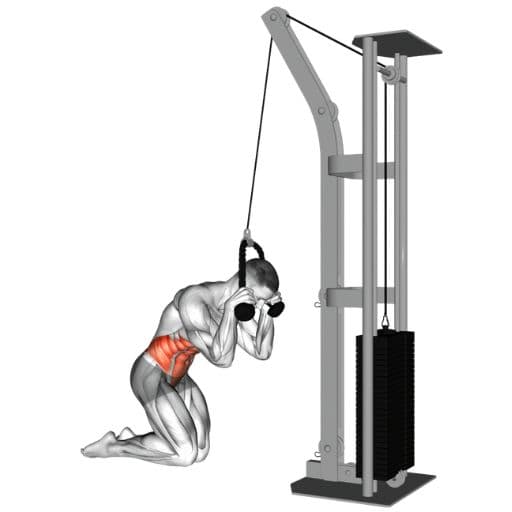
The kneeling cable crunch is one of the most effective weighted abdominal exercises for developing rectus abdominis strength and hypertrophy. It involves kneeling beneath a high-pulley cable station, grasping a rope attachment behind the head, and performing controlled spinal flexion against adjustable resistance. The cable crunch is performed kneeling in front of a high-pulley cable station with a rope attachment. The movement involves flexing the spine by curling the ribcage toward the pelvis against resistance, primarily targeting the rectus abdominis with secondary involvement of the external obliques and internal obliques. Unlike compound lifts, the cable crunch isolates abdominal flexion without significant hip or lower-extremity contribution.
The standards on this page assume a kneeling cable crunch with a rope attachment on a standard high-pulley cable station. Other variations (standing cable crunch, straight-bar attachment, different pulley heights) alter the resistance profile and are not directly comparable. Because cable machines vary in pulley ratio, friction, and calibration, these numbers are most useful for tracking progress on the same machine over time.
What Each Cable Crunch Strength Level Means
Here is how to interpret your cable crunch strength classification, typical training experience, and what it takes to progress from one tier to the next. All levels are internally derived training benchmarks.
Beginner
1–3 Months TrainingYou are learning the kneeling cable crunch movement pattern—developing the mind-muscle connection with the rectus abdominis and distinguishing trunk flexion from hip flexion.
Training Focus: Early gains come from learning to initiate the crunch from the abdominals rather than pulling with the arms or rocking the hips. Focus on controlled eccentrics and full range of motion at light weight.
Novice
3–9 Months TrainingYou can perform cable crunches with meaningful resistance through a full range of motion, maintaining consistent form across multiple sets.
Training Focus: Progressive overload in small increments (5 lb / 2.5 kg) is still effective. Your rectus abdominis is developing the capacity to generate force against appreciable external resistance.
Intermediate
9 Months – 2 Years TrainingA strong abdominal foundation. You can cable crunch with substantial resistance through a complete range of spinal flexion with controlled tempo.
Training Focus: At this level, you likely train core as a dedicated focus, not just an afterthought. Periodizing between heavy sets (6–8 reps) and higher-rep endurance work (15–20 reps) becomes beneficial.
Advanced
2–4+ Years TrainingImpressive core strength relative to bodyweight. Cable crunching 0.75× bodyweight (men) or 0.55× bodyweight (women) indicates significant abdominal development and motor control.
Training Focus: Progress at this level requires intentional core periodization, tempo manipulation, and complementary anti-extension exercises. Recovery between heavy core sessions becomes a factor.
Elite
4+ Years Dedicated TrainingExceptional cable crunch strength—using your entire bodyweight (men) or 0.75× bodyweight (women) on the cable stack. This represents dedicated, long-term abdominal training.
Training Focus: Typically achieved by lifters who prioritize core strength as a primary training goal, often competitive athletes or advanced bodybuilders with years of structured abdominal programming.
Cable Crunch Methodology & Data Sources
Every cable crunch benchmark on this page is calculated using transparent formulas. Unlike barbell powerlifts, no peer-reviewed population norms or competition standards exist for the cable crunch. Here is how each number is derived.
1. Bodyweight Ratios for Cable Exercises
Normalizing cable crunch strength across different body sizes
We express cable crunch strength as a Bodyweight Ratio (estimated cable-stack 1RM ÷ bodyweight). Because the cable crunch is a single-joint isolation exercise targeting the rectus abdominis, these ratios are substantially lower than those for compound barbell lifts.
Bodyweight Ratio = Estimated Cable-Stack 1RM ÷ Your Bodyweight| Category | Beginner | Novice | Intermediate | Advanced | Elite |
|---|---|---|---|---|---|
| Male Lifters | 0.25× BW | 0.40× BW | 0.55× BW | 0.75× BW | 1.00× BW |
| Female Lifters | 0.15× BW | 0.25× BW | 0.40× BW | 0.55× BW | 0.75× BW |
Transparency note: These multipliers are internally derived by StrengthRegimen based on observed training patterns and coaching experience. They are not taken from any published study or competition database. No peer-reviewed cable crunch strength norms exist.
2. One-Rep Max (1RM) Estimation — The Epley Formula
Estimating your maximal cable crunch resistance from a multi-rep set
When you enter a multi-rep set (for example, 80 lb × 12 reps), our tool estimates your 1RM using Boyd Epley's (1985) linear prediction equation:
Estimated 1RM = Weight × (1 + Repetitions ÷ 30)- Validated for Resistance Exercises: The Epley formula was originally validated on barbell lifts (bench press, squat, deadlift). Its accuracy on cable machine exercises has not been independently studied, but the underlying principle (submaximal load-to-failure prediction) applies to resistance training generally.
- Best Accuracy in 5–15 Reps: Cable crunches are commonly trained in the 10–20 rep range. Estimates from very high rep sets (above 15) may be less precise. For the most accurate 1RM estimate, use a set in the 5–12 rep range.
3. Classification Framework & Age Scaling
How we assign experience tiers and age-adjusted multipliers
Our five experience classifications (Beginner through Elite) are internally derived by StrengthRegimen. Unlike the squat, bench press, and deadlift—where frameworks from Kilgore/Rippetoe and ExRx.net provide widely referenced tiers—no equivalent published classification exists for cable crunches.
- •Isolation Exercise Ratios: Because the cable crunch isolates the rectus abdominis (a relatively small muscle group), bodyweight ratios top out around 1.0× for men and 0.75× for women at the Elite level—compared to 3.0× and 2.25× for the deadlift.
- •Age-Adjusted Multipliers: Peak neuromuscular strength typically occurs between ages 20 and 30 (
1.00×). Our By Age table applies internally derived scaling factors (e.g.,0.92×at age 40,0.84×at age 50) that approximate the general pattern of age-related strength decline documented in the literature. These are estimates, not taken directly from any single study.
4. Important Limitations & Equipment Variability
Factors that affect cable crunch performance and comparability
Cable crunch standards have inherent limitations that barbell standards do not. Keep these in mind when interpreting your results:
Key Takeaway: Track your cable crunch progress against your own previous numbers on the same machine. Consistent improvement in load or reps over time is the most reliable indicator of abdominal strength development, regardless of where any standards table places you.
How to Increase Your Cable Crunch (Step-by-Step Roadmap)
Use the stage-by-stage training guide below to match your current cable crunch level with the right frequency, rep scheme, technique focus, and complementary exercises.
Stage 1: Beginner to Novice
Developing mind-muscle connection, learning proper spinal flexion technique
Stage 2: Novice to Intermediate
Progressive overload, tempo manipulation, and building training variety
Stage 3: Intermediate to Advanced
Periodized core training, heavier loading phases, and anti-extension work
Stage 4: Advanced to Elite
Advanced programming strategies for maximum abdominal strength development
Remember: Cable crunch performance improves through consistent, focused training with controlled technique. Rushing to add weight at the expense of form reduces abdominal activation and increases the risk of compensating with hip flexion.
Disclaimer
The standards presented on this page are internally derived training benchmarks intended for informational and educational purposes only. They do not constitute medical or professional training advice. No peer-reviewed population norms, competition standards, or governing body classifications exist for the cable crunch exercise. Individual strength varies widely based on genetics, training history, technique, body composition, and equipment differences between cable machines. Always consult a qualified professional before beginning a new exercise program or attempting maximum efforts.