Dumbbell Curl Strength Standards
The Intermediate dumbbell curl standard is 49 lb (22 kg) per dumbbell for men and 25 lb (11 kg) for women (estimated 1RM at 180 / 140 lb bodyweight, strict form). Compare your lift by bodyweight and age below.
Configure Your Bodyweight & Unit
Male Dumbbell Curl Standards (lb/dumbbell)
StrengthRegimen standards for 180 lb bodyweight — per dumbbell
| Strength Level | Per Dumbbell (180 lb BW) | BW Ratio |
|---|---|---|
| Beginner | 18 lb | 0.10x |
| NoviceYou | 31 lb | 0.17x |
| Intermediate | 49 lb | 0.27x |
| Advanced | 68 lb | 0.38x |
| Elite | 90 lb | 0.50x |
How much should I be able to Dumbbell Curl? (lb/dumbbell)
Assess Your Dumbbell Curl
Enter the weight per dumbbell and reps completed to estimate your 1RM and strength level
Enter the weight of one dumbbell — not the combined weight of both arms
Curling 35 lb/dumbbell × 8 reps equals an estimated 1RM of 44 lb per dumbbell.
At 180 lb (Male), that is 0.24× your bodyweight per arm, which falls within the Novice range. Note: 1RM estimates for single-joint exercises are less precise than for compound lifts (r = .84\u2013.91 vs .97\u2013.98).
Shareable Dumbbell Curl Strength Card
Dumbbell Curl Strength Spectrum
Rep-Max & Training Zone Table (LB/dumbbell)
Per-dumbbell loads based on your 44 lb estimated 1RM
| Target | % of 1RM | Per Dumbbell | Programming |
|---|---|---|---|
| 1RM (Max) (1 rep) | 100% | 44 lb | 1 × 1 rep (Max Test) |
| 3RM (3 reps) | 90.9% | 40 lb | 3–4 × 3 reps |
| 5RM (5 reps) | 85.7% | 38 lb | 3–4 × 5 reps |
| 8RM (8 reps) | 78.9% | 35 lb | 3–4 × 8 reps |
| 10RM (10 reps) | 75% | 33 lb | 3–4 × 10 reps |
| 12RM (12 reps) | 71.4% | 31 lb | 3 × 12 reps |
| 15RM (15 reps) | 66.7% | 29 lb | 2–3 × 15 reps |
Complete Dumbbell Curl Reference Chart (LB/dumbbell)
Per-dumbbell standards across bodyweights for Male lifters in lb
| BW (lb) | Beginner | Novice | Intermediate | Advanced | Elite |
|---|---|---|---|---|---|
| 120 | 12 | 20 | 32 | 46 | 60 |
| 130 | 13 | 22 | 35 | 49 | 65 |
| 140 | 14 | 24 | 38 | 53 | 70 |
| 150 | 15 | 26 | 41 | 57 | 75 |
| 160 | 16 | 27 | 43 | 61 | 80 |
| 170 | 17 | 29 | 46 | 65 | 85 |
| 180 | 18 | 31 | 49 | 68 | 90 |
| 190 | 19 | 32 | 51 | 72 | 95 |
| 200 | 20 | 34 | 54 | 76 | 100 |
| 210 | 21 | 36 | 57 | 80 | 105 |
| 220 | 22 | 37 | 59 | 84 | 110 |
| 230 | 23 | 39 | 62 | 87 | 115 |
| 240 | 24 | 41 | 65 | 91 | 120 |
| 250 | 25 | 43 | 68 | 95 | 125 |
| 260 | 26 | 44 | 70 | 99 | 130 |
| 270 | 27 | 46 | 73 | 103 | 135 |
| 280 | 28 | 48 | 76 | 106 | 140 |
| 290 | 29 | 49 | 78 | 110 | 145 |
| 300 | 30 | 51 | 81 | 114 | 150 |
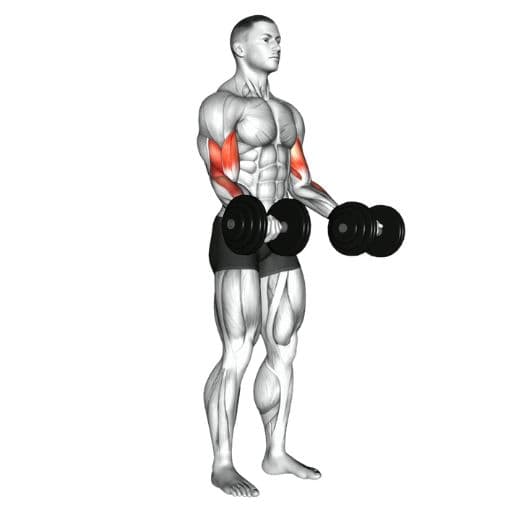
About the Dumbbell Curl
The standing dumbbell biceps curl is a single-joint isolation exercise targeting the elbow flexors. The lifter stands upright holding one dumbbell in each hand with a supinated (palms-up) grip and curls through full elbow flexion with strict form — no torso swing, no shoulder movement, and a controlled eccentric. The dumbbell curl is a common gym exercise for biceps training, frequently used as a benchmark for upper-arm strength.
All benchmarks on this page represent the weight of one dumbbell (per arm). If you curl 35 lb in each hand, enter 35 lb — not 70 lb.
Dumbbell Curl vs. Barbell Curl
Do not convert your dumbbell curl load to a barbell curl equivalent. The barbell curl uses a fixed-width grip, allows bilateral force production, and typically permits heavier absolute loads. Two 35 lb dumbbells does not equal a 70 lb barbell curl — the stabilization, grip mechanics, and resistance profile differ. Use each exercise’s standards independently.
Strict Dumbbell Curl Protocol
These standards assume a strict standing dumbbell curl. Follow this protocol for consistent, comparable results.
Starting Position
Stand upright with feet shoulder-width apart. Hold one dumbbell in each hand at arm’s length with palms facing forward (supinated grip). Upper arms remain at your sides throughout the movement. Shoulders back, core braced.
Curl & Peak Contraction
Flex at the elbow to curl the dumbbells toward the shoulders. The upper arm stays stationary — only the forearm moves. Curl until the forearm approaches the upper arm (full intended range of elbow flexion). Brief pause at the top.
Controlled Eccentric
Lower the dumbbells back to the starting position under control (~2 second eccentric). Do not let gravity drop the weight. Return to near-full elbow extension before the next rep. Alternating or simultaneous arms are both acceptable for these standards.
Valid Counted Rep
- • Full range of elbow flexion (forearm approaches upper arm at top)
- • Near-full elbow extension at the bottom (controlled, not hyperextended)
- • Upper arms stay at the sides — no forward shoulder swing
- • Controlled eccentric (no dropping the weight)
Invalid / Disallowed
- • Torso swinging or leaning back to generate momentum
- • Elbows drifting forward past the torso during the curl
- • Partial reps (cutting ROM short at top or bottom)
- • Using the opposite arm or legs to assist
Strength Level Benchmarks
Per-dumbbell benchmarks for the strict standing dumbbell curl relative to bodyweight.
Beginner
Male 0.10× BW • Female 0.06× BWCan perform a controlled dumbbell curl with light weight through a full range of motion. Strength at this stage comes primarily from learning to isolate the biceps without torso momentum.
Focus: Focus on strict form with 8–12 reps per set. Prioritize full elbow extension at the bottom and controlled eccentric over adding weight.
0–6 months of consistent training
Novice
Male 0.17× BW • Female 0.11× BWReliable strict curl form with moderate loads. Can maintain upper arm position and complete full reps without momentum at working weights.
Focus: Linear progression with 2.5–5 lb dumbbell jumps. Work in the 6–10 rep range with strict form. Begin incorporating variation (e.g., incline curls, hammer curls) as accessories.
6–12 months of structured training
Intermediate
Male 0.27× BW • Female 0.18× BWSolid elbow-flexor strength maintained with strict technique. Represents the typical level of a dedicated gym-goer with 1–2 years of consistent arm training.
Focus: Periodize rep ranges across 6–15 reps. Progress requires intentional overload — small increments, drop sets, or tempo manipulation.
1–2+ years of consistent training
Advanced
Male 0.38× BW • Female 0.27× BWUpper-tier strict curl strength. Requires years of dedicated arm training and careful progressive overload with controlled technique.
Focus: Structured mesocycles. Balance direct biceps volume with compound pulling (rows, pull-ups). Manage elbow/tendon recovery between heavy sessions.
3–5+ years of dedicated training
Elite
Male 0.50× BW • Female 0.36× BWExceptional strict dumbbell curl strength, typically seen in competitive bodybuilders or strength athletes with years of focused arm development.
Focus: Prioritize tendon health and long-term joint integrity. Very small, calculated increases over multi-month blocks. Strategic deloads are essential.
5+ years of serious strength training
How These Standards Are Derived
Sources, calculation methods, and limitations for every number on this page.
1. Data Sources & Classification
These are StrengthRegimen-derived training benchmarks, not peer-reviewed population norms. They are informed by:
- Community self-reported data from StrengthLevel.com, which aggregates 3,634,702 dumbbell curl submissions (957,996 qualifying results: 844,943 male, 113,053 female) from 2017–2026. All values represent per-dumbbell load. These are self-reported, not laboratory-measured.
- Cross-reference with FitnessVolt community standards, which show a similar distribution pattern for per-dumbbell loads by bodyweight.
- General coaching conventions for strict dumbbell curl performance, adjusted conservatively because StrengthRegimen specifies strict form (no torso momentum).
The five-tier classification (Beginner through Elite) mirrors the StrengthRegimen framework used across all tools, informed by the coaching literature conventions (Kilgore & Rippetoe’s Practical Programming, ExRx.net), adapted for a single-joint isolation exercise.
2. Bodyweight Ratio — Single-Joint Limitation
Standards are expressed as per-dumbbell load ÷ bodyweight. This provides a useful normalization across body sizes, but is less physiologically meaningful for the dumbbell curl than for compound lifts like the squat or bench press.
Why: The dumbbell curl is a single-joint exercise using a relatively small muscle group (biceps brachii). Factors like limb length, biceps tendon insertion point, and muscle cross-sectional area have proportionally greater influence on curl performance than on multi-joint compound lifts where total body mass is more relevant.
Despite this limitation, BW ratio is the universal convention across all existing dumbbell curl standards platforms (including StrengthLevel’s 3.6M-lift dataset) and provides a better comparison than raw load alone. We use a single set of ratios across all bodyweight classes.
3. 1RM Estimation — Lower Accuracy for Isolation Exercises
When you enter a multi-rep set, the tool estimates your 1RM using the Epley formula:
Single-joint accuracy caveat: Research on 1RM prediction for the biceps curl shows lower correlations (r = .84–.91) compared to the bench press (r = .97–.98), with total prediction errors of 5.25–6.92 kg for the biceps curl in 27 recreationally trained males. The equations can rank-order individuals, but the absolute accuracy is lower than for compound lifts.
A separate study on 49 older adults (ages ~53) across 10 exercises including biceps curl found that Epley and Wathan formulas had the lowest average error, but accuracy improved substantially when reps-to-failure were 10 or fewer.
Recommendation: Use sets of 10 reps or fewer. The tool displays a warning above 10 reps. Treat the estimated 1RM as an approximate guide, not a precise measurement.
4. Age Scaling
The “By Age” table applies gradual scaling factors based on the general pattern of neuromuscular force output across the lifespan: peak strength between ages 20–30, with gradual decline thereafter.
Limitation: These age multipliers are generalized — they are NOT derived from dumbbell curl-specific longitudinal data. The rate of age-related strength decline may differ between upper and lower body, and between isolation and compound exercises. Treat age-adjusted values as approximate guides.
Transparency: The multipliers, calculation methods, data sources, and limitations described above are the complete methodology. No proprietary algorithms, hidden adjustments, or unpublished datasets are used. Where evidence is limited (particularly for single-joint exercise norms and 1RM prediction accuracy), we state so explicitly.
Disclaimer
The dumbbell curl strength standards on this page are practical training benchmarks intended for self-assessment and educational use. All values represent the weight of one dumbbell (per arm). Individual performance depends on limb length, muscle insertion points, training history, and technique. Consult a healthcare professional before initiating high-intensity resistance training.