Pull-Up Strength Standards
The Intermediate strict Pull-Up benchmark is 13 reps for a man and 6 reps for a woman (ages 20–29, pronated grip, chin over bar). Compare your performance by sex and age.
Bodyweight Pull-Ups or Weighted Pull-Ups?
Measure your max strict reps with a pronated grip (chin over bar). Classification is based on sex, age bracket, and bodyweight — heavier lifters face more absolute load per rep, so thresholds are adjusted accordingly.
Select Your Sex, Age & Bodyweight
Male Bodyweight Pull-Up Standards (20–29 years)
Bodyweight-adjusted thresholds for 180 lb (pronated grip, dead hang, chin over bar)
| Strength Level | Minimum Reps |
|---|---|
| Beginner | 1 reps |
| NoviceYou | 7 reps |
| Intermediate | 13 reps |
| Advanced | 21 reps |
| Elite | 30 reps |
Assess Your Bodyweight Pull-Ups
Enter your max consecutive strict reps (pronated grip, chin over bar)
10 strict reps at 180 lb places you at the Novice level for males, 20–29 years.
StrengthRegimen bodyweight pull-up standard. Pronated grip, dead hang start, chin over bar, no momentum. Thresholds adjusted for your bodyweight via allometric scaling.
Shareable Pull-Up Strength Card
Bodyweight Pull-Up Strength Spectrum
Pull-Up Reps by Bodyweight (Male, 20–29 years)
Expected minimum reps at each tier for different bodyweights. Heavier lifters move more load per rep, so fewer reps are needed.
| BW (lb) | Beginner | Novice | Intermediate | Advanced | Elite |
|---|---|---|---|---|---|
| 110 | 4 | 10 | 17 | 26 | 36 |
| 120 | 3 | 10 | 16 | 25 | 35 |
| 130 | 3 | 9 | 16 | 24 | 34 |
| 140 | 2 | 9 | 15 | 23 | 33 |
| 150 | 2 | 8 | 14 | 23 | 32 |
| 160 | 2 | 8 | 14 | 22 | 31 |
| 170 | 1 | 7 | 13 | 22 | 31 |
| 180◀ You | 1 | 7 | 13 | 21 | 30 |
| 190 | 1 | 7 | 13 | 21 | 29 |
| 200 | <1 | 6 | 12 | 20 | 29 |
| 210 | <1 | 6 | 12 | 20 | 28 |
| 220 | <1 | 6 | 11 | 19 | 28 |
| 230 | <1 | 5 | 11 | 19 | 27 |
| 240 | <1 | 5 | 11 | 18 | 27 |
| 250 | <1 | 5 | 11 | 18 | 27 |
| 260 | <1 | 5 | 10 | 18 | 26 |
| 270 | <1 | 4 | 10 | 17 | 26 |
| 280 | <1 | 4 | 10 | 17 | 25 |
| 290 | <1 | 4 | 9 | 17 | 25 |
| 300 | <1 | 4 | 9 | 17 | 25 |
| 310 | <1 | 4 | 9 | 16 | 24 |
Complete Bodyweight Pull-Up Standards by Age (Male)
Minimum strict reps to reach each tier at reference bodyweight (pronated grip, chin over bar)
| Age Group | Beginner | Novice | Intermediate | Advanced | Elite |
|---|---|---|---|---|---|
| 15–19 years | <1 | 3 | 9 | 16 | 24 |
| 20–29 years | 1 | 7 | 13 | 21 | 30 |
| 30–39 years | 1 | 7 | 13 | 21 | 30 |
| 40–49 years | <1 | 6 | 12 | 20 | 28 |
| 50–59 years | <1 | 2 | 8 | 14 | 21 |
| 60+ years | <1 | 1 | 4 | 10 | 16 |
About the Pull-Up
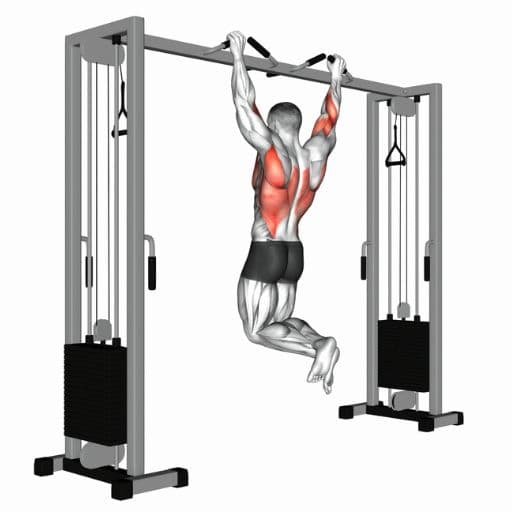
The strict overhand pull-up is a compound upper-body pulling exercise performed on a fixed bar. From a dead hang with a pronated grip, the lifter pulls their body upward until the chin clears the bar, then lowers under control to full arm extension. It is one of the most effective bodyweight measures of relative upper-body pulling strength, widely used in military, occupational, and athletic fitness testing. Biomechanically, the pull-up combines shoulder adduction, shoulder extension, and elbow flexion—recruiting the latissimus dorsi as the primary mover, alongside the biceps brachii, brachialis, brachioradialis, rhomboids, and lower trapezius as powerful synergists.
Unlike machine pulldowns, a pull-up requires lifting 100% of your body mass (plus external load) against gravity in a closed kinetic chain. Because heavier individuals must overcome greater absolute resistance per repetition, our standards offer both rep-based bodyweight tiers and load-normalized weighted assessments.
Bodyweight Pull-Ups vs. Weighted Pull-Ups
Two complementary metrics assessing different physical qualities
Relative Muscular Endurance
Evaluated by maximum strict unbroken repetitions to form failure. No 1RM estimation formulas are applied. Benchmarks are stratified by sex and age bracket to reflect natural endurance curves.
Maximal Absolute Pulling Strength
Evaluated by Total System Load (Bodyweight + Added Load) using submaximal 1RM estimation. Enables fair comparison between lifters of differing body sizes.
Strict Pull-Up Movement Standards
These standards evaluate strict overhand (pronated) pull-ups on a rigid horizontal bar. For an accurate and valid comparison against these population benchmarks, every repetition must satisfy all criteria below.
Start Position (Active Dead Hang)
Begin from a dead hang with arms fully extended and elbows locked out. Scapulae should remain slightly active (not completely disengaged). Feet must be entirely off the ground with the body motionless—pre-swinging or momentum before the first rep is strictly disallowed.
Grip & Hand Placement
Use a strict pronated (overhand) grip with thumbs wrapped securely around the bar. Hand spacing should be approximately shoulder-width apart or slightly wider (1.2–1.5× biacromial diameter). Excessive ultra-wide grips shorten range of motion and strain shoulder connective tissue.
Ascending Pull (Concentric Phase)
Initiate by depressing the scapulae, then pull smoothly upward until the entire chin clearly clears the top horizontal plane of the bar. Reaching forehead or nose level does not constitute a valid rep. The ascent must be continuous, steady, and free of jerking or neck straining.
Controlled Descent (Eccentric Phase)
Lower your body under control back down into a full dead-hang position with both arms completely extended. Dropping abruptly without deceleration or failing to reach full lockout invalidates the subsequent rep.
Torso & Lower-Body Discipline
A slight natural body arch is acceptable. Legs may remain straight or crossed with knees gently bent. Absolutely no kipping, swinging, hip thrusts, knee tucks, or bicycle kicks are permitted. A brief pause in the dead-hang position is allowed, but prolonged rests between reps invalidate the set.
Weighted Loading Protocol (If Applicable)
External weight must be safely secured using a heavy-duty dip belt, chain, or snug weight vest hanging centrally beneath the pelvis. The same strict lockout and chin clearance criteria apply. Total System Load is calculated as your exact scale bodyweight plus added external plates.
Excluded Pull-Up Variations
The benchmarks on this page are strictly defined for dead-hang pronated pull-ups. The following variations alter joint kinematics, muscular leverage, or momentum and must be evaluated separately:
What Each Strength Level Means for Pull-Ups
These tiers apply across both bodyweight repetitions and weighted total load assessments. They provide standardized benchmarks informed by trained populations, allowing you to gauge your vertical pulling capacity relative to your peers.
New to pull-ups or unable to complete a full dead-hang repetition. In untrained populations, the majority of women and a substantial percentage of men cannot perform a single strict overhand pull-up due to high relative strength demands. At this stage, focus on negative pull-ups, band-assisted reps, and dead hangs to build base scapular and lat recruitment.
Able to perform clean, unbroken strict repetitions with good form. For men, reaching 5–7 reps indicates solid foundational strength. For women, completing that crucial first strict pull-up is an exceptional novice-level accomplishment. Movement is performed under bodyweight alone, with consistent lockout and chin-over-bar clearance.
Strong, reliable vertical pulling proficiency representing approximately 1–2 years of dedicated upper-body training. At this stage, a 180 lb man can typically pull with +72 lb added load (1.40× total system load) for a 1RM, while maintaining strict form through full range of motion. Rep endurance and back hypertrophy are well developed.
Exceptional pulling strength achieved through multiple years of structured resistance or calisthenics training. A 180 lb man at this level can add ~135 lb on a dip belt (approaching 1.75× total system load) for a single rep, or execute 20+ unbroken strict reps. Surpasses roughly 85–90% of active gym-goers.
World-class vertical pulling capabilities found among competitive gymnasts, elite calisthenics athletes, and advanced powerlifters. Total system load exceeds double bodyweight for men (adding 200+ lb on a dip belt at 180 lb bodyweight). Strict dead-hang technique remains flawless even under maximum fatigue.
How Pull-Up Strength Standards Are Formulated
The calculation models, community dataset synthesis, allometric scaling equations, and biomechanical principles powering our strict pull-up standards.
1. Data Sources & Benchmark Calibration
Cross-referenced community logs and military physical fitness protocols
All benchmarks are StrengthRegimen-derived performance tiers designed for self-assessment, progressive training, and goal tracking. Because strict pull-ups involve zero momentum and full dead-hang lockouts, our thresholds are informed by two primary data references:
StrengthLevel Community Dataset
Aggregates 4,852,758 user-submitted pull-up entries with 1,348,109 qualifying strict results (1,220,115 male, 127,994 female). Yields verified median performance metrics of 13 strict reps for men and 6 reps for women at Intermediate tier (ages 20–29).
USMC Physical Fitness Test (MCO 6100.13A)
Official United States Marine Corps scoring tables provide empirical validation for age-related pull-up performance curves, ensuring fair benchmarks from teenage through master age divisions (60+).
StrengthRegimen thresholds are intentionally set slightly conservative relative to unverified self-reported databases to strictly uphold strict form requirements: dead-hang start, pronated overhand grip, clear chin over the bar, and zero kipping or swinging.
2. Dual-Mode Evaluation: Bodyweight vs. Weighted
Separating muscular endurance capacity from absolute vertical pulling power
Pull-up performance operates across two distinct physiological dimensions that require independent assessment models:
Max Reps to Strict Muscular Failure
Measures submaximal relative muscular endurance without external loading. Standards are stratified across sex and 6 progressive age brackets (15–19, 20–29, 30–39, 40–49, 50–59, 60+), directly reflecting the natural endurance and bodyweight scaling of trainees.
Total System Load 1RM ÷ Bodyweight
Measures maximal neurological strength output by adding external load (via dip belt or vest). Evaluated using total system load (Bodyweight + Added Weight) divided by bodyweight, enabling equitable strength comparison across different weight classes.
3. Weighted 1RM Estimation & Load Calculation
Boyd Epley formula extended to total vertical system mass
In weighted mode, the calculator uses the validated Epley equation adapted for total kinetic system mass:
Total System Load = Bodyweight + Added Weight, and Added 1RM = Total 1RM − Bodyweight.Scientific Validation & Rep Accuracy: Direct 1RM testing of upper-body pulling exercises demonstrates high test-retest reliability in sports science literature, with studies reporting ICC ≥ 0.96 for strict-protocol 1RM assessments. Predictive accuracy is highest when testing with heavy submaximal sets of 1 to 5 repetitions. When testing sets exceed 10 repetitions, local forearm grip fatigue and cardiorespiratory endurance contribute more significantly to failure. Note: rep-to-failure prediction equations (e.g., Epley, Mayhew) tend to underestimate actual 1RM for upper-body pulling movements by approximately 2–7 kg (Pérez-Castilla et al., 2021, tested on lat pulldown and seated cable row).
4. Bodyweight as Resistance & Allometric Scaling
Accounting for non-linear power-to-weight scaling (α = 0.82)
Unlike barbell movements where the implement is independent of the lifter, in a pull-up your body mass is 100% of the baseline resistance. A 200 lb lifter pulling bodyweight generates 200 lb of upward force per rep, whereas a 150 lb lifter moves 150 lb. Because muscle cross-sectional area scales as a two-dimensional surface (L²) while body mass scales as a three-dimensional volume (L³), heavier individuals naturally experience higher relative resistance.
To address this in our Bodyweight Rep Chart, we apply allometric scaling with an empirically fitted exponent (α = 0.82), aligned with established exercise physiology literature (Jaric, 2003; Vanderburgh & Dooman, 2000):
5. Structural Balance: Pull-Up to Bench Press Ratio
Antagonist-to-agonist joint balance for shoulder health and longevity
In competitive strength coaching, structural balance ratios evaluate symmetry between opposing movement patterns. Adapted from Charles Poliquin’s foundational strength diagnostics (originally formulated for supinated chin-ups relative to close-grip bench press at ~87%), an athlete’s Weighted Pull-Up Total System Load 1RM should approximate 85% of their Flat Barbell Bench Press 1RM (±10% tolerance band). Note: Baker & Newton (2004) studied 42 rugby players and found the ratio closer to ~98% for trained athletes, suggesting considerable individual variation.
Ideal structural equilibrium between horizontal pressing and vertical pulling forces.
Indicates lat/biceps weakness or chest overdevelopment; prioritize strict weighted pulling.
Indicates exceptional vertical pulling power; horizontal pressing is the lagging movement.
6. Age Decay Scaling & Percentile Standards
Lifespan performance standards across 6 age brackets
In bodyweight mode, age adjustments are directly integrated into bracket-specific threshold tables derived from age-decay patterns in military fitness standards and competitive gym populations. In weighted mode, reference tables utilize age-scaling multipliers (peaking between ages 23–28, with gradual physiological taper past age 35–40).
Approximate community percentile mapping informed by StrengthLevel tier distribution and cross-referenced coaching sources: Beginner ≈ Top 95% (stronger than ~5% of active trainees), Novice ≈ Top 80%, Intermediate ≈ Top 50% (approximately the median among regular gym-goers), Advanced ≈ Top 20%, and Elite ≈ Top 5%.
Pull-Up Training Insights & Questions
Expert recommendations on overcoming plateaus, programming weighted sets, understanding grip biomechanics, and optimizing pull-up performance.
How do I get my first strict pull-up?
How do I get my first strict pull-up?
If you cannot yet perform a strict pull-up, attempting repeated failed concentric reps is counterproductive. Instead, utilize the three proven physiological progressions:
Eccentric Overload
Step or jump to chin-over-bar position, then lower down for a strict 3–5 second count to full dead hang. 3–4 sets of 3–5 reps.
Full Kinetic Groove
Use a heavy loop resistance band under knees or feet. It assists most at the bottom (dead hang), tapering off as your chin approaches the bar.
Scapular & Grip Base
Build up to 45–60 second active hangs to condition the rotator cuff, lower traps, and forearms to support your body mass under tension.
Inverted rows and lat pulldowns are valuable auxiliary volume builders, but specific vertical motor pattern practice (negatives and band-assisted pull-ups) yields the fastest neuromuscular adaptation.
When should I add external weight?
When should I add external weight?
A gold-standard rule of thumb is to introduce external load once you can complete 3 sets of 10–12 strict bodyweight pull-ups with full extension and zero kipping. Beyond this threshold, additional bodyweight volume primarily develops local muscular endurance rather than myofibrillar hypertrophy or maximal neural drive.
Recommended Loading Progression:
- Initial load: Begin with 5–10 lb (2.5–5 kg) on a quality dip belt.
- Rep range: Shift focus from high-rep sets to 3–5 heavy sets of 4–6 reps.
- Progression trigger: When you achieve 3 sets of 6 clean reps at a given load, increase by 2.5–5 lb (1–2.5 kg).
- Equipment choice: Use a dedicated dip belt centered below the pelvis. Snug weight vests work well up to 20–30 lb, but dip belts allow unlimited progressive overload without restricting thoracic breathing.
Pull-ups vs. chin-ups — what is the difference?
Pull-ups vs. chin-ups — what is the difference?
While both exercises are elite multi-joint vertical pulling exercises, their grip mechanics dictate differing muscle recruitment profiles and force output:
Places the forearm in pronation, which mechanically disadvantages the biceps brachii. This shifts greater neural demand onto the latissimus dorsi, brachialis, brachioradialis, and lower trapezius. Trainees typically pull 1–3 fewer reps compared to chin-ups.
Forearm supination places the biceps brachii in its optimal mechanical line of pull and active length-tension relationship. This grants greater mechanical leverage, enabling most lifters to lift 5–10% heavier loads or complete additional reps.
Note: Because chin-up leverage differs significantly, chin-up performances should not be evaluated against the strict overhand standards provided on this page.
Does bodyweight significantly affect pull-up reps?
Does bodyweight significantly affect pull-up reps?
Yes, substantially. In closed-kinetic-chain calisthenics, every repetition requires moving 100% of your body mass against gravity. By contrast, a 220 lb lifter on a lat pulldown can simply select 120 lb on the pin stack; on a pull-up bar, they must produce enough muscular force to elevate all 220 lb.
Why Bodyweight Dictates Repetition Capacity:
According to biomechanical scaling laws, muscle cross-sectional area (and therefore force capacity) scales at roughly body mass to the 2/3 power (mass^(2/3)), whereas total body mass scales as a full volume (mass^1). As bodyweight increases, relative pulling capacity naturally tapers unless specific pulling power outpaces total mass.
This explains why our bodyweight standards are stratified by sex and age, while our weighted standards evaluate Total System Load (Bodyweight + Added Weight) to provide an unbiased assessment of absolute pulling strength.
How reliable is a weighted pull-up 1RM estimate?
How reliable is a weighted pull-up 1RM estimate?
The weighted pull-up 1RM test is highly reliable when tested under strict protocols. Sports science literature on upper-body pulling exercises reports high test-retest reliability with intraclass correlation coefficients (ICC) of 0.96 and above. Baker & Newton (2004) further demonstrated the utility of the pull-up 1RM as a field test, finding strong correlations between bench press and pull-up maximum strength in trained athletes.
Best Practices for 1RM Accuracy:
- Keep test sets under 5 reps: Submaximal 1RM estimation formulas (such as Epley) are most accurate in the 1–5 repetition range. High-rep sets (10+ reps) introduce lactic fatigue and cardiorespiratory strain that skew strength estimates.
- Factor in full bodyweight: Always calculate 1RM from Total System Load (Bodyweight + External Plates), not added plates alone. Calculating 1RM exclusively on added weight distorts physics because your body mass is the primary baseline load.
- Adhere to strict lockouts: Cutting range of motion by an inch can inflate estimates by 15–20 lb. Full dead hang to chin-over-bar is required on every rep.
Assessment Disclaimer & Training Guidance
The Pull-Up strength standards on this page are practical training benchmarks intended for self-assessment, progressive overload tracking, and educational purposes. They are derived from large-scale community training logs and physical fitness testing protocols, not peer-reviewed clinical datasets. Individual performance varies based on limb length, grip width, body composition, training age, and shoulder mechanics. Always ensure thorough shoulder warm-ups and consult a sports medicine specialist or certified coach before attempting maximum-load weighted pull-ups.