Neutral Grip Pull-Up Strength Standards
The Intermediate strict Neutral Grip Pull-Up benchmark is 14 reps for a man and 7 reps for a woman (ages 20–29, parallel handles, chin over bar). Compare your performance by sex and age.
Bodyweight or Weighted Neutral Grip Pull-Ups?
Measure your max strict reps on parallel handles (neutral grip, chin over bar). Classification is based on sex, age bracket, and bodyweight — heavier lifters face more absolute load per rep, so thresholds are adjusted accordingly.
Select Your Sex, Age & Bodyweight
Male Bodyweight Neutral Grip Pull-Up Standards (20–29 years)
Bodyweight-adjusted thresholds for 180 lb (neutral grip, dead hang, chin over bar)
| Strength Level | Minimum Reps |
|---|---|
| Beginner | 1 reps |
| NoviceYou | 8 reps |
| Intermediate | 14 reps |
| Advanced | 23 reps |
| Elite | 32 reps |
Assess Your Neutral Grip Pull-Ups
Enter your max consecutive strict reps (neutral grip, chin over bar)
10 strict reps at 180 lb places you at the Novice level for males, 20–29 years.
StrengthRegimen neutral grip pull-up standard. Parallel handles, dead hang start, chin over bar, no momentum. Thresholds adjusted for your bodyweight via allometric scaling.
Shareable Strength Card
Neutral Grip Pull-Up Strength Spectrum
Neutral Grip Pull-Up Reps by Bodyweight (Male, 20–29 years)
Expected minimum reps at each tier for different bodyweights. Heavier lifters move more load per rep, so fewer reps are needed.
| BW (lb) | Beginner | Novice | Intermediate | Advanced | Elite |
|---|---|---|---|---|---|
| 110 | 4 | 12 | 18 | 28 | 38 |
| 120 | 3 | 11 | 17 | 27 | 37 |
| 130 | 3 | 10 | 17 | 26 | 36 |
| 140 | 2 | 10 | 16 | 25 | 35 |
| 150 | 2 | 9 | 15 | 25 | 34 |
| 160 | 2 | 9 | 15 | 24 | 33 |
| 170 | 1 | 8 | 14 | 24 | 33 |
| 180◀ You | 1 | 8 | 14 | 23 | 32 |
| 190 | 1 | 8 | 14 | 22 | 31 |
| 200 | <1 | 7 | 13 | 22 | 31 |
| 210 | <1 | 7 | 13 | 22 | 30 |
| 220 | <1 | 7 | 12 | 21 | 30 |
| 230 | <1 | 6 | 12 | 21 | 29 |
| 240 | <1 | 6 | 12 | 20 | 29 |
| 250 | <1 | 6 | 11 | 20 | 28 |
| 260 | <1 | 6 | 11 | 20 | 28 |
| 270 | <1 | 5 | 11 | 19 | 28 |
| 280 | <1 | 5 | 11 | 19 | 27 |
| 290 | <1 | 5 | 10 | 19 | 27 |
| 300 | <1 | 5 | 10 | 18 | 27 |
| 310 | <1 | 4 | 10 | 18 | 26 |
Complete Neutral Grip Pull-Up Standards by Age (Male)
Minimum strict reps to reach each tier at reference bodyweight (neutral grip, chin over bar)
| Age Group | Beginner | Novice | Intermediate | Advanced | Elite |
|---|---|---|---|---|---|
| 15–19 years | <1 | 4 | 10 | 18 | 26 |
| 20–29 years | 1 | 8 | 14 | 23 | 32 |
| 30–39 years | 1 | 8 | 14 | 23 | 32 |
| 40–49 years | <1 | 7 | 13 | 22 | 30 |
| 50–59 years | <1 | 3 | 9 | 16 | 23 |
| 60+ years | <1 | 1 | 5 | 12 | 18 |
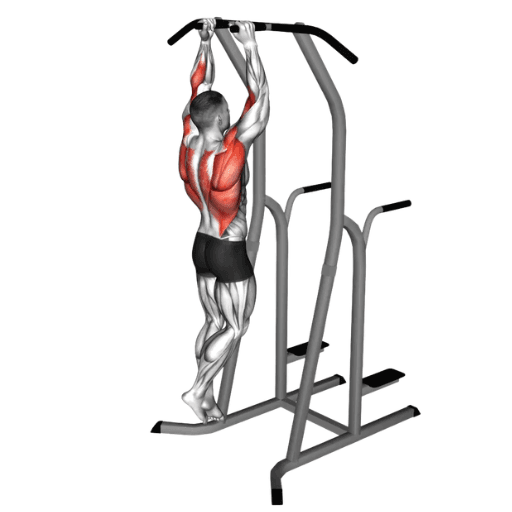
About the Neutral Grip Pull-Up
The strict neutral grip pull-up is a compound upper-body pulling exercise performed on parallel handles with palms facing each other. From a dead hang with a semi-pronated grip, the lifter pulls upward until the chin clears the handles, then lowers under control to full arm extension. The neutral grip places the wrist in its most natural position and shifts greater demand to the brachioradialis, making it a joint-friendly alternative to pronated pull-ups while maintaining strong lat recruitment. The semi-pronated wrist position combines shoulder adduction, shoulder extension, and elbow flexion—recruiting the latissimus dorsi as the primary mover, with the brachioradialis in its optimal mechanical position, alongside the biceps brachii, rhomboids, and lower trapezius.
Like all pull-up variations, the neutral grip requires lifting 100% of your body mass (plus external load) against gravity. The parallel handle position reduces wrist and shoulder strain compared to pronated grip, making it an accessible option for lifters with joint sensitivities while maintaining strong lat and back recruitment.
How Neutral Grip Compares to Other Pull-Up Grips
Biomechanical differences that affect performance and joint stress
Balanced & Joint-Friendly
Wrist in natural 0° position. Brachioradialis at peak leverage. ~5–8% stronger than pronated grip. Ideal for lifters with wrist or shoulder discomfort.
Standard Competition Grip
Full forearm pronation disadvantages the biceps, shifting demand to lats and brachioradialis. The standard used in military and competitive testing. 1–2 fewer reps than neutral.
Maximum Biceps Leverage
Full supination places the biceps brachii in its strongest position. Enables 5–10% more load than pronated. A distinct exercise with separate standards.
Bodyweight vs. Weighted Neutral Grip Pull-Ups
Two complementary metrics assessing different physical qualities
Relative Muscular Endurance
Evaluated by maximum strict unbroken repetitions on parallel handles to form failure. No 1RM estimation applied. Benchmarks stratified by sex and age bracket.
Maximal Absolute Pulling Strength
Evaluated by Total System Load (Bodyweight + Added Load) using submaximal 1RM estimation. Enables fair comparison between lifters of differing body sizes.
What Each Strength Level Means for Neutral Grip Pull-Ups
These tiers apply across both bodyweight repetitions and weighted total load assessments. They provide standardized benchmarks for gauging your vertical pulling capacity on parallel handles relative to your peers.
New to pull-ups or unable to complete a full dead-hang repetition on parallel handles. At this stage, focus on negative neutral grip pull-ups, band-assisted reps, and dead hangs to build scapular stability and lat recruitment. The neutral grip’s joint-friendly position makes it an excellent starting point for beginners.
Able to perform clean, unbroken strict repetitions with good form on parallel handles. For men, reaching 5–8 reps indicates solid foundational pulling strength. For women, completing that first strict neutral grip pull-up is a strong novice-level accomplishment. Movement is performed under bodyweight alone.
Strong, reliable vertical pulling proficiency representing approximately 1–2 years of dedicated training. At this stage, a 180 lb man can pull with approximately +85 lb added load (1.47× total system load) for a 1RM while maintaining strict form through full range of motion.
Exceptional pulling strength achieved through multiple years of structured resistance or calisthenics training. A 180 lb man at this level can add approximately 150 lb on a dip belt (approaching 1.84× total system load) for a single rep, or execute 23+ strict neutral grip reps. Surpasses roughly 85–90% of active gym-goers.
World-class vertical pulling capabilities found among competitive calisthenics athletes and advanced strength trainees. Total system load exceeds double bodyweight for men. Strict dead-hang technique on parallel handles remains flawless even under maximum fatigue.
Neutral Grip Pull-Up Training Insights
Recommendations on progression, grip selection, joint health, and optimizing neutral grip pull-up performance.
How do I get my first neutral grip pull-up?
How do I get my first neutral grip pull-up?
If you cannot yet perform a strict neutral grip pull-up, attempting repeated failed concentric reps is counterproductive. Instead, use these three proven progressions on parallel handles:
Eccentric Overload
Jump or step to chin-over-bar position on the parallel handles, then lower for a strict 3–5 second count to full dead hang. 3–4 sets of 3–5 reps.
Full Kinetic Groove
Loop a heavy resistance band around one handle and under your knees or feet. It assists most at the bottom (dead hang), tapering off as your chin approaches the bar.
Grip & Scapular Base
Build up to 45–60 second active hangs on the parallel handles to condition the rotator cuff, lower traps, and forearms.
The neutral grip’s joint-friendly wrist position makes it an excellent starting grip for beginners who find pronated grip uncomfortable.
When should I add external weight?
When should I add external weight?
Introduce external load once you can complete 3 sets of 10–12 strict neutral grip pull-ups with full extension and zero kipping. Beyond this threshold, additional bodyweight volume primarily develops local muscular endurance rather than maximal strength.
Recommended Loading Progression:
- Initial load: Begin with 5–10 lb (2.5–5 kg) on a dip belt.
- Rep range: Shift to 3–5 heavy sets of 4–6 reps.
- Progression trigger: When you achieve 3 sets of 6 clean reps at a given load, increase by 2.5–5 lb (1–2.5 kg).
- Equipment: Use a dip belt centered below the pelvis. Weight vests work well up to 20–30 lb but limit progressive overload beyond that range.
Neutral grip vs. pronated vs. chin-up — which grip should I use?
Neutral grip vs. pronated vs. chin-up — which grip should I use?
Each grip places different demands on the forearm, biceps, and shoulder:
Palms face each other on parallel handles. Wrist in its most natural position. Best for: lifters with wrist discomfort, those seeking balanced arm flexor recruitment, and beginners building foundational pulling strength.
Palms face away. Mechanically disadvantages the biceps, shifting more demand to the brachioradialis and lats. Most lifters perform 1–2 fewer reps than neutral grip. The standard military and competitive pull-up grip.
Palms face toward you. Places the biceps brachii in its optimal mechanical line of pull. Enables 5–10% more load or additional reps vs pronated. A distinct exercise with different standards.
For well-rounded pulling development, rotate between all three grips across training cycles. Do not evaluate neutral grip performance against pronated or chin-up standards.
Does neutral grip reduce wrist and shoulder strain?
Does neutral grip reduce wrist and shoulder strain?
Yes. The neutral grip places the wrist at 0 degrees of pronation/supination—its most natural resting position. This reduces strain on the pronator teres and the wrist joint capsule compared to full pronation.
Shoulder Benefits:
- Reduced internal rotation: Pronated pull-ups require full forearm pronation, which couples with shoulder internal rotation under load. The neutral position mitigates this, reducing impingement risk in the subacromial space.
- Natural scapular tracking: The shoulder blade can protract and retract along a more natural path during neutral grip pulling, reducing anterior shoulder stress.
- Elbow-friendly: The semi-pronated position distributes load more evenly between the biceps brachii and brachioradialis, reducing stress concentration on the distal biceps tendon.
If you experience wrist pain with pronated pull-ups or mild shoulder impingement, neutral grip is a practical alternative that maintains strong lat recruitment while reducing joint stress.
How reliable is the weighted neutral grip pull-up 1RM estimate?
How reliable is the weighted neutral grip pull-up 1RM estimate?
The weighted pull-up 1RM test is highly reliable under strict protocols, with intraclass correlation coefficients (ICC) of 0.96 and above reported in sports science literature. This reliability applies equally to neutral grip and pronated grip variations.
Best Practices for 1RM Accuracy:
- Keep test sets under 5 reps: Submaximal 1RM estimation formulas are most accurate in the 1–5 repetition range.
- Factor in full bodyweight: Always calculate 1RM from Total System Load (Bodyweight + External Plates), not added plates alone.
- Strict lockouts: Cutting range of motion by even an inch can inflate estimates by 15–20 lb. Full dead hang to chin-over-bar is required on every rep.
Assessment Disclaimer
These Neutral Grip Pull-Up strength standards are practical training benchmarks adapted from pronated pull-up community data for self-assessment and progressive overload tracking. Individual performance varies based on limb length, grip width, body composition, and shoulder mechanics. Consult a certified coach or sports medicine specialist before attempting maximum-load weighted pull-ups.