Dips Strength Standards
The Intermediate Dip standard is 20 strict reps for men (age 20–29) and 9 reps for women. For weighted dips, intermediate is 1.55× bodyweight total system load. Compare your performance by sex, age, and bodyweight.
Bodyweight Dips or Weighted Dips?
Measure your max strict reps on parallel bars. Classification is based on age bracket and sex — no 1RM estimation involved.
Select Your Sex & Age
Male Bodyweight Dip Standards (20–29 years)
Minimum strict reps to reach each tier (parallel-bar dips, full depth, full lockout)
| Strength Level | Minimum Reps |
|---|---|
| Beginner | 3 reps |
| NoviceYou | 9 reps |
| Intermediate | 20 reps |
| Advanced | 31 reps |
| Elite | 43 reps |
Assess Your Bodyweight Dips
Enter your max consecutive strict reps on parallel bars
15 strict reps on parallel bars places you at the Novice level for males, 20–29 years.
StrengthRegimen bodyweight dip standard. Full depth (upper arms parallel), full lockout, no momentum.
Shareable Dips Strength Card
Bodyweight Dips Strength Spectrum
Complete Bodyweight Dip Standards by Age (Male)
Minimum strict reps to reach each tier on parallel bars
| Age Group | Beginner | Novice | Intermediate | Advanced | Elite |
|---|---|---|---|---|---|
| 15–19 years | 1 | 5 | 13 | 23 | 33 |
| 20–29 years | 3 | 9 | 20 | 31 | 43 |
| 30–39 years | 3 | 9 | 20 | 30 | 42 |
| 40–49 years | 2 | 7 | 16 | 27 | 38 |
| 50–59 years | 1 | 4 | 12 | 22 | 32 |
| 60+ years | <1 | 1 | 8 | 16 | 24 |
About the Dips
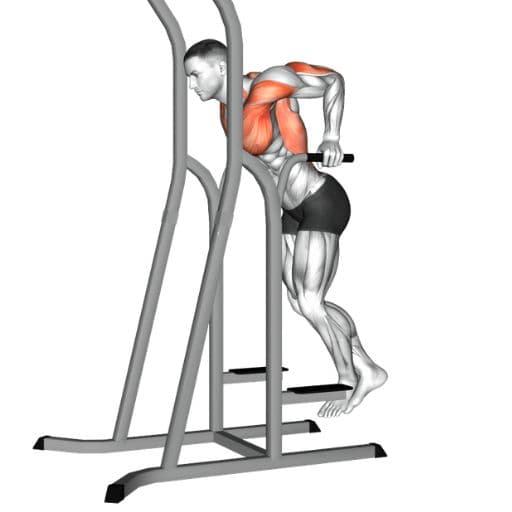
The parallel-bar dip is a compound upper-body pressing exercise performed on parallel bars. The lifter supports their full body mass on extended arms, lowers until the upper arms are at least parallel to the floor, and presses back to lockout. It is one of the most effective bodyweight exercises for developing pushing strength in the chest, triceps, and anterior deltoids. Biomechanically, dips combine shoulder extension, shoulder adduction, and elbow extension—recruiting the pectoralis major (sternal head emphasized), triceps brachii (all three heads), and anterior deltoids as prime movers, while the rhomboids, lower trapezius, and rotator cuff stabilize the shoulder girdle.
Unlike the bench press, dips require supporting 100% of your body mass (plus any added weight) through the upper extremities in a closed kinetic chain. This makes bodyweight a direct factor in exercise difficulty and is why dips have both a rep-based bodyweight assessment and a load-based weighted assessment.
Bodyweight Dips vs. Weighted Dips
These are two different measurements. Bodyweight dip performance is measured in maximum strict repetitions — no 1RM estimation is involved. Weighted dip performance is measured as total system load (bodyweight + added weight) with 1RM estimation applied to the total load. The two modes use separate standards and should not be compared directly with each other.
Parallel-Bar Dip Protocol
These standards apply to strict parallel-bar dips on standard parallel bars (approximately 18–24 inches apart). For a valid comparison against these benchmarks, every repetition must meet the criteria below.
Start Position
Arms fully extended (lockout) with the body supported above the bars. Shoulders depressed and retracted. Feet off the ground.
Descent (Eccentric)
Lower the body under control until the upper arms are at least parallel to the floor (elbow angle ≤ 90°). No bouncing at the bottom. Partial-depth reps do not count.
Ascent (Concentric)
Press back to full arm lockout in a steady, controlled motion. The rep is complete only when the elbows are fully extended.
Body Position
Torso upright or with a slight forward lean. Legs crossed below the body or held straight. No kipping, swinging, or use of momentum. A momentary pause at the top is acceptable, but extended resting between reps is not.
Weighted Dips (if applicable)
External weight attached via a dip belt, weight vest, or dumbbell held between the legs. The same form requirements apply. “Added weight” means only the external load — bodyweight is separate. “Total system load” = bodyweight + added weight.
What Each Strength Level Means for Dips
These tiers apply to both bodyweight and weighted dip assessments. They are StrengthRegimen-defined training benchmarks, not scientifically established population categories.
Beginner
New to parallel-bar dips or unable to perform strict reps consistently. For bodyweight dips, this typically means fewer than a handful of full-depth reps. For weighted dips, performing bodyweight-only dips without added load (men) or requiring band assistance (women).
Novice
Can perform multiple strict bodyweight dips and is developing consistent technique. Form is reliable but rep counts and loading capacity are still building. Weighted dip loads are modest relative to bodyweight.
Intermediate
Demonstrates solid bodyweight dip proficiency (roughly 20 strict reps for men age 20–29, 9 for women). For weighted dips, total system load reaches approximately 1.55× bodyweight (men) or 1.00× bodyweight (women). Typically 1–2 years of consistent upper-body training.
Advanced
High bodyweight rep capacity and/or substantial added loading. Weighted dip total system load approaches 2.00× bodyweight for men. Multiple years of dedicated push training. Competitive strength at local level.
Elite
Exceptional dip performance relative to trained populations. Bodyweight rep counts well above 40 (men) or total weighted loads exceeding 2.50× bodyweight. Many years of dedicated training. Competitive at regional or national level in relevant strength sports.
Methodology & Data Sources
About Our Dips Standards
All values on this page are StrengthRegimen-derived training benchmarks. They are NOT scientifically established population norms, peer-reviewed percentile cutoffs, or official competition standards. They are informed by community data and general coaching conventions, intended for self-assessment and goal-setting.
Bodyweight Mode (Rep-Based)
Bodyweight dip rep thresholds are classified by age bracket and sex. They are informed by:
- StrengthLevel.com: 2.1M+ self-reported dip submissions with rep counts by bodyweight, sex, and age. These are user-submitted, unverified numbers.
- FitnessVolt / Symmetric Strength: Cross-referenced rep norms from self-reported gym data.
- Endura.coach: Age-bracket rep standards for bodyweight dips.
There are no peer-reviewed normative datasets for parallel-bar dip repetitions from ACSM, NSCA, or CSEP. A Semantic Scholar paper on “floor triceps dips” measures a fundamentally different exercise (bench dips, not parallel-bar dips) and is not applicable.
StrengthRegimen thresholds are set slightly conservative relative to StrengthLevel.com to account for strict form enforcement: full depth (upper arms parallel), full lockout, no kipping or momentum.
Weighted Mode (Load-Based)
Weighted dip standards use bodyweight-ratio multipliers representing total system load / bodyweight for estimated 1RM. They are informed by:
- MovementRebels: Weighted dip standards by bodyweight with total-system-load ratios.
- Endura.coach: Added-load ratios for weighted dips.
- A small reliability study of 15 adult male athletes has been reported to show dip 1RM test-retest ICC 0.96–0.99, with mean relative dip strength 1.59 ± 0.23 × BW (total system load). Full citation (authors, journal, DOI) is not available for independent verification. The reported mean aligns with intermediate-to-advanced classification in our framework.
1RM Estimation (Weighted Mode Only)
The weighted mode uses the Epley formula: 1RM = totalLoad × (1 + reps / 30), where totalLoad = bodyweight + added weight. The formula is then used to derive both a total 1RM and an added-weight 1RM (total 1RM − bodyweight).
Important limitation: The Epley formula was validated for barbell exercises (bench press, squat, deadlift) by LeSuer et al. (1997). It has not been directly validated for dips in peer-reviewed literature. Applying it to dips introduces an additional source of variability because technique plays a larger role in bodyweight-based exercises. Accuracy decreases above 10 reps; for 2–6 rep sets, prediction error is within approximately 3% for barbell lifts.
Age Adjustments
Bodyweight mode: Age adjustments are built directly into the age-bracket thresholds. Each bracket has its own rep counts.
Weighted mode: The “By Age” reference table uses generalized age multipliers (peaking at 1.00 around age 23–25, declining gradually after 30). These are not derived from dips-specific longitudinal data. They represent a general age-related strength decline pattern used consistently across StrengthRegimen tools.
Limitations
- All community data is self-reported and unverified.
- No peer-reviewed normative datasets exist for parallel-bar dip reps.
- The Epley formula is not specifically validated for dips.
- Heavier lifters face greater absolute load per rep in bodyweight mode, which is inherent to the exercise and not accounted for by a simple multiplier.
- Bar width, grip angle, and individual limb proportions affect performance but are not captured by these standards.
- Strict form requirements (full depth, full lockout, no momentum) may produce lower rep counts than self-reported community data.
Dips Training Insights
How do I progress from 0 to 10+ bodyweight dips?
If you cannot yet perform a full parallel-bar dip, start with negatives (controlled descent only), band-assisted dips, or machine-assisted dips. Work toward your first strict rep before adding volume.
Once you can complete 1–3 strict reps, accumulate volume through multiple low-rep sets (e.g., 5–8 sets of 1–3 reps). As strength develops, consolidate into fewer sets with more reps per set.
When should I add external weight?
A common guideline is to add weight once you can complete 3 sets of 12–15 strict bodyweight dips. At that point, bodyweight dips primarily train muscular endurance rather than maximal strength.
Start with a modest load (5–10 lb / 2.5–5 kg) and reduce reps to 5–8 per set. Progress the load when you can complete 3 sets of 8 with good form.
Dips vs. bench press — which is a better pushing exercise?
They target overlapping but not identical muscle groups. The bench press primarily loads the pectoralis major and anterior deltoids in a horizontal plane. Dips load the chest, triceps, and anterior deltoids in a more vertical pressing pattern with additional stabilization demands.
Neither is universally superior. The bench press allows precise external loading and is the standard upper-body test in powerlifting. Dips require no equipment beyond parallel bars and develop closed-chain pressing strength. They complement each other in a balanced program.
Shoulder considerations for dips
Dips place the shoulder in extension under load, which some individuals find uncomfortable. If you experience anterior shoulder discomfort, limit depth to the point where the upper arms are parallel to the floor rather than going deeper, and ensure the bars are at a comfortable width.
Individuals with a history of shoulder instability should consult a qualified professional before performing heavy or high-volume dips.
How reliable is a weighted dip 1RM estimate?
A small reliability study of 15 adult male athletes has been reported to show dip 1RM test-retest ICC of 0.96–0.99, with a smallest worthwhile change of approximately 4% in relative strength. While the full citation for this study is not available, the reported result suggests the dip 1RM test is highly reproducible.
However, the Epley formula used for estimation was validated on barbell lifts, not dips. For the most reliable estimate, use heavy sets of 2–6 reps rather than lighter high-rep sets. The prediction error increases above 10 reps.
Disclaimer
The Dips strength standards on this page are practical training benchmarks intended for self-assessment and educational use. They are derived from community data, not peer-reviewed normative datasets. Individual strength varies based on genetics, training history, technique, body composition, bar width, and many other factors. The Epley 1RM formula used in weighted mode was validated for barbell exercises, not dips. Consult a qualified professional before beginning a new exercise program or attempting maximum lifts. Individuals with shoulder issues should exercise caution with dips.