Push-Up Strength Standards
Compare your push-up count against age and sex-adjusted strength standards. Enter your max strict push-up reps to see where you stand — from beginner to elite.
Sex & Age
For context only — does not affect your push-up classification
Male Push-Up Standards — 20–29 years
StrengthRegimen rep standards for strict push-ups (max reps in a single set to failure)
| Strength Level | Minimum Reps |
|---|---|
| Beginner | 10 reps |
| NoviceYou | 20 reps |
| Intermediate | 35 reps |
| Advanced | 55 reps |
| Elite | 75 reps+ |
How many push-ups should I be able to do?
A male aged 20–29 who can complete 35 strict push-ups in a single set is considered Intermediate according to StrengthRegimen push-up standards. These are internally derived training benchmarks informed by published fitness testing norms.
Enter Your Max Strict Push-Ups
How many strict push-ups can you complete in a single set to failure? Count only reps with full depth (upper arms parallel) and full lockout.
20 strict push-ups at age 25 (Male).
This places you in the Novice range for the 20–29 years age bracket according to StrengthRegimen push-up standards.
Shareable Push-Up Strength Card
Complete Male Push-Up Standards by Age
Strict push-up rep thresholds for each age bracket (male)
| Age Bracket | Beginner | Novice | Intermediate | Advanced | Elite |
|---|---|---|---|---|---|
| 15–19 years | 12 | 23 | 38 | 58 | 78+ |
| 20–29 years◂ You | 10 | 20 | 35 | 55 | 75+ |
| 30–39 years | 8 | 17 | 30 | 47 | 65+ |
| 40–49 years | 6 | 13 | 25 | 40 | 55+ |
| 50–59 years | 5 | 10 | 20 | 33 | 45+ |
| 60+ years | 3 | 8 | 15 | 25 | 38+ |
About the Push-Up
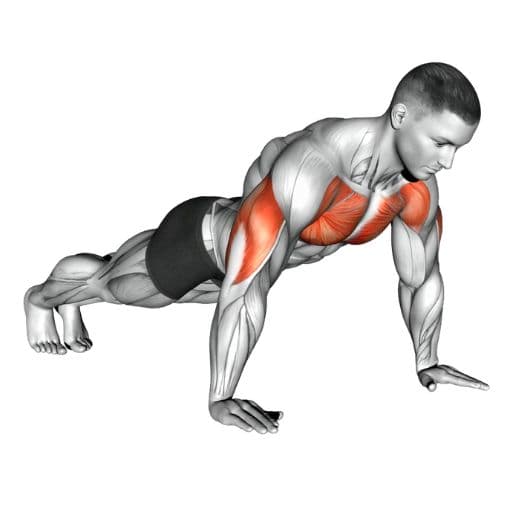
The push-up is a fundamental bodyweight exercise that develops upper-body pushing strength and muscular endurance. It involves lowering the body from a high plank position until the upper arms are at least parallel to the floor, then pressing back to full arm extension while maintaining a rigid, straight body line from head to heels. The push-up primarily targets the pectoralis major (chest), anterior deltoids (front of the shoulder), and triceps brachii (back of the upper arm). The core musculature — including the rectus abdominis, obliques, and transverse abdominis — works isometrically to maintain the rigid body line throughout the movement. The serratus anterior stabilizes the scapulae against the ribcage during the pressing phase.
Unlike barbell pressing movements, the push-up is a closed kinetic chain exercise — the hands are fixed and the body moves relative to them. In the standard push-up position, approximately 64% of total bodyweight is supported by the hands at lockout (Suprak et al. 2011) — and somewhat more at the bottom of the movement — making it a self-scaling exercise where load is proportional to the trainee's own mass. Push-up performance is one of the most widely studied bodyweight fitness metrics, with normative data published by ACSM, CSEP-PATH, and the Cooper Institute across multiple age and sex groups.
What Counts as a Strict Push-Up?
Push-up standards on this page assume a strict push-up protocol consistent with the form used in major fitness testing frameworks (ACSM, CSEP-PATH, NSCA). Only reps meeting this standard should be counted when using the assessment tool above.
Strict Push-Up Protocol — Step by Step
Start Position — High Plank
Place hands flat on the floor, roughly shoulder-width apart. Arms fully extended. Body forms one straight line from the crown of the head through the shoulders, hips, and heels. Feet together or up to hip-width apart.
Lowering Phase — Controlled Descent
Bend the elbows to lower the chest toward the floor. Maintain the rigid body line — no sagging hips, no piking. Continue until the upper arms reach at least parallel to the floor (elbows at approximately 90 degrees or slightly below).
Bottom Position — Depth Checkpoint
Upper arms at least parallel to the floor. Chest is near but not necessarily touching the floor. Elbows may flare slightly but should not splay wide beyond 45–60 degrees from the torso.
Pressing Phase — Full Lockout
Press the body back up to the start position by fully extending the elbows. The rep is complete only when the arms are straight (full lockout) and the body line is restored.
Continuous Repetitions
Repeat without extended pauses at the top or bottom. Brief momentary pauses at lockout are acceptable; resting on the floor or holding a plank for more than a few seconds between reps terminates the set.
Good Rep
- Full depth: upper arms reach at least parallel
- Full lockout: arms straight at the top
- Rigid body line maintained throughout
- Continuous cadence without extended pauses
No Rep
- Hips sag below the shoulder-to-heel line (loss of rigid body position)
- Hips pike upward significantly (shortening the lever arm)
- Knees touch the floor during the rep
- Upper arms do not reach parallel at the bottom (partial depth)
- Elbows do not fully lock out at the top (partial lockout)
- Resting the chest or body on the floor between reps
- Using momentum or a bouncing motion off the floor
Can't do a strict push-up yet?
This is more common than many people realize and is a perfectly valid starting point. Build toward your first strict push-up using regression progressions:
- Wall push-ups: Stand arm's length from a wall, perform push-ups against the wall surface
- Incline push-ups: Hands elevated on a bench, countertop, or sturdy surface — gradually lower the incline over weeks
- Knee push-ups: Full range of motion with knees on the floor — use this to build volume while training depth
- Negative push-ups: Lower yourself slowly (3–5 seconds) from the top to the floor, then reset. Eccentric-focused training is an effective method for building the pressing strength needed to complete the full movement.
Most healthy adults who train consistently can work toward their first strict push-up within several weeks of progressive regression work, though individual timelines vary considerably based on starting strength, bodyweight, and consistency.
What Do the Push-Up Strength Levels Mean?
Each tier represents a range of maximum strict push-up repetitions in a single set for a given age bracket and sex. These are internally derived training benchmarks informed by published fitness testing norms — no single source defines universal push-up strength tiers.
Beginner
A beginner can complete only a few strict push-ups before form breaks down. This is the starting point for most untrained adults, especially those new to upper-body pressing or returning to exercise after an extended period. Fatigue typically manifests as hip sag, partial range of motion, or inability to lock out at the top.
- Form deteriorates noticeably after a handful of reps — hips sag or depth shortens
- Triceps and chest fatigue rapidly; the set often ends due to muscular failure rather than cardiovascular demand
- Elbow lockout becomes incomplete in the later reps
- May benefit from regression progressions (incline, knee, or eccentric push-ups) to build volume
Rep ranges shown are for the 20–29 age bracket. Thresholds are age-adjusted — see the full standards table for your specific bracket.
Novice
A novice can complete a meaningful set of strict push-ups — enough to be used as a working exercise in a training program. Form is generally maintained for most of the set, though the final reps may show some form degradation. This level represents the transition from 'learning the movement' to 'training the movement.'
- Able to maintain rigid body line for the majority of the set
- Can control descent speed and press with deliberate cadence
- Chest and triceps are the primary limiters; core bracing is adequate
- Push-ups are a productive working exercise — no longer just a warm-up or test
Rep ranges shown are for the 20–29 age bracket. Thresholds are age-adjusted — see the full standards table for your specific bracket.
Intermediate
Intermediate push-up performance represents solid upper-body muscular endurance. This level is typical of individuals who have trained consistently for one to several years and include push-ups or pressing movements in their regular programming. Form is maintained throughout the set, and the limiting factor shifts toward cardiovascular demand and muscular endurance rather than raw strength.
- Full depth and full lockout maintained on every rep through the entire set
- Cadence remains steady — no stalling, no partial reps, no extended rests at lockout
- Sufficient endurance to use push-ups in circuits, supersets, or high-volume training blocks
- Most recreational fitness standards consider this range a mark of good functional fitness
Rep ranges shown are for the 20–29 age bracket. Thresholds are age-adjusted — see the full standards table for your specific bracket.
Advanced
Advanced push-up performance exceeds typical recreational fitness levels. Achieving this rep range requires dedicated upper-body endurance training, significant chest/tricep work capacity, and excellent core stability maintained across dozens of reps. This level is common among military fitness test high-scorers, competitive CrossFit athletes, and serious calisthenics practitioners.
- Consistent strict form over 50+ continuous reps — no degradation in depth or lockout
- Cardiovascular demand becomes a meaningful factor alongside muscular endurance
- Often achieved by those who specifically train push-up volume (not just pressing strength)
- Performance at this level typically requires periodized endurance programming
Rep ranges shown are for the 20–29 age bracket. Thresholds are age-adjusted — see the full standards table for your specific bracket.
Elite
Elite push-up performance is rare in the general population and represents exceptional upper-body muscular endurance. Reaching this level demands years of systematic push-up-specific training, including high-volume sets, endurance protocols, and careful management of repetitive-strain risk. This performance range is seen in military special operations candidates, competitive push-up athletes, and elite calisthenics specialists.
- 75+ (male) or 55+ (female) strict push-ups maintained with no form breakdown
- Exceptional fatigue resistance in chest, anterior deltoids, triceps, and core simultaneously
- Requires push-up-specific training volume — general pressing strength alone is insufficient
- Joint health management (wrist, elbow, shoulder) becomes essential at this volume
Rep ranges shown are for the 20–29 age bracket. Thresholds are age-adjusted — see the full standards table for your specific bracket.
How These Push-Up Standards Were Derived
Transparency about methodology and evidence sources.
StrengthRegimen Standards Disclosure
The push-up standards on this page are internally derived training benchmarks. They are informed by published push-up norms from recognized organizations (ACSM, CSEP-PATH, Cooper Institute) but are not direct reproductions of any copyrighted dataset. They have not been independently validated through a peer-reviewed study, nor are they endorsed by any specific fitness organization.
Rep-Based Classification (Not 1RM)
Evidence Sources
Five-Tier Framework
Limitations & Considerations
Push-Up Progression Roadmap
A phase-based approach to improving your strict push-up count, from your first rep to elite-level endurance. Each phase builds on the foundation established in the prior stage.
Foundation — 0 to First Strict Push-Up
The goal is your first full strict push-up. Use regression progressions to build the foundational pressing strength and core stability required.
- Wall push-ups → Incline push-ups (lower the surface height progressively over weeks)
- Knee push-ups with full depth and full lockout — focus on range of motion, not speed
- Negative (eccentric) push-ups: lower yourself over 3–5 seconds, then reset at the top
- Plank holds (high plank and forearm plank) for core bracing endurance — aim for 30–60 seconds
- Train 3–4 times per week; allow at least one rest day between sessions
Building Volume — 5 to 20 Reps
You can do a few strict push-ups but fatigue quickly. The focus shifts to accumulating volume while maintaining strict form on every rep.
- Multiple small sets throughout the day ('greasing the groove') — e.g., 3 push-ups every hour, 8–10 times a day
- Structured sets: 3–5 sets at 60–70% of your max (e.g., sets of 3–4 if your max is 6)
- Add 1 rep per set per week when all reps are strict
- Supplement with incline push-ups for higher-rep sets to build endurance without form breakdown
- Accessory work: dumbbell bench press, tricep dips, and plank variations support pressing strength
Endurance Development — 20 to 50 Reps
At this stage raw strength is sufficient — the challenge is muscular endurance and managing fatigue across dozens of continuous reps.
- Pyramid sets: ascending (5-10-15-20) then descending, with 30–60 second rests between sets
- Max-rep test once every 2–4 weeks to track progress; train sub-maximally the rest of the time
- Tempo manipulation: slow eccentrics (3–4 seconds) build endurance and time under tension
- Include push-up variations (wide, narrow, staggered) to prevent overuse and build balanced strength
- Core and shoulder stabilization work: dead bugs, pallof presses, band pull-aparts
Advanced & Elite — 50+ Reps
Pushing beyond 50 strict reps requires dedicated push-up-specific endurance programming. General pressing strength alone is insufficient at this level — sustained volume and fatigue management become primary training objectives.
- High-volume training blocks: 200–500 total push-ups per session across multiple set structures
- Interval sets: 30 seconds of push-ups / 15 seconds rest, repeated for 5–10 rounds
- Weekly periodization: alternate heavy (low-rep weighted or deficit) and endurance (high-rep) days
- Active recovery and joint health: wrist stretches, shoulder mobility, and elbow tendon care become essential
- Test max reps no more than once per month to avoid burnout; trust the volume in training
Training Considerations
- Push-ups are generally considered a lower-injury-risk exercise relative to maximal barbell lifts, but high-volume push-up training can produce wrist discomfort, elbow tendinopathy, or shoulder impingement if form degrades or recovery is insufficient.
- Warm up before max-effort testing: arm circles, scapular push-ups (protraction/retraction), and a set of 5–10 easy reps before going to failure.
- For balanced upper-body development, complement push-ups with pulling movements (rows, pull-ups) to maintain shoulder health and postural balance.
Disclaimer
The push-up standards presented on this page are internally derived training benchmarks intended for informational and educational purposes only. They do not constitute medical or professional training advice. These standards are informed by published push-up norms from recognized organizations (ACSM, CSEP-PATH, Cooper Institute) but are not direct reproductions of any copyrighted dataset. Individual push-up performance varies widely based on bodyweight, limb proportions, training history, body composition, hand placement, testing conditions, and many other factors. Always consult a qualified professional before beginning a new exercise program or performing max-effort fitness tests.