Dumbbell Bench Press Strength Standards
The Intermediate dumbbell bench press standard is 94 lb (43 kg) per dumbbell for men and 43 lb (20 kg) for women (estimated 1RM at 180 / 140 lb bodyweight). Compare your lift by bodyweight and age below.
Configure Your Bodyweight & Unit
Male Dumbbell Bench Press Standards (lb/dumbbell)
StrengthRegimen standards for 180 lb bodyweight — per dumbbell
| Strength Level | Per Dumbbell (180 lb BW) | BW Ratio |
|---|---|---|
| Beginner | 36 lb | 0.20x |
| NoviceYou | 72 lb | 0.40x |
| Intermediate | 94 lb | 0.52x |
| Advanced | 112 lb | 0.62x |
| Elite | 149 lb | 0.83x |
How much should I Dumbbell Bench Press? (lb/dumbbell)
Assess Your Dumbbell Bench Press
Enter the weight per dumbbell and reps completed to estimate your 1RM and strength level
Enter the weight of one dumbbell — not the combined weight of both hands
Pressing 75 lb/dumbbell × 5 reps equals an estimated 1RM of 88 lb per dumbbell.
At 180 lb (Male), that is 0.49× your bodyweight per arm, which falls within the Novice range. Epley-based estimate; accuracy is highest when reps ≤ 10.
Shareable Dumbbell Bench Press Strength Card
Dumbbell Bench Press Strength Spectrum
Rep-Max & Training Zone Table (LB/dumbbell)
Per-dumbbell loads based on your 88 lb estimated 1RM
| Target | % of 1RM | Per Dumbbell | Programming |
|---|---|---|---|
| 1RM (Max) (1 rep) | 100% | 88 lb | 1 × 1 rep (Max Test) |
| 3RM (3 reps) | 90.9% | 80 lb | 3–4 × 3 reps |
| 5RM (5 reps) | 85.7% | 75 lb | 3–4 × 5 reps |
| 8RM (8 reps) | 78.9% | 69 lb | 3–4 × 8 reps |
| 10RM (10 reps) | 75% | 66 lb | 3–4 × 10 reps |
| 12RM (12 reps) | 71.4% | 63 lb | 3 × 12 reps |
| 15RM (15 reps) | 66.7% | 59 lb | 2–3 × 15 reps |
Complete Dumbbell Bench Press Reference Chart (LB/dumbbell)
Per-dumbbell standards across bodyweights for Male lifters in lb
| BW (lb) | Beginner | Novice | Intermediate | Advanced | Elite |
|---|---|---|---|---|---|
| 120 | 24 | 48 | 62 | 74 | 100 |
| 130 | 26 | 52 | 68 | 81 | 108 |
| 140 | 28 | 56 | 73 | 87 | 116 |
| 150 | 30 | 60 | 78 | 93 | 125 |
| 160 | 32 | 64 | 83 | 99 | 133 |
| 170 | 34 | 68 | 88 | 105 | 141 |
| 180 | 36 | 72 | 94 | 112 | 149 |
| 190 | 38 | 76 | 99 | 118 | 158 |
| 200 | 40 | 80 | 104 | 124 | 166 |
| 210 | 42 | 84 | 109 | 130 | 174 |
| 220 | 44 | 88 | 114 | 136 | 183 |
| 230 | 46 | 92 | 120 | 143 | 191 |
| 240 | 48 | 96 | 125 | 149 | 199 |
| 250 | 50 | 100 | 130 | 155 | 208 |
| 260 | 52 | 104 | 135 | 161 | 216 |
| 270 | 54 | 108 | 140 | 167 | 224 |
| 280 | 56 | 112 | 146 | 174 | 232 |
| 290 | 58 | 116 | 151 | 180 | 241 |
| 300 | 60 | 120 | 156 | 186 | 249 |
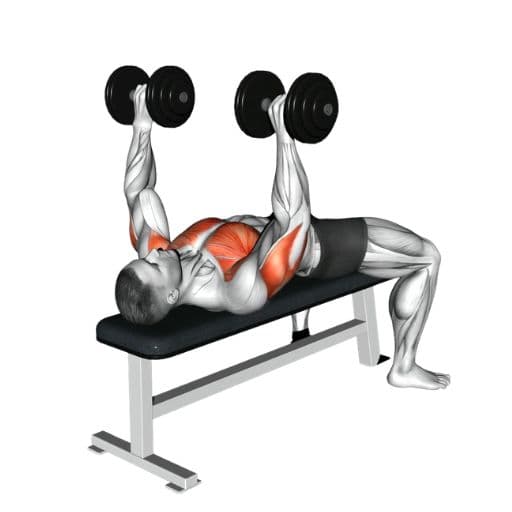
About the Dumbbell Bench Press
The flat dumbbell bench press is a compound upper-body pressing movement. The lifter lies supine on a flat bench holding one dumbbell in each hand, lowers them to chest level, and presses to full elbow lockout. Independent arms require greater stabilizer activation than the barbell variant. It is one of the most popular pressing variations for chest development and upper-body pressing strength.
All benchmarks on this page represent the weight of one dumbbell (per hand). If you press 75 lb in each hand, enter 75 lb — not 150 lb.
Dumbbell Bench Press vs. Barbell Bench Press
Research by Saeterbakken et al. (2011) found that total dumbbell bench press load (both hands combined) is approximately 83% of barbell bench press 1RM in trained males. The lower load reflects greater stabilization demands with independent dumbbells, not weaker muscles. Do not simply halve your barbell bench to get a per-dumbbell target — use this tool’s standards, which already account for the conversion.
Flat Dumbbell Bench Press Protocol
These standards assume a flat dumbbell bench press with full range of motion. Follow this protocol for consistent, comparable results.
Setup & Start Position
Lie supine on a flat bench with feet flat on the floor. Hold one dumbbell in each hand at arm’s length above the chest, palms facing forward (toward feet). Retract and depress the shoulder blades. Maintain a natural arch in the lower back.
Descent & Bottom Position
Lower the dumbbells under control to chest level, elbows at roughly 45–75° from the torso. The bottom position should bring the dumbbells to approximately the outer chest or nipple line. Maintain scapular retraction throughout the descent.
Press & Lockout
Press both dumbbells simultaneously upward until the elbows reach full extension. The dumbbells may converge slightly at the top but should not clank together. Lower under control for the next rep. Both arms press simultaneously — no alternating.
Valid Counted Rep
- • Dumbbells lowered to chest level (outer chest or nipple line)
- • Full elbow lockout at the top of each rep
- • Both dumbbells pressed simultaneously
- • Controlled eccentric — no bouncing off the chest
- • Hips remain on the bench throughout
Invalid / Disallowed
- • Partial range of motion (cutting depth at top or bottom)
- • Excessive arching that lifts the hips off the bench
- • Alternating arms or pressing one side at a time
- • Bouncing dumbbells off the chest to gain momentum
- • Incline, decline, or floor press position
Strength Level Benchmarks
Per-dumbbell benchmarks for the flat dumbbell bench press relative to bodyweight.
Beginner
Male 0.20× BW • Female 0.12× BWCan perform a controlled flat dumbbell bench press with light dumbbells through a full range of motion. Strength at this stage comes primarily from learning the movement pattern and stabilizing two independent implements.
Focus: Focus on controlled reps with 8–12 per set. Prioritize consistent dumbbell path (both arms moving symmetrically), full depth to the chest, and lockout at the top.
0–6 months of consistent training
Novice
Male 0.40× BW • Female 0.21× BWReliable form with moderate dumbbell loads. Can maintain scapular retraction, symmetrical arm movement, and consistent depth across multiple reps at working weights.
Focus: Linear progression with 5 lb dumbbell jumps. Work primarily in the 5–10 rep range. Begin incorporating accessory work (flies, incline press) to address sticking points.
6–12 months of structured training
Intermediate
Male 0.52× BW • Female 0.31× BWSolid pressing strength maintained with consistent technique under meaningful load. Represents the typical level of a dedicated gym-goer with 1–2 years of regular pressing training.
Focus: Periodize rep ranges across 5–12 reps. Progress requires intentional overload — micro-loading, volume manipulation, or targeted weak-point training. Consider alternating dumbbell and barbell pressing blocks.
1–2+ years of consistent training
Advanced
Male 0.62× BW • Female 0.46× BWUpper-tier dumbbell pressing strength. Requires years of dedicated pressing training and careful progressive overload. Handling heavy dumbbells demands significant stabilizer strength and practiced setup/dismount technique.
Focus: Structured mesocycles with planned intensity peaks. Balance direct pressing volume with shoulder health work. Heavy dumbbells require deliberate warm-up progressions and spotter availability.
3–5+ years of dedicated training
Elite
Male 0.83× BW • Female 0.60× BWExceptional dumbbell bench press strength, typically seen in competitive strength athletes or advanced bodybuilders with years of focused pressing development. Handling dumbbells at this load per arm requires extraordinary stabilizer strength.
Focus: Prioritize shoulder and pec tendon health. Very small, calculated increases over multi-month blocks. Strategic deloads are essential. At this level, the setup and dismount of heavy dumbbells becomes a skill in itself.
5+ years of serious strength training
Dumbbell Bench Press Training Insights
Dumbbell bench press vs. barbell bench press — which should I train?
Both are effective chest-pressing movements that target the pectoralis major, anterior deltoids, and triceps. The barbell bench press allows heavier absolute loads and more precise micro-loading (2.5 lb plate jumps). The dumbbell bench press requires independent arm stabilization, allows a greater range of motion at the bottom, and can help identify and correct bilateral strength imbalances.
Most strength-focused programs benefit from including both. A common approach is to use the barbell bench press as the primary pressing movement for strength development and the dumbbell bench press as a supplemental or hypertrophy-focused accessory.
How do I progress with dumbbell bench press?
Dumbbell progression is inherently less granular than barbell progression because most gyms stock dumbbells in 5 lb (2.5 kg) increments. A 5 lb jump per dumbbell represents a 10 lb total increase — equivalent to adding a 5 lb plate to each side of a barbell.
To manage this, add reps at a given weight before increasing load. For example, work up from 3×6 to 3×10 at 70 lb before moving to 75 lb at 3×6. Some lifters also use fractional weight magnetic add-ons (1.25–2.5 lb plates that attach to dumbbells) for smaller jumps.
When should I switch from dumbbells to a barbell for bench pressing?
There is no mandatory switch point. Some lifters use dumbbells exclusively throughout their training career, while others transition to barbell pressing when they want to pursue maximal-strength goals or compete in powerlifting.
Practical considerations: as dumbbell weight increases, the setup and dismount become more challenging. Many lifters find that above ~100 lb (45 kg) per dumbbell, getting the dumbbells into position requires a practiced “kick-up” technique or a training partner. At that point, barbell pressing may be more practical for maximal loading.
How reliable is a dumbbell bench press 1RM estimate?
The Epley formula used here was validated on barbell bench press data (LeSuer et al., 1997 — r > 0.95 for 1–10 reps). The dumbbell bench press is a compound movement using the same muscle groups, so the model transfers reasonably well. However, the independent arm stabilization demand introduces additional variability between reps, which may slightly reduce prediction precision compared to barbell.
For the most reliable estimate, use sets of 3–6 reps with a weight you can control through full range of motion. Estimates from sets above 10 reps carry meaningfully more error.
Can I convert my dumbbell bench press to a barbell equivalent?
A rough approximation: total dumbbell load (both hands combined) is approximately 83% of barbell bench press 1RM, based on Saeterbakken et al. (2011). So if you press 90 lb per dumbbell (180 lb total), your estimated barbell bench 1RM would be approximately 180 ÷ 0.83 ≈ 217 lb. However, this ratio varies by individual — lifters with more barbell experience may have a higher barbell-to-dumbbell ratio, while lifters who train primarily with dumbbells may press relatively closer to their barbell max.
Use each exercise’s standards independently for the most accurate assessment. Cross-exercise conversion should be treated as a rough estimate only.
How These Standards Are Derived
Sources, conversion method, and limitations for every number on this page.
1. Barbell-to-Dumbbell Conversion
No independent peer-reviewed normative dataset exists for the dumbbell bench press. These standards are derived from barbell bench press data using an empirically documented conversion factor.
Source study: Saeterbakken, van den Tillaar & Fimland (2011, Journal of Sports Sciences) compared barbell and dumbbell bench press 1RM in 12 resistance-trained males and reported that total dumbbell load (both dumbbells combined) was approximately 83% of barbell 1RM.
per-dumbbell BW ratio = barbell BW ratio × 0.83 ÷ 2
= barbell BW ratio × 0.415
Example: The barbell bench press Intermediate male standard is 1.25× BW. Applying the formula: 1.25 × 0.415 = 0.52× BW per dumbbell. For a 180 lb male: 180 × 0.52 = 94 lb per dumbbell.
2. Community Cross-Reference
Derived values were cross-referenced against StrengthLevel.com community data (~2.1 million dumbbell bench press submissions) and general coaching expectations. The derived intermediate male value (94 lb per dumbbell at 180 lb BW) aligns with the upper range of community intermediate data, which is expected because community data includes estimated 1RMs from self-reported multi-rep sets.
StrengthRegimen multipliers sit at the higher end of the community range because they represent a strict 1RM standard rather than an averaged self-reported estimate.
3. 1RM Estimation — Epley Formula
When you enter a multi-rep set, the tool estimates your 1RM using the Epley formula:
The Epley formula was validated for the barbell bench press with high accuracy (r > 0.95 for 1–10 reps, LeSuer et al., 1997). The dumbbell bench press uses the same primary muscle groups (pectorals, anterior deltoids, triceps), so the prediction model is expected to transfer reasonably well. However, increased stabilization demands with dumbbells may introduce additional rep-to-rep variability not captured by the barbell-derived model.
Recommendation: Use sets of 10 reps or fewer. The tool displays a warning above 10 reps. Treat the estimated 1RM as an approximate guide.
4. Limitations
Conversion factor scope: The Saeterbakken et al. (2011) study used 12 resistance-trained males. The 83% factor may vary by training status, sex, or individual biomechanics. It is the best available published estimate, but should not be treated as a universal constant.
Age multipliers: The “By Age” table applies gradual scaling factors based on the general pattern of neuromuscular force output across the lifespan. These are NOT derived from dumbbell bench press-specific longitudinal data.
Bodyweight ratio: A single set of BW ratios is used across all bodyweight classes. In practice, lighter lifters tend to achieve higher per-dumbbell BW ratios while heavier lifters press greater absolute loads.
These are StrengthRegimen-derived training benchmarks, not scientifically established population norms. They are intended for self-assessment and goal-setting.
Disclaimer
These are training benchmarks for self-assessment, not clinical standards. All values represent one dumbbell (per hand). Standards are derived from barbell bench press data using a published conversion factor; individual ratios may vary.