Incline Dumbbell Bench Press Strength Standards
The Intermediate incline dumbbell bench press standard is 77 lb (35 kg) per dumbbell for men and 36 lb (16 kg) for women (estimated 1RM at 180 / 140 lb bodyweight, per dumbbell). Bench angle: 30 degrees. Compare your lift by bodyweight and age below.
Configure Your Bodyweight & Unit
Male Incline Dumbbell Bench Press Standards (lb/dumbbell)
StrengthRegimen standards for 180 lb bodyweight — per dumbbell — 30° incline
| Strength Level | Per Dumbbell (180 lb BW) | BW Ratio |
|---|---|---|
| Beginner | 32 lb | 0.18x |
| NoviceYou | 54 lb | 0.30x |
| Intermediate | 77 lb | 0.43x |
| Advanced | 95 lb | 0.53x |
| Elite | 126 lb | 0.70x |
How much should I Incline Dumbbell Bench Press? (lb/dumbbell)
Assess Your Incline Dumbbell Bench Press
Enter the weight per dumbbell and reps completed to estimate your 1RM and strength level
Enter the weight of one dumbbell — not the combined weight of both hands
Pressing 55 lb/dumbbell × 5 reps on a 30° incline equals an estimated 1RM of 64 lb per dumbbell.
At 180 lb (Male), that is 0.36× your bodyweight per arm, which falls within the Novice range. Epley-based estimate; accuracy is highest when reps ≤ 10.
Shareable Incline Dumbbell Bench Press Strength Card
Incline Dumbbell Bench Press Strength Spectrum
Rep-Max & Training Zone Table (LB/dumbbell)
Per-dumbbell loads based on your 64 lb estimated 1RM — 30° incline
| Target | % of 1RM | Per Dumbbell | Programming |
|---|---|---|---|
| 1RM (Max) (1 rep) | 100% | 64 lb | 1 × 1 rep (Max Test) |
| 3RM (3 reps) | 90.9% | 58 lb | 3–4 × 3 reps |
| 5RM (5 reps) | 85.7% | 55 lb | 3–4 × 5 reps |
| 8RM (8 reps) | 78.9% | 51 lb | 3–4 × 8 reps |
| 10RM (10 reps) | 75% | 48 lb | 3–4 × 10 reps |
| 12RM (12 reps) | 71.4% | 46 lb | 3 × 12 reps |
| 15RM (15 reps) | 66.7% | 43 lb | 2–3 × 15 reps |
Complete Incline Dumbbell Bench Press Reference Chart (LB/dumbbell)
Per-dumbbell standards across bodyweights for Male lifters in lb
| BW (lb) | Beginner | Novice | Intermediate | Advanced | Elite |
|---|---|---|---|---|---|
| 120 | 22 | 36 | 52 | 64 | 84 |
| 130 | 23 | 39 | 56 | 69 | 91 |
| 140 | 25 | 42 | 60 | 74 | 98 |
| 150 | 27 | 45 | 65 | 80 | 105 |
| 160 | 29 | 48 | 69 | 85 | 112 |
| 170 | 31 | 51 | 73 | 90 | 119 |
| 180 | 32 | 54 | 77 | 95 | 126 |
| 190 | 34 | 57 | 82 | 101 | 133 |
| 200 | 36 | 60 | 86 | 106 | 140 |
| 210 | 38 | 63 | 90 | 111 | 147 |
| 220 | 40 | 66 | 95 | 117 | 154 |
| 230 | 41 | 69 | 99 | 122 | 161 |
| 240 | 43 | 72 | 103 | 127 | 168 |
| 250 | 45 | 75 | 108 | 133 | 175 |
| 260 | 47 | 78 | 112 | 138 | 182 |
| 270 | 49 | 81 | 116 | 143 | 189 |
| 280 | 50 | 84 | 120 | 148 | 196 |
| 290 | 52 | 87 | 125 | 154 | 203 |
| 300 | 54 | 90 | 129 | 159 | 210 |
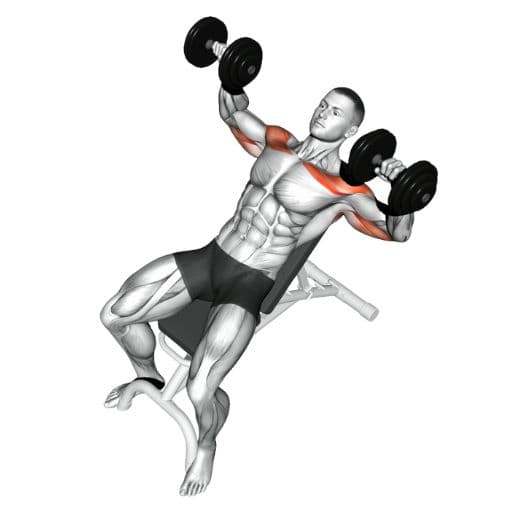
About the Incline Dumbbell Bench Press
The incline dumbbell bench press is a compound upper-body pressing movement performed on a bench set to approximately 30 degrees. The lifter holds one dumbbell in each hand, lowers them to upper-chest level, and presses to full arm extension. The incline angle increases upper pectoralis and anterior deltoid emphasis compared to the flat variant. Independent arms require greater stabilizer activation than barbell pressing.
All benchmarks on this page represent the weight of one dumbbell (per hand) on a 30° incline bench. If you press 55 lb in each hand, enter 55 lb — not 110 lb.
Incline vs. Flat Dumbbell Bench Press
Research on barbell pressing shows that incline pressing strength is roughly 78–85% of flat pressing strength (Lander et al. 2017 found a 21.5% reduction at 6RM; Kim & Kang 2006 found a 24.8% reduction at 1RM). For dumbbells, the ratio is expected to be slightly closer to flat because both exercises already involve independent arm stabilization.
Do not simply reduce your flat dumbbell bench by a fixed percentage to get an incline target. Individual incline-to-flat ratios vary with training emphasis, shoulder mobility, and upper vs. lower pec development. Use this tool’s standards directly — they are derived from incline-specific community data, not converted from flat bench numbers.
Incline Dumbbell Bench Press Strength Levels Explained
What each strength level means for the incline dumbbell bench press — from your first week with light dumbbells to the point where getting into position is the hardest part. All values are per-dumbbell weight relative to bodyweight on a 30° incline.
Beginner
Male 0.18× BW • Female 0.09× BWCan complete a full-ROM incline dumbbell bench press with light dumbbells while maintaining proper back contact and controlled tempo. Strength at this stage comes primarily from learning the pressing pattern on an incline. Most beginners reach this level within their first few weeks of training.
Focus: Focus on full range of motion, controlled lowering, and keeping both dumbbells moving evenly. Work in the 10–15 rep range with light dumbbells to build coordination and the incline-specific pressing groove.
0–6 months of consistent training
Novice
Male 0.30× BW • Female 0.17× BWConsistent incline dumbbell presses with moderate load and reliable form. Can maintain controlled tempo and full ROM across multiple sets without technique breakdown. The incline pressing pattern feels comfortable and automatic.
Focus: Linear progression in small dumbbell increments (typically 5 lb jumps). Work primarily in the 8–12 rep range. Begin pairing incline pressing with flat pressing and shoulder work for balanced development.
6–12 months of structured upper-body training
Intermediate
Male 0.43× BW • Female 0.26× BWSolid incline dumbbell pressing strength with strict form under meaningful load. Represents the typical level of a dedicated lifter with 1–2 years of regular pressing training. The incline angle and independent arms are no longer limiting factors — raw pressing strength is.
Focus: Periodize rep ranges across 6–12 reps. Progress requires intentional overload — adding reps before increasing dumbbell weight. Balance incline work with flat pressing and overhead pressing for complete shoulder and chest development.
1–2+ years of consistent training
Advanced
Male 0.53× BW • Female 0.38× BWUpper-tier incline dumbbell pressing strength. Getting the dumbbells into position becomes a challenge in itself at this load. Requires years of dedicated pressing training with well-developed upper pectoralis, anterior deltoid, and triceps musculature.
Focus: Structured mesocycles with planned intensity peaks. A spotter or training partner is valuable for getting heavy dumbbells into the starting position safely. Consider alternating between dumbbell and barbell incline pressing across training blocks.
3–5+ years of dedicated training
Elite
Male 0.70× BW • Female 0.45× BWExceptional incline dumbbell pressing strength. At this per-dumbbell load, grip security, getting into position, and controlling the descent become significant limiting factors beyond raw pressing power. This level represents years of serious upper-body training.
Focus: Prioritize joint health (shoulders, elbows) and recovery. Very small, calculated increases over multi-month blocks. Consider using barbell incline pressing as the primary overload tool and heavy dumbbell incline as a secondary movement.
5+ years of serious strength training
Incline Dumbbell Bench Press FAQ
How does the incline dumbbell bench press compare to the flat dumbbell bench press?
Both train the pectoralis major, anterior deltoids, and triceps through a pressing motion with independent arms. The 30° incline shifts emphasis toward the upper (clavicular) fibers of the pectoralis major and increases anterior deltoid involvement, while the flat bench targets the sternal head of the pec more evenly.
Research shows incline pressing strength is roughly 78–85% of flat pressing strength (Lander et al. 2017; Kim & Kang 2006 — barbell data). For dumbbells, the ratio is expected to be slightly higher because the stability challenge is already present on a flat bench with independent arms. There is no reliable universal conversion factor between the two exercises — individual ratios vary with training emphasis, shoulder mobility, and muscle development.
Does the bench angle matter?
Yes. These standards use a 30-degree incline. A steeper angle (e.g., 45°) shifts more load to the anterior deltoids and reduces pectoralis involvement, meaning you will press less weight at 45° than at 30°. A shallower angle (e.g., 15°) is closer to flat pressing and typically allows more weight.
Results from different bench angles are not directly comparable. For consistent progress tracking, always test and train at the same angle. If your gym’s bench does not have a 30° setting, choose the closest available angle and keep it consistent.
How should I log my weight?
Enter the weight of one dumbbell (per hand). If you press two 50 lb dumbbells, enter 50 lb — not 100 lb. This is the standard dumbbell convention used across StrengthRegimen, StrengthLevel.com, and general coaching practice.
Do not enter the combined weight of both dumbbells, and do not compare your per-dumbbell number directly to a barbell bench press total. They measure different things.
When should I use incline dumbbell pressing instead of flat?
The incline dumbbell bench press is a common choice when you want to develop the upper chest specifically, address an imbalance between upper and lower pectoralis development, or add variety to a pressing program. Many programs include both flat and incline pressing across the training week.
The incline variant is also useful for lifters with shoulder discomfort on the flat bench — some individuals find the incline angle more comfortable because it reduces the degree of shoulder extension at the bottom of the press. However, it increases anterior deltoid demand, which may aggravate different shoulder issues. Choose based on your own response, not a general recommendation.
Why is the 1RM estimate limited to 10 reps?
The Epley formula (1RM = weight × (1 + reps / 30)) was validated for barbell compound lifts — not incline dumbbell presses specifically. Prediction accuracy decreases above 10 reps for all exercises, and the independent arm stabilization demand on an incline further increases rep-to-rep variability at higher rep counts.
The tool still accepts higher rep counts but warns you that accuracy decreases. For the most reliable 1RM estimate, use a weight you can press for 10 reps or fewer with strict form on a 30° incline.
Disclaimer
These are training benchmarks for self-assessment, not clinical standards. All values represent one dumbbell (per hand) on a 30° incline bench. Standards are derived from StrengthLevel.com community data with a strict-form discount; individual results will vary with bench angle, technique, and training background. Consult a qualified professional before starting high-intensity resistance training.