Overhead Press Strength Standards
The Intermediate overhead press standard is 133 lb (60 kg) for men and 64 lb (29 kg) for women (estimated 1RM at 180 / 140 lb bodyweight). All values represent total barbell weight (bar + plates), strict standing press with no leg drive. Compare your lift by bodyweight and age below.
Configure Your Bodyweight & Unit
Male Overhead Press Standards (lb)
StrengthRegimen standards for 180 lb bodyweight — total barbell weight (bar + plates)
| Strength Level | Barbell Weight (180 lb BW) | BW Ratio |
|---|---|---|
| Beginner | 58 lb | 0.32x |
| NoviceYou | 92 lb | 0.51x |
| Intermediate | 133 lb | 0.74x |
| Advanced | 171 lb | 0.95x |
| Elite | 214 lb | 1.19x |
How much should I Overhead Press? (lb)
Assess Your Overhead Press
Enter your barbell weight and reps to estimate your 1RM and strength level
Enter total weight: bar + all plates (standard bar = 45 lb / 20 kg)
Pressing 95 lb × 5 reps equals an estimated 1RM of 111 lb (total barbell).
At 180 lb (Male), that is 0.62× your bodyweight, which falls within the Novice range. Epley-based estimate; accuracy is highest when reps ≤ 10.
Shareable Overhead Press Strength Card
Where Your Overhead Press Ranks
Normalized against male lifters at 180 lb bodyweight
Overhead Press Strength Spectrum
Rep-Max & Training Zone Table (LB)
Working loads based on your 111 lb estimated 1RM — total barbell
| Target | % of 1RM | Barbell Weight | Programming |
|---|---|---|---|
| 1RM (Max) (1 rep) | 100% | 111 lb | 1 × 1 rep (Max Test) |
| 3RM (3 reps) | 90.9% | 101 lb | 3–4 × 3 reps |
| 5RM (5 reps) | 85.7% | 95 lb | 3–5 × 5 reps |
| 8RM (8 reps) | 78.9% | 88 lb | 3–4 × 8 reps |
| 10RM (10 reps) | 75% | 83 lb | 3–4 × 10 reps |
| 12RM (12 reps) | 71.4% | 79 lb | 3 × 12 reps |
| 15RM (15 reps) | 66.7% | 74 lb | 2–3 × 15 reps |
Complete Overhead Press Reference Chart (LB)
Standards across bodyweights for Male lifters in lb
| BW (lb) | Beginner | Novice | Intermediate | Advanced | Elite |
|---|---|---|---|---|---|
| 120 | 38 | 61 | 89 | 114 | 143 |
| 130 | 42 | 66 | 96 | 124 | 155 |
| 140 | 45 | 71 | 104 | 133 | 167 |
| 150 | 48 | 77 | 111 | 143 | 179 |
| 160 | 51 | 82 | 118 | 152 | 190 |
| 170 | 54 | 87 | 126 | 162 | 202 |
| 180 | 58 | 92 | 133 | 171 | 214 |
| 190 | 61 | 97 | 141 | 181 | 226 |
| 200 | 64 | 102 | 148 | 190 | 238 |
| 210 | 67 | 107 | 155 | 200 | 250 |
| 220 | 70 | 112 | 163 | 209 | 262 |
| 230 | 74 | 117 | 170 | 219 | 274 |
| 240 | 77 | 122 | 178 | 228 | 286 |
| 250 | 80 | 128 | 185 | 238 | 298 |
| 260 | 83 | 133 | 192 | 247 | 309 |
| 270 | 86 | 138 | 200 | 257 | 321 |
| 280 | 90 | 143 | 207 | 266 | 333 |
| 290 | 93 | 148 | 215 | 276 | 345 |
| 300 | 96 | 153 | 222 | 285 | 357 |
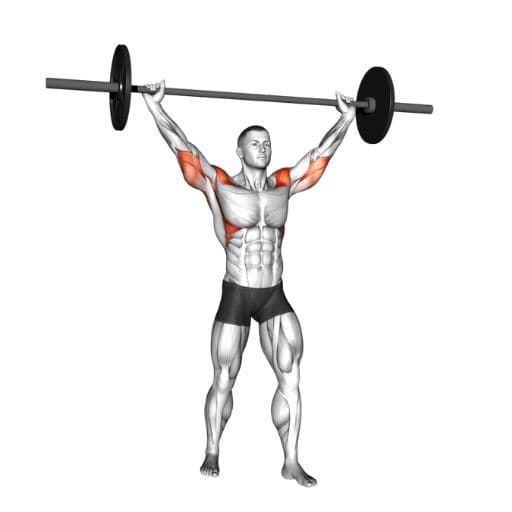
What Is the Overhead Press?
The overhead press (OHP) is a compound barbell exercise targeting the anterior deltoids, lateral deltoids, and triceps, with significant demand on the upper chest, core, and spinal stabilizers. The lifter stands with a barbell at shoulder height in the front rack position and presses it overhead to full lockout, then lowers it under control.
Also called the strict press or military press, it is the weakest of the four main barbell lifts (squat, deadlift, bench press, OHP) because the deltoids are smaller than the pectorals and posterior chain, the bar path is the longest, and standing eliminates the bench’s external support. A trained lifter’s strict OHP typically falls between 55–70% of their bench press 1RM.
All benchmarks on this page use total barbell weight (bar + plates). A standard Olympic barbell weighs 45 lb (20 kg). If you load 25 lb on each side, enter 95 lb.
Strict Press Only — No Push Press
These standards measure the standing barbell strict press: no knee bend, no hip drive, no momentum from the lower body. The torso remains near-vertical throughout. A push press (which uses a deliberate dip-and-drive) typically allows 15–25% more weight than the same lifter’s strict press. Do not compare push press numbers against these standards.
What counts as strict press
Bar starts at shoulder height (front rack). Press to full overhead lockout with elbows extended. No knee dip or hip thrust at any point. No excessive layback — the torso stays near-vertical. The bar travels in a straight line, with the head moving through the “window” at lockout.
Common form breaks that inflate numbers
Subtle knee dip before pressing (turns it into a push press). Excessive layback (uses chest leverage, not shoulder strength). Bouncing out of the bottom position. Shortening range of motion by not fully locking out overhead. Any of these will produce numbers that are too high for strict press standards.
Overhead Press Strength Levels Explained
What each strength level means for the standing barbell overhead press — from your first session under the bar to elite-level strict pressing. All values represent total barbell weight (bar + plates) relative to bodyweight. Strict form only — no leg drive or push press.
Beginner
Male 0.32× BW • Female 0.18× BWCan press a barbell from the shoulders to lockout overhead with basic form. Most of the effort at this stage goes into learning the bar path (straight up, head through at lockout), maintaining a rigid torso, and avoiding the instinct to use leg drive. The weight is light enough that shoulder strength is not the limiting factor — coordination and positioning are.
Focus: Focus on the press path with 3–5 sets of 5 reps. Start with the empty bar (45 lb) if needed. Keep the wrists stacked over the elbows, brace the core before each rep, and think about pushing your head through the “window” at lockout. Linear progression of 2.5–5 lb per session is typical at this stage.
0–6 months of consistent overhead pressing
Novice
Male 0.51× BW • Female 0.32× BWConsistent lockout on every rep with moderate weight. Can maintain a vertical bar path, brace effectively, and complete sets without excessive layback or knee dip. The sticking point just above forehead height becomes the primary challenge — triceps strength and shoulder positioning determine whether the rep finishes.
Focus: Linear progression in 2.5–5 lb jumps. Work primarily in the 3–8 rep range. Pair with horizontal pressing (bench press) and vertical pulling (chin-ups, lat pulldowns) for balanced upper-body development. If progress stalls, add a light pressing day at 70–80% of your working weight.
6–12 months of structured pressing
Intermediate
Male 0.74× BW • Female 0.46× BWSolid overhead pressing strength with strict form under meaningful load. Represents roughly 1–2 years of dedicated pressing. For men, the OHP intermediate (0.74× BW) is roughly 59% of the bench press intermediate (1.25× BW). For women, the OHP intermediate (0.46× BW) is roughly 61% of the bench intermediate (0.75× BW). Both ratios are consistent with the practitioner consensus of 55–70% for lifters who train the strict press regularly.
Focus: Periodize rep ranges across 3–8 reps. Progress requires intentional overload: micro-loading (1.25 lb plates), rep PRs before weight PRs, and occasional back-off weeks. Pin presses or Z-presses can target the sticking point. OHP responds well to higher frequency (2–3 sessions per week) at moderate intensity.
1–2+ years of consistent training
Advanced
Male 0.95× BW • Female 0.63× BWUpper-tier strict pressing strength. At this load, the temptation to use subtle leg drive or layback is significant — maintaining strict form requires deliberate discipline on every rep. Core stability becomes a genuine limiting factor alongside deltoid and triceps strength. Most lifters at this level are pressing near or above bodyweight, which is a long-standing milestone in the strength community.
Focus: Structured mesocycles with planned intensity peaks in the 1–5 rep range. Belt usage is common for intra-abdominal pressure support. Accessory work targeting the sticking point: seated dumbbell press, push press (for overload), lateral raises, and close-grip bench press for triceps. Volume management is critical — the shoulders are involved in nearly every upper-body exercise.
3–5+ years of dedicated training
Elite
Male 1.19× BW • Female 0.84× BWExceptional strict overhead pressing strength seen in competitive strength athletes, weightlifters, and advanced powerlifters with years of overhead work. Pressing more than bodyweight overhead with strict form requires outstanding deltoid and triceps strength, shoulder mobility, core rigidity, and technique. The distinction between strict press and push press matters most at this level — a small dip can add 15–25% to the weight moved.
Focus: Prioritize joint health (especially shoulders and elbows) and manage total pressing volume across all exercises. Very small, calculated increases over multi-month blocks. Competition-style peaking may be warranted. Heavy singles should be infrequent and intentional. Recovery and accessory balance (pulling volume equal to or greater than pressing volume) are essential for longevity.
5+ years of serious strength training
Overhead Press FAQ
How does the overhead press compare to the bench press?
Both are compound barbell pressing movements, but they train different primary muscles through different planes. The bench press is a horizontal push targeting the pectorals, while the overhead press is a vertical push targeting the deltoids. The bench press allows heavier absolute loads because the pectorals are larger muscles and the lifter is braced against a bench.
A trained lifter’s strict overhead press typically falls between 55–70% of their bench press 1RM. For men, the StrengthRegimen OHP intermediate (0.74× BW) is roughly 59% of the bench intermediate (1.25× BW). For women, the OHP intermediate (0.46× BW) is roughly 61% of the bench intermediate (0.75× BW). If your OHP is below 55% of your bench, it usually means you’re not training overhead pressing as a primary movement rather than having inherently weak shoulders.
What is the difference between strict press and push press?
The strict press (what this tool measures) requires pressing the barbell from shoulder height to overhead lockout using only upper-body strength. No knee bend, no hip drive, no momentum from the lower body. The torso remains near-vertical throughout.
The push press begins with a deliberate dip-and-drive: the lifter bends the knees slightly, then explosively extends the hips and knees to generate momentum that helps drive the bar past the sticking point. A push press typically allows 15–25% more weight than the same lifter’s strict press. These are fundamentally different exercises — do not compare push press numbers against strict press standards.
Why is the overhead press the weakest of the four main lifts?
Three reasons. First, the prime movers are smaller: the deltoids and triceps are significantly smaller than the pectorals (bench press), glutes and quadriceps (squat), or posterior chain (deadlift). Second, the bar path is longer — from shoulder height to full overhead lockout is a greater distance than chest-to-lockout on the bench. Third, standing eliminates external support — the lifter must stabilize their entire body against gravity while pressing, demanding significant core strength that is “free” on the bench.
This is completely normal. For a balanced lifter, the OHP typically ranks: deadlift > squat > bench press > overhead press. The gap between bench and OHP is the largest relative gap among the four main lifts.
What rep ranges work best for the overhead press?
For strength: Work primarily in the 1–5 rep range with 2–3 minutes rest between sets. The OHP responds well to heavy singles and triples once technique is established. Typically 3–5 working sets, 2–3 times per week. Progress is slower than other main lifts — adding 5 lb per month at intermediate level is solid progress.
For hypertrophy: Use moderate loads in the 6–10 rep range with 90–120 seconds rest. Controlled tempo and full range of motion (bar touching the front deltoids at the bottom, full lockout at the top). Supplement with dumbbell pressing, lateral raises, and face pulls for complete deltoid development.
For 1RM estimation accuracy: Sets of 10 or fewer reps produce the most reliable Epley-based 1RM predictions. Above 10 reps, form degradation and subtle leg drive make the estimate less trustworthy.
Where does the overhead press stall, and how do I break through?
The most common sticking point is just above the forehead — where the bar transitions from in front of the face to directly overhead. At this point, the anterior deltoids lose mechanical advantage and the triceps must take over to complete the lockout. If reps consistently fail at this height, triceps strength is likely the limiting factor.
Strategies that address this: pin presses from the sticking point (set safety pins at forehead height and press from a dead stop), close-grip bench press for triceps development, push press for overload (the lower-body drive gets the bar past the sticking point, exposing the triceps to heavier loads in the lockout range), and increasing pressing frequency to 2–3 sessions per week at moderate intensity.
Disclaimer
These are StrengthRegimen training benchmarks for self-assessment, not clinical standards. All values represent total barbell weight (bar + plates) for the standing strict press with no leg drive. Multi-rep sets are converted to an estimated 1RM using the Epley formula; accuracy is highest at 10 reps or fewer and decreases at higher rep counts. Standards are derived from community datasets (StrengthLevel 1.83M qualifying lifts, cross-checked against Gravitus and StrengthLog) and adjusted for strict form; individual results vary based on training history, anthropometry, and technique.