Machine Chest Press Strength Standards
The Intermediate machine chest press standard is 158 lb (72 kg) for men and 67 lb (30 kg) for women (estimated 1RM at 180 / 140 lb bodyweight, machine-reported weight). Machine design affects comparability — track your progress on the same machine. Compare your lift by bodyweight and age below.
Configure Your Bodyweight & Unit
Male Machine Chest Press Standards (lb)
StrengthRegimen standards for 180 lb bodyweight — machine-reported weight
| Strength Level | Machine Weight (180 lb BW) | BW Ratio |
|---|---|---|
| Beginner | 76 lb | 0.42x |
| Novice | 117 lb | 0.65x |
| IntermediateYou | 158 lb | 0.88x |
| Advanced | 230 lb | 1.28x |
| Elite | 297 lb | 1.65x |
How much should I be able to Machine Chest Press? (lb)
Assess Your Machine Chest Press
Enter the machine weight and reps completed to estimate your 1RM and strength level
Pin-selected stack weight or total plates loaded
Pressing 130 lb × 8 reps equals an estimated 1RM of 165 lb (machine weight).
At 180 lb (Male), that is 0.92× your bodyweight, which falls within the Intermediate range. Epley-based estimate; the formula has not been validated for machine chest presses specifically.
Shareable Strength Card
Machine Chest Press Strength Spectrum
Rep-Max & Training Zone Table (LB)
Machine-weight loads based on your 165 lb estimated 1RM
| Target | % of 1RM | Machine Wt | Programming |
|---|---|---|---|
| 1RM (Max) (1 rep) | 100% | 165 lb | 1 × 1 rep (Max Test) |
| 3RM (3 reps) | 90.9% | 150 lb | 3–4 × 3 reps |
| 5RM (5 reps) | 85.7% | 141 lb | 3–4 × 5 reps |
| 8RM (8 reps) | 78.9% | 130 lb | 3–4 × 8 reps |
| 10RM (10 reps) | 75% | 124 lb | 3–4 × 10 reps |
| 12RM (12 reps) | 71.4% | 118 lb | 3 × 12 reps |
| 15RM (15 reps) | 66.7% | 110 lb | 2–3 × 15 reps |
Complete Machine Chest Press Reference Chart (LB)
Machine-weight standards across bodyweights for Male lifters in lb
| BW (lb) | Beginner | Novice | Intermediate | Advanced | Elite |
|---|---|---|---|---|---|
| 120 | 50 | 78 | 106 | 154 | 198 |
| 130 | 55 | 85 | 114 | 166 | 215 |
| 140 | 59 | 91 | 123 | 179 | 231 |
| 150 | 63 | 98 | 132 | 192 | 248 |
| 160 | 67 | 104 | 141 | 205 | 264 |
| 170 | 71 | 111 | 150 | 218 | 281 |
| 180 | 76 | 117 | 158 | 230 | 297 |
| 190 | 80 | 124 | 167 | 243 | 314 |
| 200 | 84 | 130 | 176 | 256 | 330 |
| 210 | 88 | 137 | 185 | 269 | 347 |
| 220 | 92 | 143 | 194 | 282 | 363 |
| 230 | 97 | 150 | 202 | 294 | 380 |
| 240 | 101 | 156 | 211 | 307 | 396 |
| 250 | 105 | 163 | 220 | 320 | 413 |
| 260 | 109 | 169 | 229 | 333 | 429 |
| 270 | 113 | 176 | 238 | 346 | 446 |
| 280 | 118 | 182 | 246 | 358 | 462 |
| 290 | 122 | 189 | 255 | 371 | 479 |
| 300 | 126 | 195 | 264 | 384 | 495 |
About the Machine Chest Press
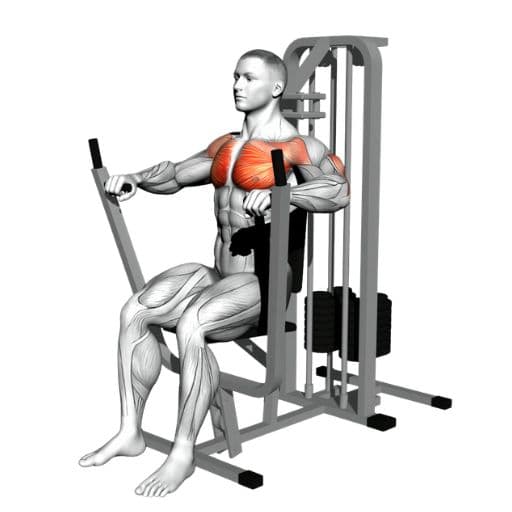
The seated machine chest press trains horizontal pushing through a fixed or guided path, placing primary load on the pectoralis major with significant contribution from the anterior deltoids and triceps. The machine eliminates stabilizer demand, allowing you to focus entirely on pressing force.
All benchmarks on this page use machine-reported weight (total plates loaded or pin-selected stack weight), excluding the machine’s empty carriage or lever-arm weight.
⚠ Machine Variability — Why Your Numbers May Differ
Chest press machines differ significantly in cam profiles, lever-arm geometry, and pulley ratios. 150 lb on one machine may feel like 120 lb on another — even though both display the same number. These standards use machine-reported weight, not effective resistance. For meaningful comparisons, always test on the same machine with the same seat and handle settings.
Understanding Machine Chest Press Numbers
Chest press machines vary across brands. Here is how to log your weight consistently.
Log the Displayed Weight
Enter the pin-selected stack weight (selectorized machines) or total plates loaded on both sides (plate-loaded machines). Exclude the empty carriage or lever-arm weight — it varies by manufacturer and is not part of the displayed load.
Leverage & Pulley Differences
Cam profiles, lever-arm geometry, and pulley ratios modify the actual resistance at the handles. 150 lb on a cable-stack chest press feels different from 150 lb on a plate-loaded lever press — even though the label says the same number.
Track on the Same Machine
For meaningful progress tracking, always test and train on the same machine with the same seat and handle settings. Switching machines resets your baseline — your numbers may go up or down due to mechanical differences, not strength changes.
StrengthRegimen Machine Chest Press Protocol
Follow these steps for consistent, repeatable results. No universally standardized machine chest press protocol exists — this is the StrengthRegimen testing protocol used to generate the benchmarks on this page.
- Seat height: Adjust the seat so the handles align with mid-chest (approximately nipple line). Feet flat on the floor or footrest.
- Back pad: Sit with the back flat against the pad. Maintain contact throughout the set — no lifting the back off the pad.
- Grip: Grip the handles with a firm, neutral or overhand grip (whichever the machine provides). Wrists neutral, elbows pointing outward.
- Press: Push forward to full arm extension with a soft lockout (elbows straight but not hyperextended). Controlled tempo — no explosively slamming the stack.
- Return: Lower the weight under control until the handles reach the starting chest-level position. Do not let the weight stack crash or bounce at the bottom.
- Range of motion: Full ROM from chest to lockout on every rep. Partial reps do not count. If you cannot complete a full rep, the set is over.
- Consistency: Use the same seat height, handle position, and back-pad setting for every test. Record these settings so you can reproduce them.
Machine Chest Press FAQ
How does the machine chest press compare to the barbell bench press?
Both train the pectoralis major, anterior deltoids, and triceps through a horizontal pressing motion. The barbell bench press requires you to stabilize the bar path, recruit rotator cuff and serratus anterior as stabilizers, and control the bar in three dimensions. The machine fixes the path and eliminates stabilizer demand.
Because of this, there is no reliable universal conversion factor between the two exercises. Some lifters press more on the machine (stability removed); others press less (the machine’s geometry may not suit their limb proportions or pressing angle). Comparing your machine number to a barbell bench number is not meaningful.
Which machines do these standards cover?
These standards cover any seated horizontal chest press machine — both selectorized (pin-loaded weight stack) and plate-loaded lever machines. Common examples include the Hammer Strength seated chest press, Life Fitness chest press, Technogym chest press, and generic cable-stack chest press machines found in most commercial gyms.
They do not cover incline or decline machine presses, Smith machine bench press, cable crossovers, or any free-weight pressing exercise. Each has a different angle, resistance curve, or stabilization demand that makes direct comparison invalid.
How should I log my weight?
Enter the weight shown on the machine: the pin-selected stack weight for selectorized machines, or the total plates loaded on both sides for plate-loaded machines. Do not include the machine’s empty carriage or lever-arm weight — it varies by manufacturer and is not part of the displayed load.
If your machine uses a different labeling system (e.g., numbered resistance levels instead of actual weight), these standards cannot be applied directly. The tool requires an actual weight value in pounds or kilograms.
When should I switch to a barbell bench press?
Consider adding barbell or dumbbell bench pressing when you want to develop stabilizer strength, improve free-weight pressing performance, or when the machine’s weight stack is no longer sufficient for progressive overload. Most selectorized machines max out at 200–300 lb, which limits progression for advanced lifters.
That said, the machine chest press remains a valid training tool at any level. It is excellent for isolating the pressing muscles without stabilizer fatigue, for high-volume accessory work, and for lifters with shoulder injuries who benefit from the guided path. Many advanced lifters use both.
Why is the 1RM estimate limited to 10 reps?
The Epley formula (1RM = weight × (1 + reps / 30)) was validated for barbell compound lifts — not machine chest presses specifically. Prediction accuracy decreases above 10 reps for all exercises, and machine-specific resistance curves (from cams and levers) may further distort the rep-to-1RM relationship.
The tool still accepts higher rep counts but warns you that accuracy decreases. For the most reliable 1RM estimate, use a weight you can press for 10 reps or fewer with strict form.
Machine Chest Press Strength Levels Explained
What each strength level means for the machine chest press — from your first week on the machine to the practical ceiling where the weight stack runs out. All values are machine-reported weight relative to bodyweight.
Beginner
Male 0.42× BW • Female 0.13× BWCan complete a full-ROM machine chest press with light resistance while maintaining proper seat position and controlled tempo. Strength at this stage comes primarily from learning the pressing pattern on the machine. Most beginners reach this level within their first few gym sessions.
Focus: Focus on full range of motion and controlled tempo with 10–15 reps per set. Learn to keep the back flat against the pad, press to full extension, and lower under control. Establish consistent seat and handle settings.
0–6 months of consistent training
Novice
Male 0.65× BW • Female 0.30× BWConsistent machine chest presses with moderate load and reliable form. Can maintain controlled tempo and full ROM across multiple sets without sacrificing technique. Pressing feels comfortable and the movement pattern is automatic.
Focus: Linear progression in small weight increments (typically 5–10 lb jumps on the stack). Work primarily in the 8–12 rep range. Begin pairing machine chest press with other upper-body pushing movements.
6–12 months of structured upper-body training
Intermediate
Male 0.88× BW • Female 0.48× BWSolid machine chest press strength with strict form under meaningful load. Represents the typical level of a dedicated lifter with 1–2 years of regular pressing training. The machine’s guided path allows you to focus entirely on progressive overload without stabilizer limitations.
Focus: Periodize rep ranges across 6–12 reps. Progress requires intentional overload — adding reps before increasing weight. Consider supplementing with free-weight pressing (barbell or dumbbell bench) for stabilizer development.
1–2+ years of consistent training
Advanced
Male 1.28× BW • Female 0.72× BWUpper-tier machine chest press strength. At this load, you are likely approaching the practical ceiling of many gym’s selectorized machines (most max out at 200–300 lb). Requires years of dedicated pressing training and strong chest, deltoid, and triceps development.
Focus: Structured mesocycles with planned intensity peaks. If the machine’s weight stack is no longer sufficient, consider plate-loaded chest press machines or transitioning primary pressing work to a barbell bench press for continued overload.
3–5+ years of dedicated training
Elite
Male 1.65× BW • Female 1.00× BWExceptional machine chest press strength. Most selectorized machines cannot provide enough resistance at this level — plate-loaded machines or barbell bench press are typically necessary. This level represents years of serious upper-body training with well-developed pressing musculature.
Focus: Prioritize joint health (shoulders, elbows) and recovery. Very small, calculated increases over multi-month blocks. The machine’s max stack weight may be the practical ceiling — consider free-weight pressing as the primary overload tool at this stage.
5+ years of serious strength training
Disclaimer
These benchmarks are for self-assessment and educational use. Because lever ratios and pulley systems vary across gym equipment, always track progress on the same machine. The machine chest press is not directly comparable to the barbell bench press or any other pressing exercise. Consult a qualified professional before starting high-intensity resistance training.