Machine Seated Crunch Strength Standards
The Intermediate machine seated crunch standard is 158 lb (72 kg) for men and 80 lb (36 kg) for women (estimated 1RM at 180 / 140 lb bodyweight). Machine weight does not equal effective resistance — track progress on the same machine. Compare your lift by bodyweight and age below.
Configure Your Bodyweight & Unit
Male Machine Seated Crunch Standards (lb)
StrengthRegimen standards for 180 lb bodyweight — machine-reported weight
| Strength Level | Machine Weight (180 lb BW) | BW Ratio |
|---|---|---|
| Beginner | 40 lb | 0.22x |
| NoviceYou | 79 lb | 0.44x |
| Intermediate | 158 lb | 0.88x |
| Advanced | 230 lb | 1.28x |
| Elite | 288 lb | 1.60x |
How much should I Machine Seated Crunch? (lb)
Assess Your Machine Seated Crunch
Enter the machine weight and reps to estimate your 1RM and strength level
Enter the weight shown on the machine — pin selection or plates loaded
Crunching 100 lb × 10 reps equals an estimated 1RM of 133 lb (machine weight).
At 180 lb (Male), that is 0.74× your bodyweight, which falls within the Novice range. Epley-based estimate; accuracy is highest when reps ≤ 12.
Shareable Machine Seated Crunch Strength Card
Where Your Machine Seated Crunch Ranks
Normalized against male lifters at 180 lb bodyweight
Machine Seated Crunch Strength Spectrum
Rep-Max & Training Zone Table (LB)
Working loads based on your 133 lb estimated 1RM — machine weight
| Target | % of 1RM | Machine Weight | Programming |
|---|---|---|---|
| 1RM (Max) (1 rep) | 100% | 133 lb | 1 × 1 rep (Max Test) |
| 3RM (3 reps) | 90.9% | 121 lb | 3–4 × 3 reps |
| 5RM (5 reps) | 85.7% | 114 lb | 3–4 × 5 reps |
| 8RM (8 reps) | 78.9% | 105 lb | 3–4 × 8 reps |
| 10RM (10 reps) | 75% | 100 lb | 3–4 × 10 reps |
| 12RM (12 reps) | 71.4% | 95 lb | 3 × 12 reps |
| 15RM (15 reps) | 66.7% | 89 lb | 2–3 × 15 reps |
Complete Machine Seated Crunch Reference Chart (LB)
Standards across bodyweights for Male lifters in lb
| BW (lb) | Beginner | Novice | Intermediate | Advanced | Elite |
|---|---|---|---|---|---|
| 120 | 26 | 53 | 106 | 154 | 192 |
| 130 | 29 | 57 | 114 | 166 | 208 |
| 140 | 31 | 62 | 123 | 179 | 224 |
| 150 | 33 | 66 | 132 | 192 | 240 |
| 160 | 35 | 70 | 141 | 205 | 256 |
| 170 | 37 | 75 | 150 | 218 | 272 |
| 180 | 40 | 79 | 158 | 230 | 288 |
| 190 | 42 | 84 | 167 | 243 | 304 |
| 200 | 44 | 88 | 176 | 256 | 320 |
| 210 | 46 | 92 | 185 | 269 | 336 |
| 220 | 48 | 97 | 194 | 282 | 352 |
| 230 | 51 | 101 | 202 | 294 | 368 |
| 240 | 53 | 106 | 211 | 307 | 384 |
| 250 | 55 | 110 | 220 | 320 | 400 |
| 260 | 57 | 114 | 229 | 333 | 416 |
| 270 | 59 | 119 | 238 | 346 | 432 |
| 280 | 62 | 123 | 246 | 358 | 448 |
| 290 | 64 | 128 | 255 | 371 | 464 |
| 300 | 66 | 132 | 264 | 384 | 480 |
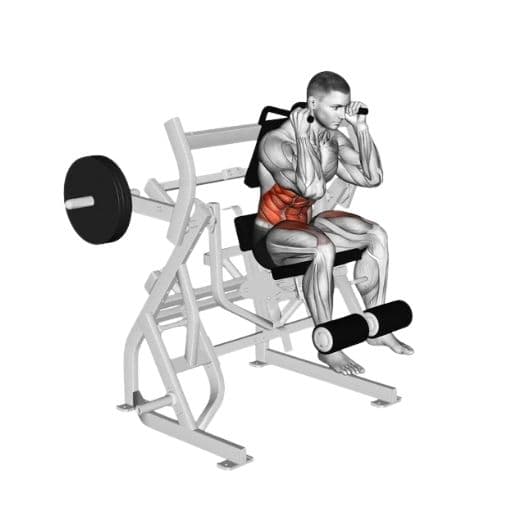
What Is the Machine Seated Crunch?
The machine seated crunch is a single-joint isolation exercise targeting the rectus abdominis and obliques. The lifter sits with their back against a pad, holds the handles or arm pads, and performs controlled spinal flexion (curling the ribcage toward the pelvis) against the machine’s resistance, then returns under control to the starting position.
The machine provides full body support — the seat, back pad, and arm pads stabilize the torso — so the abdominals work in relative isolation compared to free-weight or cable-based core exercises. This makes it an effective hypertrophy tool for the rectus abdominis, especially for lifters who struggle to maintain proper form on cable crunches or weighted floor crunches.
All benchmarks on this page use machine-reported stack weight (the pin-selected number or total plates loaded). Enter the weight shown on the machine — do not try to calculate “effective resistance.”
Machine Weight Does Not Equal Effective Resistance
The weight displayed on an ab crunch machine is not a standardized measurement. Lever arms, cam profiles, pulley ratios, counterbalancing, and bearing friction all modify the actual resistance. The same “100 lb” setting on two different machines can represent very different loads on the abdominals. Always compare your numbers on the same machine.
Real-world example: SportsArt S931
Gravitus warns that on the SportsArt S931, the decal reads 3.3× the real pull — so a 60 kg pin is only 20 kg of actual resistance. Other brands counterbalance the arm so the first rep starts lighter. This is not unusual; it is the norm across manufacturers.
How the standards handle this
The community data behind these standards (StrengthLevel, 21.8K qualifying results) averages across many different machines. The benchmarks represent general ranges for typical commercial selectorized ab machines, not precise loads for any specific model. Use them for directional guidance, not exact comparisons.
Machine Seated Crunch Strength Levels Explained
What each strength level means for the machine seated crunch — from your first session on the machine to elite-level abdominal loading. All values represent machine-reported stack weight relative to bodyweight. Different machines report different “weights” for the same actual resistance.
Beginner
Male 0.22× BW • Female 0.18× BWCan complete a full set on the machine seated crunch with light stack weight and controlled spinal flexion. Strength at this stage comes primarily from learning the machine’s range of motion, finding a comfortable pad height, and building the mind-muscle connection with the rectus abdominis. Most effort goes into avoiding hip flexor dominance rather than moving heavy weight.
Focus: Focus on controlled spinal flexion with 12–15 reps per set. Adjust the seat and pad positions to fit your torso length. Use a 2-second concentric and 3-second eccentric tempo to build the abdominal contraction pattern before adding weight.
0–6 months of consistent machine core training
Novice
Male 0.44× BW • Female 0.35× BWConsistent full-range reps with a moderate stack weight across multiple sets. Can distinguish abdominal contraction from hip flexor engagement, maintains a controlled tempo, and achieves the same depth on every rep. Beginning to notice that switching machines (e.g., different gym, different manufacturer) requires re-calibrating the weight setting.
Focus: Progress in small stack increments (5–10 lb). Work primarily in the 10–15 rep range. Pair with planks or cable crunches for varied core stimulus. Keep a training log that notes which specific machine you used — the same stack weight on different machines does not mean the same resistance.
6–12 months of structured core training
Intermediate
Male 0.88× BW • Female 0.57× BWSolid machine crunch strength with meaningful stack weight and consistent full ROM. Represents roughly 1–2 years of dedicated core training that includes machine-based abdominal work. For men, the machine crunch intermediate (0.88× BW) displays roughly 160% of the cable crunch intermediate (0.55× BW) in reported weight — the higher number reflects machine lever advantage, not greater abdominal force. For women, the machine crunch intermediate (0.57× BW) is roughly 143% of cable crunch (0.40× BW).
Focus: Periodize rep ranges across 8–12 reps. Progress requires tracking on the same machine session to session. If your gym has multiple ab machines, pick one and stay consistent. Consider adding pause reps (1–2 seconds in the contracted position) before increasing stack weight.
1–2+ years of consistent training
Advanced
Male 1.28× BW • Female 0.81× BWUpper-tier machine crunch strength. At this load, maintaining strict spinal flexion without hip flexor takeover requires strong neuromuscular control. The weight stack is approaching levels where most commercial machines begin to feel different at the top versus bottom of the ROM due to cam geometry. Many lifters at this level use the machine crunch as a primary hypertrophy movement for the rectus abdominis.
Focus: Structured mesocycles with planned intensity peaks in the 6–10 rep range. Use consistent machine settings (seat height, pad position) every session. Slow eccentrics (3–4 seconds) become more valuable than adding stack weight at this stage.
3–5+ years of dedicated training
Elite
Male 1.60× BW • Female 1.08× BWExceptional machine crunch strength seen in competitive bodybuilders and strength athletes with years of targeted abdominal training. At this level, the stack weight on many commercial machines approaches or reaches the maximum available. The displayed weight is heavily influenced by the machine’s mechanical advantage — two lifters at this level on different machines may show very different numbers for the same actual abdominal strength.
Focus: Prioritize training quality over absolute stack numbers. Manage volume carefully to avoid lumbar flexion overload. If the machine stack maxes out, add pause reps, slower eccentrics, or partial-rep drop sets rather than switching to a different machine with a higher stack. Elite core strength is best demonstrated through consistent progressive overload on a single machine over months and years.
5+ years of serious strength training
Machine Seated Crunch FAQ
How does the machine seated crunch compare to the cable crunch?
Both target the rectus abdominis through resisted spinal flexion. The cable crunch is performed kneeling with a rope attachment, requiring the lifter to stabilize their body position against the cable’s pull angle. The machine seated crunch provides full body support — the seat, back pad, and arm pads stabilize the torso, so the abdominals work in isolation against the machine’s lever resistance.
For men, the StrengthRegimen machine crunch intermediate (0.88× BW) displays roughly 160% of the cable crunch intermediate (0.55× BW) in reported weight. For women, the machine crunch intermediate (0.57× BW) is roughly 143% of cable crunch (0.40× BW). The higher machine numbers reflect mechanical advantage from the lever system, not greater abdominal force production. Both exercises are effective for abdominal hypertrophy when trained through a full range of motion with controlled tempo.
What weight should I enter — the stack number or something else?
Enter the weight displayed on the machine — the number on the pin-selected weight stack or the total weight of plates loaded onto the machine. Do not try to calculate “effective resistance” or adjust for the machine’s mechanical advantage.
Every machine has a different lever ratio, cam profile, and counterbalance system. The number on the stack is the only practical, repeatable measurement. The standards in this tool are calibrated against community data that uses the same convention — machine-reported stack weight.
Why do my numbers change when I use a different machine?
Machine-reported weight is not standardized. The same “100 lb” setting on two different ab machines can represent very different actual resistances. Gravitus warns that on the SportsArt S931, the decal reads 3.3 times the real pull — so a 60 kg pin is only 20 kg of actual resistance. Other brands counterbalance the arm so the first rep starts lighter.
This is the single biggest limitation of machine-based strength standards. For meaningful progress tracking, always use the same machine in the same gym. If you switch machines, expect your numbers to change — this reflects the machine, not your strength. The standards in this tool represent general ranges for typical commercial selectorized ab machines.
What rep ranges work best for core hypertrophy on the machine crunch?
The rectus abdominis responds well to moderate-to-high rep ranges with controlled tempo. For hypertrophy, 3–4 sets of 10–15 reps with a 2-second concentric and 3-second eccentric is effective. Rest 60–90 seconds between sets. Focus on full spinal flexion (curling the ribcage toward the pelvis) rather than just hinging forward at the hips.
For strength, heavier loads in the 6–10 rep range with longer rest (90–120 seconds) build the ability to produce force in spinal flexion. Core exercises rarely benefit from true 1–3 rep maximal work — the spinal loading risk outweighs the training stimulus at very high intensities.
When should I increase weight on the machine seated crunch?
Progress the stack weight when you can complete all prescribed sets at the top of your rep range with strict form. For example, if your target is 3 × 12 reps and you can complete all 36 reps with full ROM, controlled tempo, and no hip flexor dominance, increase the stack by one pin (typically 5–10 lb).
Before adding weight, try increasing training quality first: add a 1–2 second pause in the contracted position, slow the eccentric to 3–4 seconds, or increase from 3 to 4 sets. These progressions build more abdominal stimulus without requiring heavier loads, and they reduce the risk of compensating with hip flexors at higher weights.
Disclaimer
These are StrengthRegimen training benchmarks for self-assessment, not clinical standards. All values represent machine-reported stack weight (pin selection or plates loaded). Multi-rep sets are converted to an estimated 1RM using the Epley formula; accuracy is highest at 12 reps or fewer and decreases at higher rep counts. Machine-reported weight does not equal effective resistance — track progress on the same machine. Standards are derived from community datasets and adjusted for strict form; individual results vary based on machine manufacturer, model, settings, training history, and body proportions.