Russian Twist Strength Standards
The average Russian Twist is 31 lb for men and 17 lb for women (working weight for 12–15 reps per side). Compare your rotational core strength by bodyweight and age below.
Configure Your Bodyweight & Unit
Male Russian Twist Standards (lb)
Working weight for 12–15 reps/side at 180 lb bodyweight
| Strength Level | Working Weight (180 lb BW) | BW Ratio |
|---|---|---|
| Beginner | 11 lb | 0.06x |
| NoviceYou | 20 lb | 0.11x |
| Intermediate | 31 lb | 0.17x |
| Advanced | 45 lb | 0.25x |
| Elite | 65 lb | 0.36x |
How much weight should I hold for Russian Twists? (lb)
Assess Your Russian Twist
Enter the weight you hold for working sets to see your strength level
Dumbbell, plate, or medicine ball weight
Holding 25 lb for 15 reps per side at 180 lb (Male) gives a BW ratio of 0.14×.
That falls within the Novice range for the seated weighted Russian twist.
Shareable Russian Twist Strength Card
Russian Twist Strength Spectrum
Complete Russian Twist Reference Chart (LB)
Working-weight standards across bodyweights for Male lifters in lb
| BW (lb) | Beginner | Novice | Intermediate | Advanced | Elite |
|---|---|---|---|---|---|
| 120 | 7 | 13 | 20 | 30 | 43 |
| 130 | 8 | 14 | 22 | 33 | 47 |
| 140 | 8 | 15 | 24 | 35 | 50 |
| 150 | 9 | 17 | 26 | 38 | 54 |
| 160 | 10 | 18 | 27 | 40 | 58 |
| 170 | 10 | 19 | 29 | 43 | 61 |
| 180 | 11 | 20 | 31 | 45 | 65 |
| 190 | 11 | 21 | 32 | 48 | 68 |
| 200 | 12 | 22 | 34 | 50 | 72 |
| 210 | 13 | 23 | 36 | 53 | 76 |
| 220 | 13 | 24 | 37 | 55 | 79 |
| 230 | 14 | 25 | 39 | 58 | 83 |
| 240 | 14 | 26 | 41 | 60 | 86 |
| 250 | 15 | 28 | 43 | 63 | 90 |
| 260 | 16 | 29 | 44 | 65 | 94 |
| 270 | 16 | 30 | 46 | 68 | 97 |
| 280 | 17 | 31 | 48 | 70 | 101 |
| 290 | 17 | 32 | 49 | 73 | 104 |
| 300 | 18 | 33 | 51 | 75 | 108 |
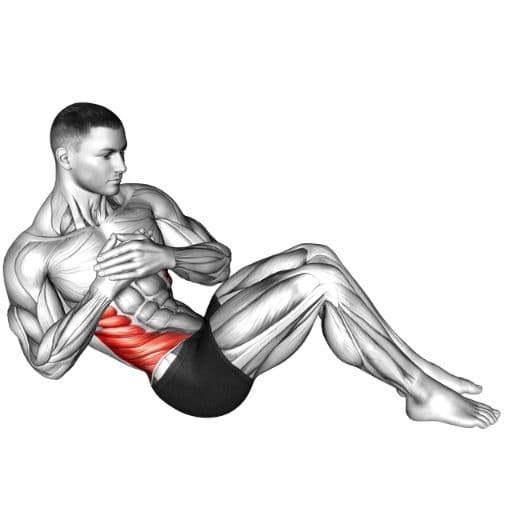
About the Russian Twist
The seated weighted Russian twist is a rotational core exercise. The lifter sits on the floor with knees bent approximately 45°, feet elevated, torso leaned back approximately 45°, holding a single implement (dumbbell, weight plate, or medicine ball) with both hands at chest level. The torso rotates side to side, with the implement touching or passing hip level on each side. This tool covers the feet-elevated weighted variation only.
All benchmarks use working weight (dumbbell, plate, or medicine ball held for 12–15 reps per side with strict form), not estimated 1RM.
How Reps Are Counted on This Page
Each side touch = 1 rep. Left touch = 1 rep, right touch = 1 rep, so one full cycle = 2 reps. “15 reps per side” = 30 total reps.
Choosing & Logging Your Weight
Enter the labeled weight of whichever implement you hold. All three types are treated equivalently for classification.
Dumbbell
Hold a single dumbbell vertically or horizontally with both hands at chest level. Enter the labeled weight of that one dumbbell (e.g., 25 lb). Most common in commercial gyms with wide weight increments.
Weight Plate
Hold a single plate by the edges with both hands at chest level. Enter the labeled plate weight (e.g., 25 lb or 45 lb). Flat grip may be slightly harder to maintain during rotation than a dumbbell.
Medicine Ball
Hold a medicine ball with both hands at chest level. Enter the labeled ball weight (e.g., 14 lb). Medicine balls allow touching the floor on each side, which some protocols require.
| Implement | Common Weights | What to Enter |
|---|---|---|
| Dumbbell | 5, 10, 15, 20, 25, 30, 35, 40+ lb | Labeled weight of the single dumbbell |
| Weight Plate | 10, 25, 35, 45 lb | Labeled weight of the single plate |
| Medicine Ball | 6, 8, 10, 14, 20 lb | Labeled weight of the ball |
Russian Twist Training Principles
Key execution and programming factors for the seated weighted Russian twist.
Progressive Loading
Start with a light implement (5–10 lb) and master the form: feet elevated, full rotation, controlled tempo. Increase weight in 5 lb increments once you can complete 3 sets of 15 reps per side with strict form. Maintain each new weight for 2–3 weeks before progressing.
Rotation Range Matters
A shallow twist (barely turning the shoulders) is dramatically easier than a full rotation to hip level. The standard requires the implement to reach or pass hip level on each side. If you can’t achieve full rotation with your current weight, reduce the load until you can. Partial rotation with heavy weight is less effective and less comparable.
Anti-Extension Demand
With feet elevated and the torso leaned back, the hip flexors and rectus abdominis must maintain the body position against gravity while the obliques rotate the trunk. This anti-extension demand is a core part of the exercise. If your lower back rounds or your feet drop, the weight is too heavy for strict form.
Programming for Core Development
Russian twists work best in the 10–20 rep per side range for hypertrophy and muscular endurance. Pair with anti-rotation exercises (Pallof press) and spinal flexion exercises (cable crunch) for comprehensive core development. Train 2–3 times per week with at least 48 hours between sessions.
Strength Level Benchmarks
Seated weighted Russian twist benchmarks expressed as working weight (for 12–15 reps per side) relative to bodyweight.
Beginner
(0–6 months)Learning the movement pattern with a light implement (5–15 lb plate or medicine ball). Focus on maintaining feet elevated, achieving full rotation range, and establishing a controlled tempo before adding weight. Work in sets of 12–20 reps per side.
Novice
(6–12 months)Consistent execution with moderate loads. Full rotation to hip level on each side, controlled 2–3 second tempo, feet elevated throughout. Progress in 5 lb increments across 12–15 rep per side sets.
Intermediate
(1–2+ years)Solid rotational core strength typical of lifters with 1–2 years of consistent training. The implement weight is substantial enough to challenge the obliques while maintaining strict form. Periodized programming with heavier and lighter sessions across the training week.
Advanced
(3–5+ years)High-level rotational core strength. Holding 40–55 lb (men) or 25–35 lb (women) for full sets with feet elevated and strict form requires substantial oblique strength and anti-extension stability. Most lifters at this level use a dumbbell or 45 lb plate.
Elite
(5+ years)Exceptional rotational core strength achieved through multi-year progressive overload. Holding 60+ lb (men) or 35–40+ lb (women) for 12–15 reps per side with feet elevated and controlled tempo is rare. Progression at this level relies on tempo manipulation, extended range of motion, and planned deloads.
Disclaimer
These are training benchmarks for self-assessment, not clinical standards. All values represent working weight for 12–15 reps per side. Compare your performance over time using the same protocol. Consult a professional before high-intensity core training, especially with spinal concerns.