Farmer's Walk Strength Standards
Compare your farmer's walk carry weight against internally derived strength standards based on bodyweight, training experience, and age. Enter your total carry load and distance to see where you stand.
Configure Your Bodyweight & Unit
Male Farmer's Walk Standards (lb)
StrengthRegimen standards for 180 lb bodyweight • Total carry load for ~50 ft / 15 m reference distance
| Strength Level | Total Carry (180 lb BW) | Bodyweight Ratio |
|---|---|---|
| Beginner | 90 lb | 0.50x |
| Novice | 135 lb | 0.75x |
| IntermediateYou | 180 lb | 1.00x |
| Advanced | 270 lb | 1.50x |
| Elite | 360 lb | 2.00x |
How much should I carry on a Farmer's Walk? (lb)
A male lifter weighing 180 lb who can farmer's walk with a total carry load of 180 lb (both implements combined) for approximately 50 ft / 15 m is considered Intermediate according to StrengthRegimen farmer's walk standards. These are internally derived training benchmarks; no standardized competition norms exist for this exercise.
Assess Your Farmer's Walk
Enter your total carry load (both implements combined) and the distance you walked to see your strength level and personalized training zones
Combined weight of both implements (e.g., two 90 lb dumbbells = 180 lb total)
Standards are based on a ~50 ft / 15 m reference distance. Longer distances require lighter loads.
Carrying 180 lb total (both implements) for 50 ft.
At a bodyweight of 180 lb (Male), you are carrying 1× your bodyweight, which falls within the Intermediate range according to StrengthRegimen farmer's walk standards.
Shareable Farmer's Walk Strength Card
Distance-Load Training Matrix (LB)
Recommended carry loads for different distances based on your 180 lb carry
| Distance | Total Load (lb) | Per Hand (lb) | % of Max | Suggested Sets | Training Zone |
|---|---|---|---|---|---|
| 25 ft / 8 m | 212 lb | 106 lb | 100% | 3–4 × 25 ft | Max Load (Heavy) |
| 50 ft / 15 mYour Distance | 180 lb | 90 lb | 85% | 3–4 × 50 ft | Standard Reference |
| 75 ft / 23 m | 159 lb | 80 lb | 75% | 3 × 75 ft | Strength-Endurance |
| 100 ft / 30 m | 138 lb | 69 lb | 65% | 2–3 × 100 ft | Carry Endurance |
| 150 ft / 45 m | 116 lb | 58 lb | 55% | 2–3 × 150 ft | Long Carry |
| 200 ft / 60 m | 95 lb | 48 lb | 45% | 2 × 200 ft | Grip Endurance |
Note: The percentages above are coaching estimates for load scaling across distances — they are not derived from a published distance-load decay model. Individual carry capacity depends on grip endurance, implement type (dumbbells, trap bar, farmer’s walk handles), and conditioning level. Use these values as starting points and adjust based on your training experience.
Complete Farmer's Walk Reference Chart (LB)
Total carry load standards across bodyweights for Male lifters in lb (reference: ~50 ft / 15 m)
| BW (lb) | Beginner | Novice | Intermediate | Advanced | Elite |
|---|---|---|---|---|---|
| 120 lb | 60 | 90 | 120 | 180 | 240 |
| 130 lb | 65 | 98 | 130 | 195 | 260 |
| 140 lb | 70 | 105 | 140 | 210 | 280 |
| 150 lb | 75 | 113 | 150 | 225 | 300 |
| 160 lb | 80 | 120 | 160 | 240 | 320 |
| 170 lb | 85 | 128 | 170 | 255 | 340 |
| 180 lb◂ You | 90 | 135 | 180 | 270 | 360 |
| 190 lb | 95 | 143 | 190 | 285 | 380 |
| 200 lb | 100 | 150 | 200 | 300 | 400 |
| 210 lb | 105 | 158 | 210 | 315 | 420 |
| 220 lb | 110 | 165 | 220 | 330 | 440 |
| 230 lb | 115 | 173 | 230 | 345 | 460 |
| 240 lb | 120 | 180 | 240 | 360 | 480 |
| 250 lb | 125 | 188 | 250 | 375 | 500 |
| 260 lb | 130 | 195 | 260 | 390 | 520 |
| 270 lb | 135 | 203 | 270 | 405 | 540 |
| 280 lb | 140 | 210 | 280 | 420 | 560 |
| 290 lb | 145 | 218 | 290 | 435 | 580 |
| 300 lb | 150 | 225 | 300 | 450 | 600 |
Implement Note: Farmer's walk performance varies significantly with implement type (dedicated handles, dumbbells, trap bar, kettlebells), surface conditions, and whether turns are involved. These standards assume dedicated farmer's walk handles or heavy dumbbells on a flat surface. Use these numbers as progress markers with the same equipment and setup.
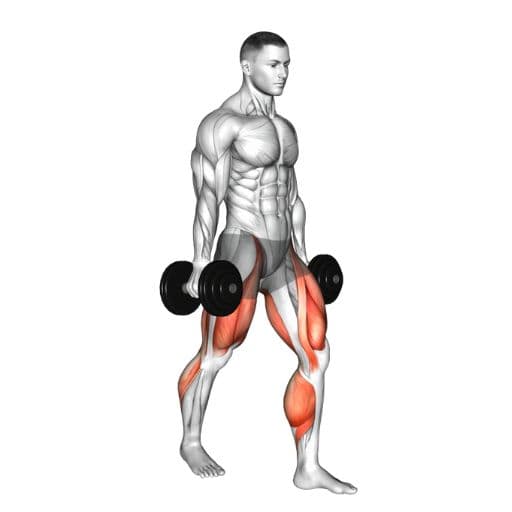
About the Farmer's Walk
The farmer's walk (farmer's carry) is a foundational loaded carry exercise originating from competitive strongman. It involves picking up a heavy implement in each hand and walking a prescribed distance while maintaining an upright, braced posture. It develops grip strength, upper-back stability, core anti-lateral-flexion, and whole-body work capacity. The farmer's walk recruits the forearm flexors and extensors (grip), trapezius (upper back stability), erector spinae (spinal extension under load), obliques and transverse abdominis (anti-lateral-flexion and bracing), gluteus medius (hip stability during single-leg phases of walking), and quadriceps and hamstrings (locomotion under load). Unlike barbell lifts, the farmer's walk has a distance dimension — making it a test of strength-endurance and not just peak force output.
In competitive strongman, the farmer's walk is one of the most common events, typically tested over 50–100 feet with implements weighing 200–400+ lb per hand at the professional level. For general strength training, loaded carries like the farmer's walk are recommended by coaches and physical therapists as one of the most functional and transferable exercises available — building the grip, trunk stability, and work capacity that support every other lift in the gym.
What Do the Farmer's Walk Strength Levels Mean?
Each tier represents a bodyweight-ratio benchmark for the total carry load (both implements combined) over a reference distance of approximately 50 feet (15 meters). These are internally derived training benchmarks — no universally standardized classification exists for the farmer's walk.
Beginner
A beginner farmer's walk means the trainee can pick up and walk with implements totaling roughly half their bodyweight for at least 50 feet without losing grip or posture. This level is typical of someone in their first several months of incorporating loaded carries into their routine.
- Grip fails before legs or lungs do — forearms are the primary limiter
- Posture tends to break: lateral trunk lean, rounded shoulders, or forward head drift
- Walks shorter than 50 feet often require a set-down and re-grip
- Handles or dumbbells may spin or slip if chalk is not used
Internally derived training benchmark — no peer-reviewed population study has established universal farmer's walk norms.
Novice
A novice can carry about three-quarters of bodyweight (male) or half bodyweight (female) for the reference distance. The grip is no longer the weakest link on short carries; instead, upper-back fatigue or general conditioning becomes the primary challenge.
- Can maintain a relatively upright torso for the full 50-foot distance
- Grip endures one or two work sets before fatigue limits additional sets
- Able to use dedicated handles or heavy dumbbells with reasonable control
- May not yet be able to perform longer carries (100+ ft) without multiple stops
Internally derived training benchmark — no peer-reviewed population study has established universal farmer's walk norms.
Intermediate
An intermediate-level farmer's walk means you can carry your own bodyweight (male) or 75% bodyweight (female) in total across both implements for 50 feet. This is a significant milestone — it signals genuine functional strength and grip endurance. Most recreational lifters who train carries consistently will reach this level.
- Total carry load equals or exceeds bodyweight for the reference distance
- Can walk 50 feet with controlled, deliberate steps — no rushing or stumbling
- Upper-back and core endurance are sufficient to maintain bracing throughout the carry
- Able to perform 3–4 working sets without grip failure being the primary limiter
Internally derived training benchmark — no peer-reviewed population study has established universal farmer's walk norms.
Advanced
Carrying 1.5× bodyweight (male) or 1.0× bodyweight (female) for 50 feet places you in the advanced tier. This is a level seen in competitive amateur strongman athletes, experienced powerlifters who train loaded carries, and strength-sport specialists. It requires years of progressive overload on grip, traps, core, and lower body simultaneously.
- Heavy carries at 1.5× BW require specialized implements (not standard gym dumbbells)
- Grip, upper back, core, and lower body all contribute to the limiting factor
- Comfortable with competition-style farmer's walk handles
- Can perform carries for multiple sets at 100+ feet at moderate intensity
Internally derived training benchmark — no peer-reviewed population study has established universal farmer's walk norms.
Elite
Carrying double bodyweight (male) or 1.5× bodyweight (female) for the reference distance is elite-level performance seen in competitive strongman athletes and highly trained strength specialists. This requires outstanding grip strength, upper-back density, exceptional core bracing, and significant lower-body power — all working together under a heavy, moving load.
- Performance consistent with competitive strongman athletes at the regional/national level
- Every aspect of the carry chain — grip, traps, core, hips, ankles — must be highly developed
- Requires dedicated carry-specific programming, not just occasional farmer's walks
- Surface conditions, implement type, and warm-up protocol all significantly affect max attempts
Internally derived training benchmark — no peer-reviewed population study has established universal farmer's walk norms.
Methodology: How Farmer's Walk Standards Are Calculated
StrengthRegimen farmer's walk standards use a bodyweight-ratio framework anchored to a 50 ft / 15 m reference distance. Below we explain every assumption, formula, and limitation.
Bodyweight-Ratio Classification for Loaded Carries
StrengthRegimen farmer's walk standards classify carry performance by the ratio of total carry load (both implements combined) to the lifter's bodyweight. For example, a 180 lb male carrying 270 lb total (135 lb per hand) has a ratio of 1.50× — placing him in the Advanced tier.
This ratio-based approach normalizes performance across bodyweights. It mirrors the convention used in barbell strength standards but is adapted for loaded carries, which have fundamentally different limiting factors. In a deadlift, the bar leaves the floor for one repetition. In a farmer's walk, the load must be carried continuously while walking, so grip endurance, trunk stability, and cardiovascular capacity all contribute.
The multipliers differ between males and females, reflecting documented differences in grip strength, upper body mass distribution, and upper-back endurance. No claim is made that these ratios represent population percentiles; they are internally derived training benchmarks.
Reference Distance Convention: 50 ft / 15 m
Unlike barbell lifts, the farmer's walk has an inherent distance or time dimension. A 300 lb carry for 25 feet is a fundamentally different effort than 300 lb for 100 feet. To create comparable standards, StrengthRegimen anchors all classifications to a reference distance of approximately 50 feet (15 meters) on a flat, even surface without turns.
This distance was chosen because it is:
- Short enough that grip failure — rather than cardiovascular fatigue — is the primary limiter for most trainees
- Long enough to meaningfully test walking mechanics, core stability, and load control under movement
- Commonly used in strongman competition events (events typically range from 50–100 feet)
- Practical in most commercial gym settings (approximately 3–4 gym floor lengths)
The Distance-Load Matrix in the tool extends these standards to shorter and longer distances using distance-load scaling factors. As distance increases, the sustainable carry load decreases — this inverse relationship is well-established in strength-endurance literature.
Five-Tier Classification Framework
StrengthRegimen uses five strength tiers: Beginner, Novice, Intermediate, Advanced, and Elite. Each tier corresponds to a specific bodyweight-ratio threshold:
| Level | Male Ratio | Female Ratio |
|---|---|---|
| Beginner | 0.50× | 0.35× |
| Novice | 0.75× | 0.50× |
| Intermediate | 1.00× | 0.75× |
| Advanced | 1.50× | 1.00× |
| Elite | 2.00× | 1.50× |
The user is classified into the highest tier whose threshold they meet or exceed. For example, a male with a 1.20× ratio exceeds Intermediate (1.00×) but does not reach Advanced (1.50×) — he is classified as Intermediate.
Limitations & Equipment Variability
No standardized competition database: Unlike the squat, bench press, and deadlift — which have decades of powerlifting meet data — the farmer's walk has no centralized performance database. Strongman competitions test carries, but events vary widely in distance, implement weight increments, and rules. StrengthRegimen standards should be treated as internally derived training benchmarks, not normative data.
Implement type significantly affects performance: Dedicated farmer's walk handles with rotating sleeves and knurled grips allow substantially heavier loads than smooth-handled dumbbells or kettlebells. A lifter's "farmer's walk max" with one implement type may differ by 15–25% with another.
Surface and environmental factors: Outdoor carries on grass, gravel, or uneven terrain are harder than indoor carries on flat rubber matting. Turns and obstacles add complexity. Temperature and humidity affect grip (sweaty palms, cold hands).
Grip aids: Chalk, lifting straps, and grip-enhancing gloves can all increase carry load beyond raw grip capacity. These standards assume chalk is permitted but lifting straps are not used (i.e., raw grip with chalk).
⚠ Transparency Note
These farmer's walk standards are internally derived training benchmarks. No peer-reviewed study, standardized competition database, or professional certification body has established universal farmer's walk norms across bodyweights and genders. Use these values as directional progress markers, not diagnostic classifications.
Farmer's Walk Training Progression Roadmap
A structured, phase-based approach to progressing your farmer's walk from beginner to elite. Each phase builds on the previous one — skip ahead only if you genuinely meet the prior tier's carry standards.
Phase 1 — Foundation
Beginner → NoviceAt the beginner stage, grip is the weakest link. The priority is developing raw grip endurance and learning to walk with heavy objects without compensatory movement patterns (trunk lean, forward head, knee valgus).
- Start with dumbbells or kettlebells at 40–50% bodyweight total
- Focus on short carries (25–50 ft) with deliberate, controlled steps
- Supplement with dead hangs (3 × max hold), plate pinches, and towel hangs
- Practice the pick-up: hip hinge to grip the handles, brace the core, stand tall — this is where most beginner injuries happen
- Use chalk freely — learning to grip heavy loads without straps builds foundational grip
- Rest 90–120 seconds between sets; grip recovery is the bottleneck
Phase 2 — Building Capacity
Novice → IntermediateReaching the bodyweight-carry milestone (1.0× BW for males, 0.75× for females) requires systematic progressive overload on both load and distance. At this stage, the upper back, core, and hip stabilizers increasingly contribute alongside grip.
- Alternate heavy days (shorter distance, heavier load: 75–90% of target for 25–50 ft) with endurance days (lighter load: 50–65% for 75–100 ft)
- Progress load by 5–10 lb (2–5 kg) per week on heavy days when all sets are completed cleanly
- Add accessory work: barbell shrugs, face pulls, suitcase carries (single-arm for anti-lateral flexion), and front-loaded carries
- Begin incorporating timed holds (pick up the weight and stand still for 30–60 seconds) to build static grip endurance
- Ensure adequate forearm recovery — farmer's walks 3 days in a row with heavy loads will accumulate tendon stress
Phase 3 — Strength Specialization
Intermediate → AdvancedMoving from 1.0× to 1.5× bodyweight is a significant jump that requires dedicated farmer's walk programming — not just occasional carries at the end of a session. At this level, implements matter: transition to dedicated farmer's walk handles if possible.
- Periodize with 3–4 week mesocycles: accumulation (moderate load, higher volume), intensification (heavier load, lower distance), realization (test max carries)
- Practice speed carries at 60–70% of max for 50 ft — walk as fast as possible while maintaining control. This builds power transfer and coordination
- Include heavy partials: load the handles to 110–120% of your carry max and simply pick them up and hold for 10–15 seconds (static overload for grip and traps)
- Train the turn: if competing, practice 180-degree turns under load — this is where implements can sway and stability is tested
- Address weak links: if grip fails first, add grip-specific work; if upper back rounds, add heavy rows and shrugs; if steps are unstable, add single-leg work
Phase 4 — Elite Performance
Advanced → EliteElite farmer's walk performance (2.0× BW for males, 1.5× for females) represents the top tier. At this level, every aspect of the carry chain must be highly developed and training must be periodized around peak performance windows.
- Training at this level typically occurs within a broader strongman or strength-sport program with dedicated event days
- Peak carry attempts should be attempted only when fully recovered, warmed up, and on a familiar surface with reliable equipment
- Recovery management is critical: heavy carries create significant CNS fatigue, trap/upper-back soreness, and forearm tendon stress. Allow 48–72 hours before heavy pulling or gripping
- Implement specificity matters enormously — train with the same handles, loading increments, and surface you will test on
- Video analysis of carry mechanics (step length, trunk angle, arm position, head position) provides actionable feedback at this level
- Consider working with a coach experienced in strongman or loaded-carry events
Injury Prevention Reminder
The farmer's walk is generally considered lower-injury-risk relative to maximal barbell lifts, but heavy carries still place significant load on the spine, shoulders, and forearm tendons. Most carry-related injuries occur during the pick-up (rounding the back to grab heavy handles) or the set-down (losing control as grip fails). Always use a hip-hinge pick-up, brace your core before lifting, and set the weight down deliberately — never drop from waist height.
Disclaimer
The farmer's walk standards presented on this page are internally derived training benchmarks intended for informational and educational purposes only. They do not constitute medical or professional training advice. No standardized competition database or peer-reviewed population study has established universal farmer's walk norms. Individual carry performance varies widely based on grip strength, implement type (dedicated handles vs. dumbbells vs. trap bar), surface conditions, training history, body composition, and many other factors. Always consult a qualified professional before beginning a new exercise program or attempting maximum-effort carries, and ensure your equipment is in good condition.