Leg Extension Strength Standards
The Intermediate leg extension standard is 207 lb (94 kg) for men and 119 lb (54 kg) for women (estimated 1RM at 180 / 140 lb bodyweight, strict form with full ROM). Machine design affects comparability — track your progress on the same machine. Compare your lift by bodyweight and age below.
Configure Your Bodyweight & Unit
Male Leg Extension Standards (lb)
StrengthRegimen standards for 180 lb bodyweight — machine-reported weight
| Strength Level | Machine Weight (180 lb BW) | BW Ratio |
|---|---|---|
| Beginner | 81 lb | 0.45x |
| NoviceYou | 135 lb | 0.75x |
| Intermediate | 207 lb | 1.15x |
| Advanced | 288 lb | 1.60x |
| Elite | 387 lb | 2.15x |
How much should I be able to Leg Extension? (lb)
Assess Your Leg Extension
Enter the machine weight and reps completed to estimate your 1RM and strength level
Pin-selected stack weight or plate load
Leg extending 150 lb × 8 reps equals an estimated 1RM of 190 lb (machine weight).
At 180 lb (Male), that is 1.06× your bodyweight, which falls within the Novice range. Note: The Epley formula has documented higher error for leg extension (~11.7% NMAE) than for compound lifts. The Lombardi equation (NMAE ~5.8%) may be more accurate for this exercise. This 1RM estimate is approximate.
Shareable Leg Extension Strength Card
Leg Extension Strength Spectrum
Rep-Max & Training Zone Table (LB)
Machine-weight loads based on your 190 lb estimated 1RM
| Target | % of 1RM | Machine Wt | Programming |
|---|---|---|---|
| 1RM (Max) (1 rep) | 100% | 190 lb | 1 × 1 rep (Max Test) |
| 3RM (3 reps) | 90.9% | 173 lb | 3–4 × 3 reps |
| 5RM (5 reps) | 85.7% | 163 lb | 3–4 × 5 reps |
| 8RM (8 reps) | 78.9% | 150 lb | 3–4 × 8 reps |
| 10RM (10 reps) | 75% | 143 lb | 3–4 × 10 reps |
| 12RM (12 reps) | 71.4% | 136 lb | 3–4 × 12 reps |
| 15RM (15 reps) | 66.7% | 127 lb | 3 × 15 reps |
| 20RM (20 reps) | 60% | 114 lb | 2–3 × 20 reps |
Complete Leg Extension Reference Chart (LB)
Machine-weight standards across bodyweights for Male lifters in lb
| BW (lb) | Beginner | Novice | Intermediate | Advanced | Elite |
|---|---|---|---|---|---|
| 120 | 54 | 90 | 138 | 192 | 258 |
| 130 | 59 | 98 | 150 | 208 | 280 |
| 140 | 63 | 105 | 161 | 224 | 301 |
| 150 | 68 | 113 | 173 | 240 | 323 |
| 160 | 72 | 120 | 184 | 256 | 344 |
| 170 | 77 | 128 | 195 | 272 | 366 |
| 180 | 81 | 135 | 207 | 288 | 387 |
| 190 | 86 | 143 | 218 | 304 | 409 |
| 200 | 90 | 150 | 230 | 320 | 430 |
| 210 | 95 | 158 | 241 | 336 | 452 |
| 220 | 99 | 165 | 253 | 352 | 473 |
| 230 | 104 | 173 | 265 | 368 | 495 |
| 240 | 108 | 180 | 276 | 384 | 516 |
| 250 | 113 | 188 | 288 | 400 | 538 |
| 260 | 117 | 195 | 299 | 416 | 559 |
| 270 | 122 | 203 | 311 | 432 | 581 |
| 280 | 126 | 210 | 322 | 448 | 602 |
| 290 | 131 | 218 | 334 | 464 | 624 |
| 300 | 135 | 225 | 345 | 480 | 645 |
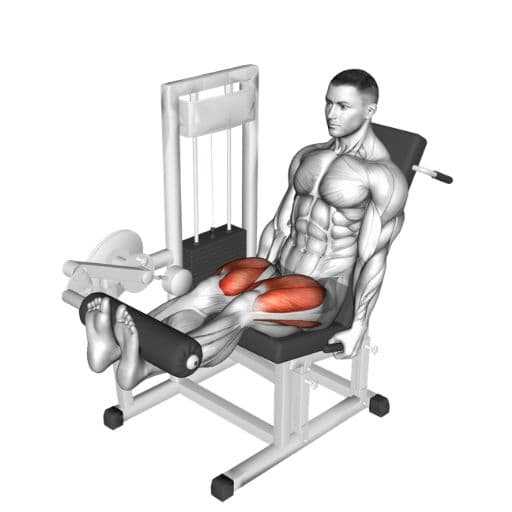
About the Leg Extension
The seated bilateral machine leg extension is a single-joint, open-chain isolation exercise targeting the quadriceps. The lifter sits on a dedicated leg extension machine with back flat against the pad, thighs supported, and shin pad positioned across the lower shins. Both knees extend from approximately 90° flexion to full extension against the machine’s resistance. Selectorized (weight-stack) and plate-loaded leg extension machines are both covered by these standards. The leg extension is one of the most widely used isolation exercises for developing the quadriceps, the four-headed muscle group on the front of the thigh responsible for knee extension.
All benchmarks on this page use machine-reported weight — the pin-selected stack weight for selectorized machines, or the total plate load for plate-loaded machines. This does not represent effective resistance at the shin pad or quadriceps force production.
Bilateral Only — Single-Leg Is a Different Exercise
These standards apply to the seated bilateral machine leg extension (both legs extending simultaneously). The single-leg (unilateral) leg extension doubles the per-leg load demand, introduces asymmetry considerations, and has different performance standards. Do not compare bilateral and unilateral leg extension numbers — they measure different exercises.
Understanding Leg Extension Machine Numbers
Leg extension machines vary significantly across brands. Here is how to log your weight consistently.
Enter the Displayed Weight
Enter the pin-selected stack weight or the total plates loaded onto the machine. Do not estimate effective resistance at the shin pad.
Cam & Lever Differences
Cam profiles, lever-arm length, pivot location, and shin-pad distance from the knee axis all modify the actual torque demand. 150 lb on one machine may feel very different from 150 lb on another.
Track on the Same Machine
Always test and track progress on the same machine with the same seat and shin-pad settings so your numbers reflect actual strength changes rather than equipment differences.
| Machine Type | Load Mechanism | Weight to Enter |
|---|---|---|
| Selectorized (Weight Stack) | Pin-selected stack with cable/cam | Displayed stack weight |
| Plate-Loaded (Lever Arm) | Olympic plates on loading peg(s) | Total plates loaded |
| Dual-Function (Leg Ext / Curl) | Shared stack, direction switch | Displayed stack weight |
Execution Standards
Standardized form for both selectorized and plate-loaded seated leg extension machines.
Setup
Sit with your back flat against the pad and thighs fully supported on the seat. Adjust the shin pad so it rests across the lower shins (just above the ankles). Align the machine’s pivot axis with the lateral femoral epicondyle (side of the knee). Grip the side handles lightly for stability.
Extend (Concentric)
Drive the shin pad upward by extending both knees simultaneously to full lockout (complete knee extension). Contract the quadriceps hard at the top and hold for 1 second. Do not use momentum or lift your hips off the seat.
Lower (Eccentric)
Lower the weight over 2–3 seconds back to approximately 90° of knee flexion. Maintain tension on the quadriceps throughout the lowering phase. Do not let the weight stack slam or rest between reps.
Valid Rep
- •Full range of motion — from approximately 90° knee flexion to complete extension
- •Controlled lowering with a 1-second hold at full extension
- •Back flat against pad and hips seated throughout
- •Both legs extending simultaneously with even effort
Invalid Rep
- •Using momentum or jerking the weight off the bottom
- •Lifting hips off the seat to recruit hip flexors
- •Partial reps that don’t reach full knee extension
- •Letting the weight stack slam or rest between reps
Leg Extension Training Principles
Key execution and programming factors for the seated bilateral machine leg extension.
Hypertrophy-Focused Rep Ranges
The quadriceps respond well to moderate-to-high rep ranges. Leg extensions are most commonly programmed in the 8–15 rep range for hypertrophy, with occasional heavier sets (5–8 reps) for strength. Include both lengthened-partial and full-ROM sets across the training week for comprehensive quadriceps development.
Knee Axis Alignment
Align the machine’s pivot with the lateral femoral epicondyle (the bony prominence on the outside of the knee). Misalignment changes the effective moment arm, alters resistance feel, and may increase shear stress at the knee joint. Re-check alignment whenever you switch machines.
Controlled Eccentric Phase
Lower the weight over 2–3 seconds on every rep. The eccentric (lowering) phase generates high mechanical tension in the quadriceps and is a primary driver of hypertrophy. Avoid dropping the weight quickly or letting gravity do the work.
Patellar Tendon Considerations
Heavy leg extensions place significant load on the patellar tendon. Progress in controlled 5–10 lb increments, maintain each new load for 2–3 weeks before increasing, and reduce volume if you experience anterior knee discomfort. Tendon tissue adapts more slowly than muscle.
Strength Level Benchmarks
Seated bilateral machine leg extension benchmarks expressed as machine weight relative to bodyweight.
Beginner
(0–6 months)Learning the movement pattern with light machine loads. Focus on achieving full knee extension at the top and controlled lowering to 90° before adding weight. Work in sets of 12–15 reps to build the mind-muscle connection with the quadriceps.
Novice
(6–12 months)Consistent full-ROM execution with moderate loads. Progress in 5–10 lb increments across 10–12 rep sets while maintaining a 2–3 second lowering phase. Most lifters can progress linearly at this stage with 2–3 sessions per week.
Intermediate
(1–2+ years)Solid quadriceps isolation strength typical of lifters with 1–2 years of structured training. Alternate between heavier sets (6–10 reps) for strength and moderate sets (10–15 reps) for hypertrophy. Periodized programming becomes important for continued progress.
Advanced
(3–5+ years)High-level quadriceps strength that approaches or reaches the maximum weight stack on many commercial selectorized machines (typically 200–250 lb). May require plate-loaded machines or add-on weight plates. Allow adequate recovery between heavy sessions to support patellar tendon health.
Elite
(5+ years)Exceptional quadriceps isolation strength achieved through multi-year progressive overload. Most standard selectorized leg extension machines (200–300 lb stacks) will be maxed out, requiring plate-loaded machines for continued progression. Progression at this level relies on micro-loading, tempo manipulation, and planned deloads.
How These Standards Are Calculated
Data calibration, bodyweight ratios, 1RM estimation, and key research informing the calculator.
1. Benchmark Calibration
Derived from 1,152,891 community leg extension submissions (StrengthLevel, 372,660 qualifying) cross-referenced with FitnessVolt and AthletePath standards. Adjusted 5–10% conservatively to reflect strict full-ROM reps with controlled tempo, no momentum, and no hip lift.
2. Bodyweight Ratio
Standards are expressed as machine weight ÷ bodyweight. Unlike standing exercises, the leg extension is seated — your bodyweight does not contribute to the resistance. The BW ratio normalizes load across body sizes for comparison purposes.
3. 1RM Estimation
Submaximal sets use the Epley equation: 1RM = Weight × (1 + Reps / 30). Test with sets of 5–10 reps for the best accuracy. See the Lombardi note below for leg extension-specific research.
4. Machine Variability
Leg extension machines use rotational mechanics through a single axis (the knee). Cam profiles, lever-arm geometry, shin-pad distance from the pivot, bearing friction, and counterbalance systems all modify the actual resistance. The same displayed weight produces different torque demands across manufacturers. These standards track machine-reported weight only.
5. Lombardi Research Note
Research from Aalborg University (2024) found that the Lombardi equation (1RM = RTF0.1 × weight) had the lowest NMAE (5.8%) across ten lower-extremity exercises, while Epley showed ~11.7% NMAE. Cross-validation (Housh lab, BISP-SURF 2025) recommended a modified formula: LE 1RM = (RTF0.1 × weight) + 1.06 for pre-training estimation. Epley is used here for cross-tool consistency, but users should expect greater estimation error for leg extension than for compound lifts.
Transparency & Limitations
- •These are training benchmarks, not scientifically established population norms.
- •Source data is community self-reported and includes estimated 1RMs (likely overestimates due to partial ROM and momentum).
- •Machine variability makes cross-machine comparisons inherently imprecise. Always track on the same machine.
- •The Epley formula has documented higher error for single-joint lower-extremity exercises (~11.7% NMAE vs ~4% for bench press).
- •Age multipliers are generalized and not derived from leg extension-specific longitudinal research.
Disclaimer
The leg extension strength standards on this page are practical training benchmarks intended for self-assessment and educational use. All values represent machine-reported weight (stack weight or plate load), not effective resistance or quadriceps force. Machine design significantly affects the actual resistance for a given displayed weight — compare your performance on the same machine for meaningful progress tracking. The Epley formula has documented higher error for single-joint lower-extremity exercises than for compound lifts — treat estimated 1RM values as approximate guides. This tool is informational only and does not constitute medical advice. Consult a healthcare professional before initiating high-intensity resistance training, especially if you have knee joint concerns.