Hack Squat Strength Standards
Plate-load benchmarks for the sled hack squat machine, based on bodyweight ratios for men and women. These are StrengthRegimen-derived training benchmarks — not universal standards. Machine design affects comparability.
Configure Your Bodyweight & Unit
Male Hack Squat Standards (lb)
StrengthRegimen standards for 180 lb bodyweight
| Strength Level | Plate Load (180 lb BW) | Bodyweight Ratio |
|---|---|---|
| Beginner | 135 lb | 0.75x |
| Novice | 225 lb | 1.25x |
| IntermediateYou | 360 lb | 2.00x |
| Advanced | 495 lb | 2.75x |
| Elite | 675 lb | 3.75x |
How much should I be able to Hack Squat? (lb)
Assess Your Hack Squat
Enter the plate load you pressed and how many reps you completed to see your estimated 1RM and strength level
Total weight of plates loaded on the sled (not including sled weight)
Pressing 360 lb × 5 reps equals an estimated One-Rep Max (1RM) of 420 lb.
At a bodyweight of 180 lb (Male), you are pressing 2.33× your bodyweight, which falls within the Intermediate range according to StrengthRegimen standards. Note: Hack Squat 1RM estimates may overestimate actual maximal strength by approximately 6–15% on machine exercises.
Shareable Hack Squat Strength Card
Hack Squat Strength Spectrum
Personalized Rep-Max & Training Zone Table (LB)
Working weights based on your 420 lb Estimated 1RM
| Target | % of 1RM | Plate Load | Programming |
|---|---|---|---|
| 1RM (Max) (1 rep) | 100% | 420 lb | 1 × 1 rep (Max Test) |
| 2RM (2 reps) | 93.8% | 394 lb | 3–4 × 2 reps |
| 3RM (3 reps) | 90.9% | 382 lb | 4–5 × 3 reps |
| 5RM (5 reps) | 85.7% | 360 lb | 4–5 × 5 reps |
| 8RM (8 reps) | 78.9% | 332 lb | 3–4 × 8 reps |
| 10RM (10 reps) | 75% | 315 lb | 3–4 × 10 reps |
| 12RM (12 reps) | 71.4% | 300 lb | 3 × 12 reps |
| 15RM (15 reps) | 66.7% | 280 lb | 2–3 × 15 reps |
Complete Hack Squat Reference Chart (LB)
Plate load standards across bodyweights for Male lifters in lb
| BW (lb) | Beginner | Novice | Intermediate | Advanced | Elite |
|---|---|---|---|---|---|
| 120 | 90 | 150 | 240 | 330 | 450 |
| 130 | 98 | 163 | 260 | 358 | 488 |
| 140 | 105 | 175 | 280 | 385 | 525 |
| 150 | 113 | 188 | 300 | 413 | 563 |
| 160 | 120 | 200 | 320 | 440 | 600 |
| 170 | 128 | 213 | 340 | 468 | 638 |
| 180 | 135 | 225 | 360 | 495 | 675 |
| 190 | 143 | 238 | 380 | 523 | 713 |
| 200 | 150 | 250 | 400 | 550 | 750 |
| 210 | 158 | 263 | 420 | 578 | 788 |
| 220 | 165 | 275 | 440 | 605 | 825 |
| 230 | 173 | 288 | 460 | 633 | 863 |
| 240 | 180 | 300 | 480 | 660 | 900 |
| 250 | 188 | 313 | 500 | 688 | 938 |
| 260 | 195 | 325 | 520 | 715 | 975 |
| 270 | 203 | 338 | 540 | 743 | 1013 |
| 280 | 210 | 350 | 560 | 770 | 1050 |
| 290 | 218 | 363 | 580 | 798 | 1088 |
| 300 | 225 | 375 | 600 | 825 | 1125 |
About the Hack Squat
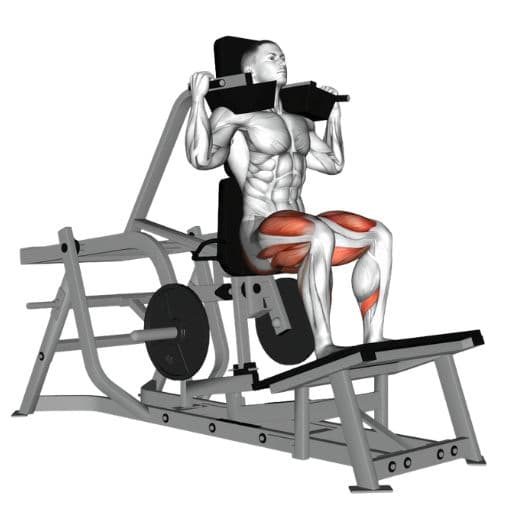
The plate-loaded sled hack squat is a machine-based compound lower-body exercise. The lifter stands on a fixed footplate with shoulders under padded yokes and presses a weighted sled along an angled track (typically 45°). It trains the quadriceps, glutes, and hamstrings with trunk support, eliminating the spinal loading and balance demands of a free barbell squat. On a standard 45-degree machine, only about 70.7% of the total sled mass acts as effective resistance (sin 45° ≈ 0.707).
Because the trunk is supported by the backpad and the sled travels along a fixed path, lifters handle higher absolute plate loads than in a free barbell squat. Clark, Lambert & Hunter (2019) found hack squat 1RM was approximately 18% greater than back squat 1RM in 10 trained males.
Hack Squat vs. Barbell Squat
Do not convert your Hack Squat numbers to a Squat equivalent or vice versa. The two exercises have different stabilization demands, spinal loading, trunk muscle activation, range of motion, and resistance mechanics (angled sled vs. vertical barbell). A 400 lb Hack Squat plate load does not mean you can squat 400 lb — the relationship is individual and inconsistent. Use each exercise’s standards independently.
Understanding Hack Squat Machine Numbers
Unlike an Olympic barbell with a universal 45 lb / 20 kg weight, commercial hack squat machines vary significantly. Here is how to interpret your numbers accurately.
What “Plate Load” Means
All benchmarks on this page count the total plate weight loaded onto the sled pegs (both sides combined). They do not include the empty sled itself, which typically weighs 40–120 lb / 18–55 kg depending on manufacturer and model.
Sled Angle & Effective Resistance
On a standard 45-degree machine, effective resistance ≈ total sled mass × sin(45°) ≈ 70.7% of the moving mass. A 30-degree machine delivers only 50%. Two machines with identical plate loads produce different actual resistance.
Track on the Same Machine
Sled angle, rail friction, bearing quality, and starting resistance all differ between brands (Hammer Strength, Cybex, Arsenal, Body-Solid). For consistent progression, test your strength on the same unit with identical foot placement each time.
Effective Resistance by Sled Angle (for reference only)
| Sled Angle | sin(θ) | % of Moving Mass | Example: 400 lb total sled mass |
|---|---|---|---|
| 30° | 0.500 | 50.0% | 200 lb effective |
| 45° (standard) | 0.707 | 70.7% | 283 lb effective |
| 60° | 0.866 | 86.6% | 346 lb effective |
Hack Squat Testing Standards
To ensure your numbers are directly comparable to these benchmarks, execute reps according to this standard.
Setup & Stance
Position feet shoulder-width in the center of the footplate with toes angled slightly outward (15–25°). Shoulders firmly under the padded yokes, back flat against the backpad, hands gripping the side handles.
Controlled Depth
Lower the sled under control until your knees reach at least 90 degrees of flexion. Keep heels in full contact with the footplate. Your back and hips must remain in contact with the backpad at all times — no lifting off the pad at the bottom.
Smooth Drive
Press through your midfoot and heels to full knee extension. Stop just short of hyperextending or violently snapping your knees into lockout. Controlled, deliberate cadence — no bouncing out of the bottom position.
Valid Counted Rep
- • Knees achieve ≥90° flexion at deepest point
- • Back and hips remain in contact with the backpad throughout
- • Full knee extension at the top (short of hyperextension)
- • Hands on handles, not assisting by pushing on knees
Invalid / Disallowed
- • Quarter-reps or stopping well short of 90°
- • Back or hips lifting off the backpad
- • Bouncing the sled off mechanical safety catches
- • Using hands to push off knees or thighs
Strength Level Benchmarks
Plate-load benchmarks for sled hack squat relative to bodyweight.
Beginner
Male 0.75× BW • Female 0.50× BWAble to operate the sled with controlled depth, smooth knee tracking, and consistent backpad contact. Strength adaptations at this stage come primarily from motor learning and establishing a comfortable foot placement on the platform.
Focus: Focus on controlled 2-second eccentrics, reaching a true 90° knee angle, and adding weight in steady 8–12 rep working sets. Prioritize full heel contact and consistent depth over load.
0–6 months of consistent lifting
Novice
Male 1.25× BW • Female 0.75× BWSolid lower-body pressing base on the machine. You can comfortably handle 1–1.5× bodyweight for working sets with strict backpad contact and consistent depth.
Focus: Use linear progression, adding 5–10 lb per week. Introduce moderate foot placement variations (higher or wider on the platform) across 6–10 rep sets.
6–12 months of structured training
Intermediate
Male 2.00× BW • Female 1.50× BWHandles working sets at or above bodyweight plate load with consistent depth and backpad contact. Represents a solid training base on the machine.
Focus: Periodize between heavier 4–6 rep blocks and high-volume 10–15 rep hypertrophy blocks. Manage knee recovery between heavy hack squat sessions and free squat days.
1–2+ years of consistent training
Advanced
Male 2.75× BW • Female 2.25× BWUpper-tier machine leg strength. Moving over 2.5× bodyweight on the sled requires sustained, structured training and good joint tolerance for heavy machine loading.
Focus: Progress is planned in 4–8 week mesocycles. Balance hack squat volume with free squats and deadlifts. Prioritize patellar tendon health and progressive overload within structured blocks.
3–5+ years of dedicated leg training
Elite
Male 3.75× BW • Female 3.00× BWPeak machine squat strength, typically seen in competitive strength athletes and dedicated bodybuilders with years of heavy lower-body training.
Focus: Prioritize joint longevity, technical consistency, and strategic deloads. Very small, calculated increases over multi-month training blocks. Knee and hip mobility maintenance is essential.
5+ years of serious strength training
How These Standards Are Derived
Sources, calculation methods, and limitations for every number on this page.
1. Data Sources & Classification
These are StrengthRegimen-derived training benchmarks, not peer-reviewed population norms. They are informed by:
- Community self-reported data from strength tracking platforms — notably StrengthLevel.com, which aggregates 564,000+ user-submitted sled hack squat results (2019–2026). These are self-reported numbers, not laboratory-measured data.
- General coaching conventions for machine-based lower-body exercises, adjusted conservatively.
- Mechanical understanding that hack squat bodyweight ratios sit between free-weight squat ratios (lower, due to stabilization demands) and leg press ratios (higher, due to reclined position). The hack squat provides trunk support but requires the lifter to stand and bear partial load through the legs.
The five-tier classification system (Beginner through Elite) mirrors the framework used across StrengthRegimen tools and is informed by the strength classification models discussed in coaching literature (Kilgore & Rippetoe’s Practical Programmingand ExRx.net conventions), adapted for machine-based lower-body exercise.
2. Bodyweight Ratio Methodology
Standards are expressed as plate load ÷ bodyweight. This normalizes performance across body sizes, allowing a 150 lb lifter and a 220 lb lifter to be compared on a relative basis.
Limitation: We use a single set of bodyweight ratios across all bodyweight classes. In practice, lighter lifters tend to achieve higher ratios while heavier lifters press greater absolute loads. Bodyweight-class-specific standards may improve granularity in the future.
Important: A bodyweight ratio on the Hack Squat is NOT equivalent to the same ratio on a barbell squat or a leg press. A 2.00× BW Hack Squat plate load, a 2.00× BW Barbell Squat, and a 2.00× BW Leg Press plate load represent very different levels of mechanical work — the three should never be directly compared.
3. 1RM Estimation — Epley Formula & Machine Limitations
When you enter a multi-rep set, the tool estimates your 1RM using the Epley formula:
Machine-exercise caveat: Research on the leg press (Nascimento et al., 2013) indicates that common 1RM prediction equations (including Epley, Brzycki, and Lander) overestimate machine-based exercise 1RM by approximately 6–15% in trained adults. The overestimation tends to increase with higher rep counts.
No hack squat-specific validation: No published study was found that specifically validates 1RM prediction equations for the sled hack squat. The Epley formula is applied by analogy to other machine-based lower-body exercises. Treat the estimated 1RM as a training guide, not a tested maximum.
Recommendation: For the most accurate assessment, use sets of 10 reps or fewer. The tool displays a warning when reps exceed 10 because the overestimation effect is more pronounced for machine-based exercises at higher rep counts.
4. Age Scaling
The “By Age” table applies gradual scaling factors based on the general pattern of neuromuscular force output across the lifespan: peak strength between ages 20–30, with gradual decline thereafter. For example: 0.92× at age 40, 0.84× at age 50, 0.74× at age 60.
Limitation: These age multipliers are generalized — they are NOT derived from hack squat-specific longitudinal data. The age-related strength decline pattern is well-documented across resistance exercises, but the specific rate of decline may differ between machine and free-weight exercises, and between upper and lower body. Treat age-adjusted values as approximate guides.
Transparency: The multipliers, calculation methods, data sources, and limitations described above are the complete methodology. No proprietary algorithms, hidden adjustments, or unpublished datasets are used. Where evidence is limited (particularly for machine-specific performance norms), we state so explicitly rather than presenting uncertain values as established facts.
Foot Placement & Programming
How foot position and set/rep structure affect muscle emphasis on the hack squat.
Footplate Placement
Center / Shoulder-Width (Default)
Balanced quadriceps, glute, and adductor recruitment. Ideal for standardized testing and primary loading. Use this position for all standards comparisons.
High Placement
Feet placed higher on the platform increase hip flexion while reducing knee travel, shifting greater tension onto the glutes and upper hamstrings. Reduces patellofemoral stress.
Low Placement
Feet placed lower on the platform increase knee flexion angle, concentrating high mechanical tension directly on the quadriceps. Requires good ankle dorsiflexion and may increase patellofemoral joint loading.
Wide Stance
Toes flared outward (~30°). Recruits the adductors (inner thighs) and medial quad (vastus medialis) more prominently. Useful for targeting inner thigh development.
Programming Recommendations
Hypertrophy Range (8–15 Reps)
The hack squat allows sets close to failure without balance or spinal fatigue becoming the limiting factor. 3–4 sets of 8–15 reps with controlled eccentrics.
Heavy Strength Sets (4–6 Reps)
Useful for building high absolute leg drive. Always set mechanical safety stops just below full depth. 4–5 sets of 4–6 reps with 2–3 minutes rest between sets.
Rest & Joint Health
Allow at least 48–72 hours between intense hack squat sessions. Complement with unilateral movements (split squats, lunges) and knee flexion exercises (leg curls) for balanced knee joint health.
Knee health note: The hack squat places significant loading on the patellofemoral joint, especially with low foot placements and deep knee flexion. If you experience knee discomfort, try raising your foot position on the platform, reducing depth slightly, or substituting with a leg press variation temporarily. Chronic knee pain warrants professional evaluation.
Disclaimer
The Hack Squat strength standards on this page are practical training benchmarks intended for self-assessment and educational use. Because commercial hack squat machines vary in sled angle, sled weight, rail friction, and track geometry, always use the same equipment for tracking long-term progress. Consult a healthcare professional before initiating high-intensity resistance training, and always engage mechanical safety stops prior to heavy sets.