Machine Calf Raise Strength Standards
The Intermediate machine calf raise standard is 288 lb (131 kg) for men and 161 lb (73 kg) for women (estimated 1RM at 180 / 140 lb bodyweight, strict form with full ROM). Machine design affects comparability — track your progress on the same machine. Compare your lift by bodyweight and age below.
Configure Your Bodyweight & Unit
Male Machine Calf Raise Standards (lb)
StrengthRegimen standards for 180 lb bodyweight — machine-reported weight
| Strength Level | Machine Weight (180 lb BW) | BW Ratio |
|---|---|---|
| Beginner | 81 lb | 0.45x |
| NoviceYou | 162 lb | 0.90x |
| Intermediate | 288 lb | 1.60x |
| Advanced | 450 lb | 2.50x |
| Elite | 630 lb | 3.50x |
How much should I be able to Machine Calf Raise? (lb)
Assess Your Machine Calf Raise
Enter the machine weight and reps completed to estimate your 1RM and strength level
Plate load (both sides) or pin-selected stack weight
Calf raising 200 lb × 8 reps equals an estimated 1RM of 253 lb (machine weight).
At 180 lb (Male), that is 1.41× your bodyweight, which falls within the Novice range. Note: The Epley formula has not been validated for calf raises specifically. Standing calf raise 1RM testing (barbell-based) has shown excellent reliability (ICC ≥ 0.98), but the rep-to-1RM estimate is approximate.
Shareable Machine Calf Raise Strength Card
Machine Calf Raise Strength Spectrum
Rep-Max & Training Zone Table (LB)
Machine-weight loads based on your 253 lb estimated 1RM
| Target | % of 1RM | Machine Wt | Programming |
|---|---|---|---|
| 1RM (Max) (1 rep) | 100% | 253 lb | 1 × 1 rep (Max Test) |
| 3RM (3 reps) | 90.9% | 230 lb | 3–4 × 3 reps |
| 5RM (5 reps) | 85.7% | 217 lb | 3–4 × 5 reps |
| 8RM (8 reps) | 78.9% | 200 lb | 3–4 × 8 reps |
| 10RM (10 reps) | 75% | 190 lb | 3–4 × 10 reps |
| 12RM (12 reps) | 71.4% | 181 lb | 3–4 × 12 reps |
| 15RM (15 reps) | 66.7% | 169 lb | 3 × 15 reps |
| 20RM (20 reps) | 60% | 152 lb | 2–3 × 20 reps |
Complete Machine Calf Raise Reference Chart (LB)
Machine-weight standards across bodyweights for Male lifters in lb
| BW (lb) | Beginner | Novice | Intermediate | Advanced | Elite |
|---|---|---|---|---|---|
| 120 | 54 | 108 | 192 | 300 | 420 |
| 130 | 59 | 117 | 208 | 325 | 455 |
| 140 | 63 | 126 | 224 | 350 | 490 |
| 150 | 68 | 135 | 240 | 375 | 525 |
| 160 | 72 | 144 | 256 | 400 | 560 |
| 170 | 77 | 153 | 272 | 425 | 595 |
| 180 | 81 | 162 | 288 | 450 | 630 |
| 190 | 86 | 171 | 304 | 475 | 665 |
| 200 | 90 | 180 | 320 | 500 | 700 |
| 210 | 95 | 189 | 336 | 525 | 735 |
| 220 | 99 | 198 | 352 | 550 | 770 |
| 230 | 104 | 207 | 368 | 575 | 805 |
| 240 | 108 | 216 | 384 | 600 | 840 |
| 250 | 113 | 225 | 400 | 625 | 875 |
| 260 | 117 | 234 | 416 | 650 | 910 |
| 270 | 122 | 243 | 432 | 675 | 945 |
| 280 | 126 | 252 | 448 | 700 | 980 |
| 290 | 131 | 261 | 464 | 725 | 1015 |
| 300 | 135 | 270 | 480 | 750 | 1050 |
About the Machine Calf Raise
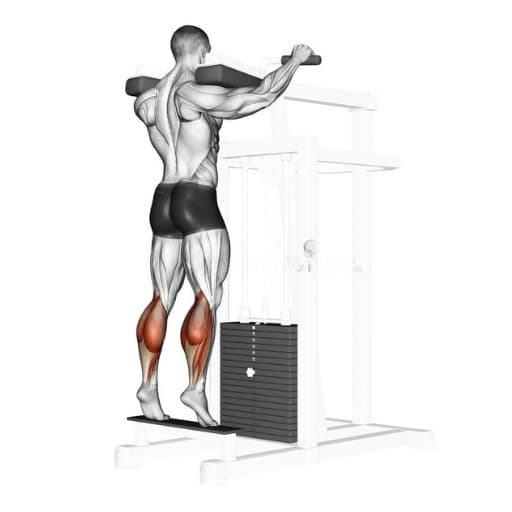
The standing machine calf raise trains ankle plantarflexion under a fixed vertical path with straight knees, placing primary mechanical load on the two-joint gastrocnemius alongside the soleus.
All benchmarks on this page use machine-reported weight (total plates loaded or pin-selected stack weight), excluding the machine’s empty carriage weight.
Standing vs. Seated Machine Calf Raise
These standards apply only to the standing machine calf raise (straight knees, gastrocnemius-dominant). The seated calf raise uses a ~90° knee bend, isolates the soleus, and uses lighter loads. Track the two exercises separately.
Understanding Machine Calf Raise Numbers
Standing calf raise machines vary across brands. Here is how to log your weight consistently.
Count Only Added Weight
Enter the total plates loaded (both sides combined) or the pin-selected stack weight. Exclude the empty carriage or lever-arm weight.
Leverage & Pulley Differences
Lever-arm ratios, cam profiles, and pulley systems modify actual resistance. 200 lb on a lever machine feels different from 200 lb on a cable stack.
Track on the Same Machine
Test and track progress on the same machine with identical foot placement so your numbers reflect actual strength gains rather than equipment differences.
| Machine Type | Load Mechanism | Weight to Enter |
|---|---|---|
| Plate-Loaded (Shoulder Pad) | Olympic plates on pegs | Total plates (both sides combined) |
| Selectorized (Weight Stack) | Pin-selected stack | Displayed stack weight |
| Plate-Loaded (Hip / Belt) | Plates loaded at hip level | Total plates (both sides combined) |
Execution Standards
Standardized form for both plate-loaded and selectorized standing calf raise machines.
Setup
Position the machine pads on your shoulders (or hips) and place the balls of both feet on the edge of the footplate with heels hanging off. Stand upright with knees straight (unlocked) and spine neutral.
Raise (Concentric)
Drive through the balls of your feet to raise your heels to maximum height (full plantarflexion). Hold the peak contraction for 1 second without bending your knees or leaning forward.
Lower (Eccentric)
Lower your heels over 2–3 seconds below the footplate into a full calf stretch (dorsiflexion). Pause briefly at the bottom to eliminate bouncing before starting the next rep.
Valid Rep
- •Full range of motion — heels drop below footplate to maximum rise
- •Controlled lowering with a 1-second hold at peak contraction
- •Knees straight and torso upright throughout the set
- •Even pressure across the balls of both feet
Invalid Rep
- •Bouncing out of the bottom stretch using momentum
- •Bending the knees to push the weight with the quads
- •Partial reps that skip the bottom stretch or top lockout
- •Hinging at the hips or leaning forward
Calf Training Principles
Key execution and programming factors for standing machine calf raises.
Volume & Frequency
The soleus (~88% slow-twitch) and gastrocnemius (~55% slow-twitch) recover quickly and tolerate high training volume. Train calves 3–4 times per week using a mix of heavy sets (6–10 reps) and moderate-to-high rep sets (12–20 reps).
Pause in the Bottom Stretch
The gastrocnemius experiences peak mechanical tension in full dorsiflexion (heels dropped below the plate). Lower for 2–3 seconds and pause for 1 second at the bottom—bouncing transfers load to the Achilles tendon's elastic recoil instead of the muscle.
Machine vs. Dumbbell Loading
Standing machines eliminate grip and balance limits, allowing far heavier loads than handheld dumbbells. Use the standing machine for primary progressive overload, and pair with seated calf raises (bent knee) to target the underlying soleus.
Achilles Tendon Adaptation
Tendon tissue adapts more slowly than skeletal muscle. Increase machine weight in controlled 10–20 lb increments and maintain each new working load for 2–3 weeks before adding more weight.
Strength Level Benchmarks
Standing machine calf raise benchmarks expressed as machine weight relative to bodyweight.
Beginner
(0–6 months)Learning the movement pattern with light machine loads. Prioritize a full heel drop (dorsiflexion stretch) and a 1-second hold at peak contraction over adding weight, working in sets of 12–20 reps.
Novice
(6–12 months)Consistent full-ROM execution with moderate loads approaching bodyweight. Progress in 10–20 lb increments across 10–15 rep sets while maintaining a 2–3 second lowering phase.
Intermediate
(1–2+ years)Solid calf strength typical of lifters with 1–2 years of structured training. Alternate between heavy sets (6–10 reps) and higher-volume sets (15–20 reps) across the training week.
Advanced
(3–5+ years)High-level calf strength often exceeding standard weight stacks and requiring plate-loaded machines. Allow 48–72 hours of recovery between heavy sessions to support Achilles tendon adaptation.
Elite
(5+ years)Exceptional plantarflexor strength achieved through multi-year progressive overload on heavy plate-loaded machines. Progression relies on micro-loading, strict tempo control, and planned deloads.
How These Standards Are Calculated
Data calibration, bodyweight ratios, and 1RM estimation used by the calculator.
1. Benchmark Calibration
Derived from 350,000+ community machine calf raise logs (StrengthLevel, FitnessVolt) and adjusted 5–10% conservatively to reflect strict full-ROM reps with a 1-second peak hold and no bottom bounce.
2. Bodyweight Ratio
Standards are expressed as machine weight ÷ bodyweight. Because standing calf raises also lift your body mass, a 180 lb lifter moving 288 lb of machine weight lifts 468 lb of total system load.
3. 1RM Estimation
Submaximal sets use the Epley equation: 1RM = Weight × (1 + Reps / 30). Test with sets of 5–10 reps for the most accurate rating, as prediction error increases above 10 reps.
Disclaimer
These benchmarks are for self-assessment and educational use. Because lever ratios and pulley systems vary across gym equipment, always track progress on the same machine. Consult a qualified professional before starting high-intensity resistance training.