Dumbbell Calf Raise Strength Standards
The Intermediate dumbbell calf raise standard is 90 lb (41 kg) per dumbbell for men and 48 lb (22 kg) for women (estimated 1RM at 180 / 140 lb bodyweight, strict form on elevated surface). Compare your lift by bodyweight and age below.
Configure Your Bodyweight & Unit
Male Dumbbell Calf Raise Standards (lb/dumbbell)
StrengthRegimen standards for 180 lb bodyweight — per dumbbell
| Strength Level | Per Dumbbell (180 lb BW) | BW Ratio |
|---|---|---|
| Beginner | 22 lb | 0.12x |
| NoviceYou | 49 lb | 0.27x |
| Intermediate | 90 lb | 0.50x |
| Advanced | 144 lb | 0.80x |
| Elite | 203 lb | 1.13x |
How much should I be able to Dumbbell Calf Raise? (lb/dumbbell)
Assess Your Dumbbell Calf Raise
Enter the weight per dumbbell and reps completed to estimate your 1RM and strength level
Enter the weight of one dumbbell — not the combined weight of both hands
Calf raising 50 lb/dumbbell × 8 reps equals an estimated 1RM of 63 lb per dumbbell.
At 180 lb (Male), that is 0.35× your bodyweight per dumbbell, which falls within the Novice range. Note: The Epley formula has not been validated for calf raises specifically. Standing calf raise 1RM testing (barbell-based) has shown excellent reliability (ICC ≥ 0.98), but the rep-to-1RM estimate is approximate.
Shareable Dumbbell Calf Raise Strength Card
Dumbbell Calf Raise Strength Spectrum
Rep-Max & Training Zone Table (LB/dumbbell)
Per-dumbbell loads based on your 63 lb estimated 1RM
| Target | % of 1RM | Per Dumbbell | Programming |
|---|---|---|---|
| 1RM (Max) (1 rep) | 100% | 63 lb | 1 × 1 rep (Max Test) |
| 3RM (3 reps) | 90.9% | 57 lb | 3–4 × 3 reps |
| 5RM (5 reps) | 85.7% | 54 lb | 3–4 × 5 reps |
| 8RM (8 reps) | 78.9% | 50 lb | 3–4 × 8 reps |
| 10RM (10 reps) | 75% | 47 lb | 3–4 × 10 reps |
| 12RM (12 reps) | 71.4% | 45 lb | 3–4 × 12 reps |
| 15RM (15 reps) | 66.7% | 42 lb | 3 × 15 reps |
| 20RM (20 reps) | 60% | 38 lb | 2–3 × 20 reps |
Complete Dumbbell Calf Raise Reference Chart (LB/dumbbell)
Per-dumbbell standards across bodyweights for Male lifters in lb
| BW (lb) | Beginner | Novice | Intermediate | Advanced | Elite |
|---|---|---|---|---|---|
| 120 | 14 | 32 | 60 | 96 | 136 |
| 130 | 16 | 35 | 65 | 104 | 147 |
| 140 | 17 | 38 | 70 | 112 | 158 |
| 150 | 18 | 41 | 75 | 120 | 169 |
| 160 | 19 | 43 | 80 | 128 | 181 |
| 170 | 20 | 46 | 85 | 136 | 192 |
| 180 | 22 | 49 | 90 | 144 | 203 |
| 190 | 23 | 51 | 95 | 152 | 215 |
| 200 | 24 | 54 | 100 | 160 | 226 |
| 210 | 25 | 57 | 105 | 168 | 237 |
| 220 | 26 | 59 | 110 | 176 | 249 |
| 230 | 28 | 62 | 115 | 184 | 260 |
| 240 | 29 | 65 | 120 | 192 | 271 |
| 250 | 30 | 68 | 125 | 200 | 283 |
| 260 | 31 | 70 | 130 | 208 | 294 |
| 270 | 32 | 73 | 135 | 216 | 305 |
| 280 | 34 | 76 | 140 | 224 | 316 |
| 290 | 35 | 78 | 145 | 232 | 328 |
| 300 | 36 | 81 | 150 | 240 | 339 |
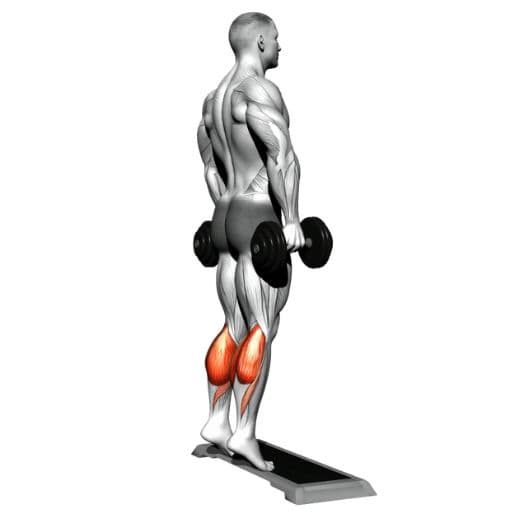
About the Dumbbell Calf Raise
The standing bilateral dumbbell calf raise is an isolation exercise targeting the plantarflexors. The lifter stands upright holding one dumbbell in each hand at the sides, rises onto the balls of both feet through full plantarflexion, holds briefly at the top, then lowers under control. An elevated surface (step or block) is recommended for full range of motion, allowing the heels to drop below the platform level for a complete dorsiflexion stretch. The dumbbell calf raise is a widely used isolation exercise for developing the gastrocnemius and soleus, the two primary muscles of the calf complex responsible for ankle plantarflexion.
All benchmarks on this page represent the weight of one dumbbell (per hand). If you hold 50 lb in each hand, enter 50 lb — not 100 lb. Your calves move bodyweight + both dumbbells combined through each rep.
Bilateral Only — Single-Leg Is a Different Exercise
These standards apply to the standing bilateral dumbbell calf raise (both feet on the platform, one dumbbell in each hand). The single-leg dumbbell calf raise is a fundamentally different exercise: it doubles the per-calf bodyweight load, introduces significant balance demands, and has separate performance data. Do not convert your bilateral numbers to single-leg equivalents or vice versa — use each exercise’s standards independently.
How to Perform a Standard Dumbbell Calf Raise
Follow these steps for results that match the StrengthRegimen standard. An elevated surface is recommended but not required.
Setup
Stand upright on an elevated surface (step, block, or calf raise platform) with the balls of both feet on the edge and heels hanging off. Hold one dumbbell in each hand at your sides with arms fully extended. Stand tall with a neutral spine and slight knee softness (not locked).
Raise (Concentric)
Rise onto the balls of your feet by pushing through the big toe and ball of the foot, driving your heels as high as possible into full plantarflexion. Keep your torso upright — no leaning forward. Hold the top position for approximately 1 second, squeezing the calves at peak contraction.
Lower (Eccentric)
Lower your heels under control (2–3 seconds) below the edge of the platform until you feel a full stretch through the calves (dorsiflexion). Do not bounce at the bottom — come to a brief pause before the next rep. Maintain straight knees throughout the movement.
✓ Valid Rep
- •Full range of motion — heels drop below platform, rise to max height
- •Controlled tempo with 1-second hold at the top
- •Straight knees throughout (no bending to assist)
- •Torso upright, dumbbells hanging naturally at sides
- •Even pressure across both feet (no rolling outward)
✗ Invalid Rep
- •Bouncing at the bottom of the rep to use stretch reflex
- •Bending knees to recruit quads for assistance
- •Partial ROM — not reaching full plantarflexion or dorsiflexion
- •Leaning forward or shifting weight to toes excessively
- •Using momentum or swinging the dumbbells
Safety Note: The dumbbell calf raise is a low-risk exercise, but use caution on elevated surfaces — ensure the platform is stable and non-slip. If you experience sharp pain in the Achilles tendon or heel, reduce the range of motion or switch to flat-ground calf raises. Progress dumbbell weight in small increments (2.5–5 lb) to allow tendon adaptation.
Evidence-Based Calf Training Tips
Practical considerations for maximizing dumbbell calf raise performance and calf development.
Calves Favor Higher Volume
The soleus muscle is approximately 88% slow-twitch (type I) fibers, while the gastrocnemius is roughly 50–60% slow-twitch. This high slow-twitch proportion means calves are fatigue-resistant and typically respond better to higher training volumes (12–20 reps) and higher weekly frequency (3–5 sessions) compared to fast-twitch-dominant muscles.
Eccentric Tempo Matters
Controlled eccentric (lowering) phases of 2–3 seconds produce greater gastrocnemius hypertrophy stimulus compared to fast drop-and-bounce reps. The stretch at the bottom position (full dorsiflexion) is where the gastrocnemius reaches its longest length and experiences the greatest mechanical tension. Pausing briefly at the bottom prevents stretch-reflex cheating.
Dumbbell vs Machine Calf Raise
Dumbbells limit maximum calf raise load compared to machines (Smith machine, leg press calf raise, standing calf raise machine). At advanced and elite levels, grip strength and balance become limiting factors before the calves reach failure. Wrist straps can extend the effective range. For maximum overload beyond dumbbell capacity, supplement with machine calf raises.
Achilles Tendon Considerations
The Achilles tendon transmits all plantarflexion force and is the strongest tendon in the body, but it adapts more slowly than muscle tissue. When increasing dumbbell weight, progress in small increments (2.5–5 lb) and allow 2–3 weeks at each new load. If you experience sharp or localized pain at the tendon insertion (heel) or midsubstance, reduce load and consult a professional.
Note: These insights are general training principles. Individual anatomy (calf muscle insertion points, Achilles tendon length, ankle mobility) significantly affects calf development potential and exercise response. Consistent progressive overload with proper form is the most reliable path to improvement regardless of genetics.
Strength Level Benchmarks
Per-dumbbell benchmarks for the standing bilateral dumbbell calf raise relative to bodyweight.
Beginner
Male 0.12× BW • Female 0.09× BWCan perform a controlled standing dumbbell calf raise with light dumbbells through a basic range of motion. Strength at this stage reflects initial neuromuscular adaptation of the plantarflexors to direct external loading beyond bodyweight.
Focus: Focus on full ROM with 12–20 reps per set. Prioritize heel drop (dorsiflexion stretch) and peak squeeze (full plantarflexion) over adding weight. Use an elevated surface from the start to establish the correct movement pattern.
0–6 months of consistent calf training
Novice
Male 0.27× BW • Female 0.20× BWReliable calf raise form with moderate dumbbell loads. Can maintain full ROM, upright posture, and controlled tempo at working weights without bouncing or knee bend.
Focus: Progress dumbbell weight in 2.5–5 lb increments. Train with 10–15 reps and controlled eccentrics (2–3 seconds down). Begin including both straight-knee (standing) and bent-knee (seated) calf work for complete development.
6–12 months of structured calf training
Intermediate
Male 0.50× BW • Female 0.34× BWSolid plantarflexor strength with strict form and full ROM. Represents the typical level of a dedicated gym-goer with 1–2 years of consistent calf training who has progressed through meaningful dumbbell loads.
Focus: Periodize across rep ranges (8–20 reps). Combine heavy dumbbell calf raises with higher-rep machine or bodyweight work. Progress requires intentional overload — small dumbbell increments, tempo manipulation, or elevated-surface ROM emphasis.
1–2+ years of consistent training
Advanced
Male 0.80× BW • Female 0.50× BWUpper-tier calf raise strength. Requires years of dedicated calf training with heavy dumbbells. At this level, dumbbell grip becomes a limiting factor for many lifters — wrist straps may be needed for maximal loads.
Focus: Structured mesocycles with progressive overload. Manage Achilles tendon recovery between heavy sessions. Consider supplementing with machine calf raises for loads beyond dumbbell availability. Eccentric-focused training (3–5 sec lowering) can be particularly effective.
3–5+ years of dedicated training
Elite
Male 1.13× BW • Female 0.67× BWExceptional dumbbell calf raise strength. Few lifters reach this level with dumbbells alone — the grip and balance demands with very heavy dumbbells are substantial, and most commercial gyms stock dumbbells only up to 100–120 lb. At a 180 lb bodyweight, this standard corresponds to approximately 203 lb per dumbbell, which exceeds typical gym equipment. Most elite-level calf strength is developed on machines (Smith machine, standing calf raise machine, or leg press calf raise), making this a rare achievement in the dumbbell-specific context.
Focus: Prioritize Achilles tendon health and long-term joint integrity. Very small, calculated increases over multi-month blocks. Wrist straps are essential for maximal loads. Strategic deloads every 4–6 weeks.
5+ years of serious strength training
How These Standards Are Derived
Sources, calculation methods, and limitations for every number on this page.
1. Data Sources & Classification
These are StrengthRegimen-derived training benchmarks, not peer-reviewed population norms. They are informed by:
- Community self-reported data from StrengthLevel.com, which aggregates 151,971 dumbbell calf raise submissions from 2020–2026. All values represent per-dumbbell load. These are self-reported, not laboratory-measured.
- Cross-reference with FitnessVolt dumbbell calf raise standards model (21 bodyweight categories × 5 levels), showing consistent distribution: male 180 lb Intermediate ~93 lb per dumbbell (0.52× BW), female 140 lb Intermediate ~48 lb per dumbbell (0.34× BW).
- General coaching conventions for standing calf raise performance, adjusted conservatively because StrengthRegimen specifies strict form (full ROM, 1-second hold at top, no bouncing, elevated surface recommended).
The five-tier classification (Beginner through Elite) mirrors the StrengthRegimen framework used across all tools, informed by the coaching literature conventions (Kilgore & Rippetoe’s Practical Programming, ExRx.net), adapted for the dumbbell calf raise context.
2. Bodyweight Ratio — Total Load Consideration
Standards are expressed as per-dumbbell load ÷ bodyweight. This provides a useful normalization across body sizes, but requires understanding a key nuance for the calf raise.
Total system load: In a standing calf raise, the calves must lift bodyweight + both dumbbells combined through each rep. A 180 lb person holding 50 lb per hand moves a total system load of 280 lb. The BW ratio on this page captures only the external dumbbell weight relative to bodyweight — not the total load on the calves.
Implication: Heavier individuals face greater absolute calf load even at the same BW ratio. A 300 lb lifter at 0.50× BW holds 150 lb per dumbbell but moves 600 lb total, while a 150 lb lifter at 0.50× BW holds 75 lb per dumbbell and moves 300 lb total. Despite this limitation, per-dumbbell BW ratio is the universal convention across existing platforms and provides a better comparison than raw load alone.
3. 1RM Estimation — Not Validated for Calf Raises
When you enter a multi-rep set, the tool estimates your 1RM using the Epley formula:
Critical caveat: The Epley formula has NOT been validated for calf raises or plantarflexion exercises. All major rep-to-1RM prediction equations were developed and validated primarily on compound lifts (bench press, squat, deadlift).
What IS reliable: Direct 1RM testing of the standing calf raise (barbell-based apparatus) has been shown to have excellent test-retest reliability (ICC = 0.981, Puschkasch-Möck et al., JASS 2025; ICC = 0.987, Möck et al., 2018, 2023), with absolute measurement error of approximately 4 kg (2.21%). Note: these studies used a barbell placed on the shoulders, not dumbbells. The reliability of dumbbell-specific calf raise 1RM testing has not been independently studied, but the underlying movement is biomechanically similar.
Practical concern: Calf raises are commonly trained at 12–25 reps, where all 1RM prediction equations lose accuracy substantially. The tool warns when reps exceed 10. For the most accurate assessment, test with a heavy dumbbell for 5 reps or fewer, or test your actual 1RM directly.
4. Age Scaling
The “By Age” table applies gradual scaling factors based on the general pattern of neuromuscular force output across the lifespan: peak strength between ages 20–30, with gradual decline thereafter.
Limitation: These age multipliers are generalized — they are NOT derived from calf raise-specific longitudinal data. Plantarflexion strength may decline at a different rate than upper-body strength with aging. Some research suggests that the ankle plantarflexors may be particularly susceptible to age-related strength loss due to the preferential atrophy of type II fibers in the gastrocnemius. Treat age-adjusted values as approximate guides.
Transparency: The multipliers, calculation methods, data sources, and limitations described above are the complete methodology. No proprietary algorithms, hidden adjustments, or unpublished datasets are used. Where evidence is limited (particularly for calf raise 1RM prediction and age-specific plantarflexion norms), we state so explicitly.
Disclaimer
The dumbbell calf raise strength standards on this page are practical training benchmarks intended for self-assessment and educational use. All values represent the weight of one dumbbell (per hand). Individual performance depends on calf muscle insertion points, Achilles tendon properties, ankle mobility, training history, and technique. The Epley formula has not been validated for calf raises specifically — treat estimated 1RM values as approximate guides. Consult a healthcare professional before initiating high-intensity resistance training.