Tricep Pushdown Strength Standards
The Intermediate tricep pushdown standard is 108 lb (49 kg) for men and 55 lb (25 kg) for women (estimated 1RM, machine-displayed stack weight at 180 / 140 lb bodyweight). These values assume a standard 1:1 cable station. Compare your lift by bodyweight and age below.
Configure Your Bodyweight & Unit
Male Tricep Pushdown Standards (lb)
StrengthRegimen standards for 180 lb bodyweight — machine-displayed stack weight — strict form (elbows pinned)
| Strength Level | Stack Weight (180 lb BW) | BW Ratio |
|---|---|---|
| Beginner | 43 lb | 0.24x |
| NoviceYou | 70 lb | 0.39x |
| Intermediate | 108 lb | 0.60x |
| Advanced | 151 lb | 0.84x |
| Elite | 194 lb | 1.08x |
How much should I Tricep Pushdown? (lb)
Assess Your Tricep Pushdown
Enter the stack weight and reps completed to estimate your 1RM and strength level
Enter the weight shown on the machine's stack selector (pin setting)
Pushing 80 lb stack × 10 reps with strict form equals an estimated 1RM of 107 lb stack weight.
At 180 lb (Male), that is 0.59× your bodyweight, which falls within the Novice range. Epley-based estimate — less precise for cable isolation exercises. Compare only on the same machine.
Shareable Tricep Pushdown Strength Card
Tricep Pushdown Strength Spectrum
Rep-Max & Training Zone Table (LB stack)
Stack weight loads based on your 107 lb estimated 1RM — strict form, elbows pinned
| Target | % of 1RM | Stack Weight | Programming |
|---|---|---|---|
| 1RM (Max) (1 rep) | 100% | 107 lb | Use with caution — cable isolation |
| 5RM (5 reps) | 85.7% | 92 lb | 3 × 5 reps |
| 8RM (8 reps) | 78.9% | 84 lb | 3–4 × 8 reps |
| 10RM (10 reps) | 75% | 80 lb | 3–4 × 10 reps |
| 12RM (12 reps) | 71.4% | 76 lb | 3 × 12 reps |
| 15RM (15 reps) | 66.7% | 71 lb | 2–3 × 15 reps |
| 20RM (20 reps) | 60% | 64 lb | 2 × 20 reps |
Complete Tricep Pushdown Reference Chart (LB)
Stack weight standards across bodyweights for Male lifters in lb
| BW (lb) | Beginner | Novice | Intermediate | Advanced | Elite |
|---|---|---|---|---|---|
| 120 | 29 | 47 | 72 | 101 | 130 |
| 130 | 31 | 51 | 78 | 109 | 140 |
| 140 | 34 | 55 | 84 | 118 | 151 |
| 150 | 36 | 59 | 90 | 126 | 162 |
| 160 | 38 | 62 | 96 | 134 | 173 |
| 170 | 41 | 66 | 102 | 143 | 184 |
| 180 | 43 | 70 | 108 | 151 | 194 |
| 190 | 46 | 74 | 114 | 160 | 205 |
| 200 | 48 | 78 | 120 | 168 | 216 |
| 210 | 50 | 82 | 126 | 176 | 227 |
| 220 | 53 | 86 | 132 | 185 | 238 |
| 230 | 55 | 90 | 138 | 193 | 248 |
| 240 | 58 | 94 | 144 | 202 | 259 |
| 250 | 60 | 98 | 150 | 210 | 270 |
| 260 | 62 | 101 | 156 | 218 | 281 |
| 270 | 65 | 105 | 162 | 227 | 292 |
| 280 | 67 | 109 | 168 | 235 | 302 |
| 290 | 70 | 113 | 174 | 244 | 313 |
| 300 | 72 | 117 | 180 | 252 | 324 |
About the Tricep Pushdown
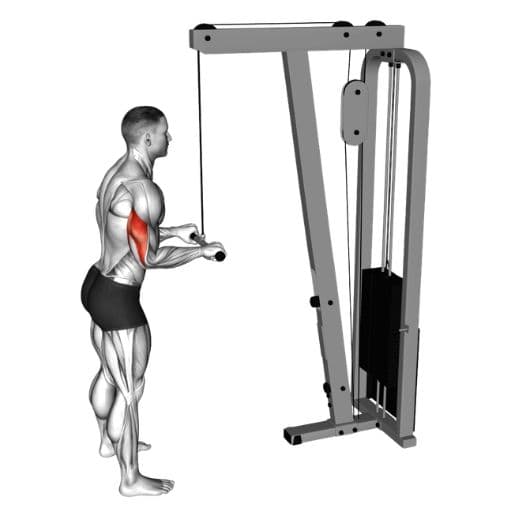
The standing cable tricep pushdown is an isolation exercise performed on a high-pulley cable station. The lifter grips an attachment (rope, straight bar, or V-bar) at chest height with elbows pinned to the sides and extends the elbows to push the attachment downward to full lockout, then returns under control. It targets all three heads of the triceps with minimal contribution from other muscles. All benchmarks use the machine’s displayed stack weight — not handle force.
The image shows a straight-bar attachment on a standard selectorized cable station. These standards aggregate all attachment types (rope, straight bar, V-bar) — be consistent with your attachment choice when tracking progress over time.
Machine Variability — The #1 Caveat for Cable Standards
The weight displayed on a cable machine's stack does not necessarily equal the resistance at the handle. Standard selectorized cable stations typically use a 1:1 pulley ratio (stack weight ≈ handle resistance), but functional trainers commonly use a 2:1 ratio — meaning 100 lb on the stack delivers only ~50 lb at the handle. Cable friction, bearing quality, and maintenance can add or subtract 5–15% from theoretical values. Different manufacturers calibrate stacks differently.
These standards assume a standard 1:1 selectorized cable station — the most common commercial gym configuration. If you train on a functional trainer (2:1 ratio), your “stack weight” would be approximately double these values for equivalent resistance. For the most meaningful comparison, track your progress on the same machine over time rather than comparing numbers across different equipment.
Tricep Pushdown Strength Levels Explained
What each strength level means for the standing cable tricep pushdown with strict form — elbows pinned to sides, full lockout, controlled eccentric, no torso lean or momentum. All values are machine-displayed stack weight relative to bodyweight on a standard 1:1 cable station.
Beginner
Male 0.24× BW • Female 0.13× BWCan perform a standing cable tricep pushdown through a controlled range of motion with light stack weight. For a 180 lb male this is approximately 43 lb on the stack. The primary challenge is keeping the elbows pinned to the sides throughout the movement — most beginners let the elbows drift forward or flare outward, turning the exercise into a pressing motion that recruits the chest and shoulders. Learning to isolate the triceps through strict elbow extension is the key skill at this stage.
Focus: Focus on strict form with 3 × 12–15 reps using a manageable stack weight. Keep your upper arms completely stationary against your sides — only your forearms should move. Practice a controlled 1–2 second lockout at the bottom and a smooth return. If your elbows drift forward or your torso rocks, lower the weight. A rope or straight bar attachment both work at this stage.
0–6 months of consistent training
Novice
Male 0.39× BW • Female 0.24× BWReliable strict pushdown form with moderate stack weights. For a 180 lb male this is approximately 70 lb on the stack. The lifter can consistently maintain elbows at the sides, achieve full lockout at the bottom, and control both the concentric and eccentric phases without momentum. The mind-muscle connection with the triceps — especially the lateral and medial heads — is developing. Able to use the pushdown productively as an accessory exercise for bench press and overhead press.
Focus: Progress by moving up one pin on the stack when all prescribed reps are completed with strict form across every set. Work primarily in the 10–12 rep range with 3–4 sets. Begin experimenting with different attachments (rope for peak contraction via wrist rotation, V-bar for neutral grip comfort) to find what feels best for your wrists and elbows.
6–12 months of structured triceps training
Intermediate
Male 0.60× BW • Female 0.39× BWSolid triceps isolation strength with consistent strict technique. For a 180 lb male this is approximately 108 lb on the stack. Represents the typical level of a dedicated lifter with 1–2 years of consistent arm training who includes pushdowns in most upper-body sessions. At this stack weight, maintaining strict elbows-pinned form becomes genuinely challenging — the temptation to lean into the weight or let the elbows creep forward is significant. The pushdown stack typically approaches or matches the lifter’s barbell curl max, reflecting the triceps being a larger muscle group than the biceps.
Focus: Periodize across 8–15 reps with planned progression. Drop sets (strip the stack down two pins after failure) and mechanical drop sets (straight bar → rope for extended ROM) are highly effective. Consider varying attachment each session: straight bar for maximum load, rope for peak contraction, V-bar for wrist comfort. Monitor elbow health — medial epicondylitis (golfer’s elbow) risk increases with heavier loads.
1–2+ years of consistent training
Advanced
Male 0.84× BW • Female 0.58× BWUpper-tier strict pushdown strength. For a 180 lb male this is approximately 151 lb on the stack — approaching or exceeding the lifter’s own bodyweight on the machine. Maintaining truly strict form (elbows pinned, no torso lean, full lockout, controlled eccentric) at this load is very difficult. The stack weight may be near or at the machine’s maximum for standard gym equipment. Few recreational lifters achieve this level without some degree of body lean or elbow drift. Visible triceps size and horseshoe definition are prominent.
Focus: Structured mesocycles with planned intensity and volume waves. Balance direct triceps isolation with compound pressing. Prioritize elbow joint health (especially the medial epicondyle and olecranon). If your machine’s stack maxes out, use pause reps (2-second hold at lockout), controlled eccentrics (3–4 seconds up), or add a plate to the stack with a pin adapter. Consider rotating between cable pushdowns and other triceps isolation (overhead extension, skull crushers) across training blocks.
3–5+ years of dedicated arm training
Elite
Male 1.08× BW • Female 0.78× BWExceptional strict pushdown strength. For a 180 lb male this is approximately 194 lb on the stack with strict isolation form — elbows pinned, no torso lean, full lockout, controlled tempo. At this level the lifter is pushing beyond the stack capacity of many commercial gym machines (typically 150–200 lb). This requires years of dedicated triceps training, excellent elbow joint health, and the ability to maintain isolation under very heavy loads. Triceps mass is a dominant feature of the upper arm, and lockout strength on bench press and overhead press is formidable.
Focus: Prioritize elbow joint longevity and long-term progression over peak loads. Very small increases over multi-month training blocks. Many elite pushdown lifters train primarily in the 8–12 rep range for joint preservation. Supplement cable pushdowns with overhead cable extensions (long head emphasis) and close-grip bench press for compound overload. Strategic deloads are essential to prevent tendon overuse.
5+ years of serious strength training
Tricep Pushdown FAQ
Why does machine variability matter so much for pushdown standards?
The weight you select on a cable machine's stack is not necessarily the resistance at the handle. Standard selectorized cable stations typically use a 1:1 pulley ratio where the stack weight approximately equals handle resistance. However, functional trainers commonly use a 2:1 ratio — meaning 100 lb on the stack delivers only ~50 lb at the handle.
Beyond pulley ratios, cable friction (from worn cables, dry bearings, or aged pulleys) can add or subtract 5–15% from the theoretical resistance. Different manufacturers calibrate weight stacks differently. The same “100 lb” pin setting may feel noticeably different across machines. This is why these standards are most useful when you track progress on the same machine over time rather than comparing numbers between different gyms or equipment.
Rope vs straight bar vs V-bar — which attachment should I use?
All three attachments work the triceps effectively, but with different characteristics. The straight bar allows the heaviest loads because the fixed grip stabilizes the wrists, making it the best choice for maximum overload. The rope permits wrist rotation at the bottom (spreading the ends apart), which enhances peak contraction and lateral head activation — but typically allows 10–15% less load. The V-bar (angled bar) provides a neutral grip that is often more comfortable for those with wrist issues.
These standards aggregate all attachment types (this matches the StrengthLevel.com dataset). No reliable data exists to provide specific attachment-to-attachment conversion factors. The most important practice is to be consistent with your attachment choice when tracking progress. If you switch from a straight bar to a rope, expect an immediate reduction in load — this does not mean you got weaker.
How does the tricep pushdown compare to dips and close-grip bench press?
The pushdown is a single-joint isolation exercise (elbow extension only), while dips and the close-grip bench press are compound movements that involve both elbow extension and shoulder movement, recruiting the chest, anterior deltoids, and triceps together. Direct load comparisons are not meaningful because the exercises use completely different loading conventions (cable stack weight vs bodyweight + external load vs barbell).
In a well-structured program, compound triceps exercises (close-grip bench, dips) build overall pressing strength and triceps mass, while the pushdown provides targeted isolation and volume accumulation with lower joint stress. Most intermediate+ lifters benefit from including both. The pushdown is particularly effective at accumulating triceps volume without fatiguing the shoulders and chest, making it ideal as an accessory exercise after heavy pressing.
How accurate is the 1RM estimate for cable pushdowns?
The estimated 1RM for cable pushdowns carries stronger caveats than for barbell compound lifts. Two major factors reduce accuracy: (1) machine variability means the “weight” in the Epley formula is machine-dependent and unstandardized, so the 1RM number is only meaningful on the same machine; (2) isolation exercise prediction accuracy is substantially lower than compound lifts — research shows r ≈ .84–.91 for single-joint exercises vs r ≈ .97–.98 for the bench press (LeSuer et al., 1997).
Additionally, form deterioration on later reps (elbow drift, torso lean) is common and inflates high-rep estimates. For the most useful result, use a weight you can push for 8–12 strict reps. The estimated 1RM should be treated as an approximate comparison metric for tracking progress on the same machine and attachment, not as an absolute strength measurement.
What are the most common form mistakes on the tricep pushdown?
1. Elbow drift: The elbows move forward during the eccentric (return) phase, turning the exercise into a pressing motion that recruits chest and shoulders. 2. Excessive torso lean: Leaning into the cable with body weight effectively reduces triceps demand by adding a downward force from the torso. 3. Flaring elbows: Letting the elbows splay outward shifts load to the shoulders and reduces triceps isolation.
4. Incomplete lockout: Stopping before full elbow extension reduces ROM and the peak contraction that is critical for triceps development. 5. Using momentum: Bouncing the weight at the top of the movement or using a hip thrust to start each rep. 6. Partial eccentric: Allowing the stack to fall rather than controlling the return to the starting position. If your elbows move, your torso rocks, or the cable jerks, the weight is too heavy for strict-form comparison against these standards.
Disclaimer
These are training benchmarks for self-assessment, not clinical standards. All values represent machine-displayed stack weight on a standard 1:1 cable station with strict form — elbows pinned to sides, full lockout, controlled eccentric, no torso lean. Standards are derived from StrengthLevel.com community data (805K lifts, 238K qualifying) with a strict-form and machine-variability discount of 12–18%, cross-validated against FitnessVolt model estimates. The 1RM prediction formula is less accurate for cable isolation exercises than for barbell compound lifts — accuracy degrades above 12 reps, and the estimate is only meaningful on the same machine and attachment. Cable machine variability (pulley ratios, friction, calibration) means cross-machine comparisons are approximate. Individual results will vary with technique, attachment choice, machine type, and training background. Consult a qualified professional before attempting high-intensity resistance training.