Sumo Squat Strength Standards
The average Sumo Squat is 220 lb (100 kg) for men and 95 lb (43 kg) for women (1RM). Compare your barbell sumo squat one-rep max against bodyweight and age standards below.
Configure Your Bodyweight & Unit
Male Sumo Squat Standards (lb)
StrengthRegimen standards for 180 lb bodyweight
| Strength Level | 1RM Target (180 lb BW) | Bodyweight Ratio |
|---|---|---|
| Beginner | 81 lb | 0.45x |
| NoviceYou | 140 lb | 0.78x |
| Intermediate | 220 lb | 1.22x |
| Advanced | 315 lb | 1.75x |
| Elite | 414 lb | 2.30x |
How much should I be able to Sumo Squat? (lb)
Assess Your Sumo Squat
Enter the weight you sumo squatted and how many reps you completed to see your estimated 1RM, strength level, and training zones
Total barbell weight sumo squatted to depth (including the 45 lb bar)
If you have not tested a true 1RM, enter a submaximal set (e.g., 5 reps) and the Epley formula will estimate it. Always squat inside a power rack with safety bars.
Sumo squatting 185 lb × 5 reps equals an estimated One-Rep Max (1RM) of 216 lb.
At a bodyweight of 180 lb (Male), you are sumo squatting 1.2× your bodyweight, which falls within the Novice range according to StrengthRegimen sumo squat standards.
Shareable Sumo Squat Strength Card
Personalized Rep-Max & Training Zone Table (LB)
Exact working weights & plate loading based on your 216 lb Estimated 1RM
| Rep Max | % of 1RM | Working Weight (lb) | Recommended Sets | Training Zone |
|---|---|---|---|---|
1RM (Max) | 100% | 216 lb | 1 × 1 rep (Max Test) | Maximal Strength |
2RM | 94% | 203 lb | 3–4 × 2 reps | Maximal Strength |
3RM | 91% | 196 lb | 4–5 × 3 reps | Heavy Strength |
5RMYour Set | 86% | 185 lb | 3–5 × 5 reps | Strength & Power |
8RM | 79% | 171 lb | 3–4 × 8 reps | Hypertrophy (Muscle) |
10RM | 75% | 162 lb | 3–4 × 10 reps | Hypertrophy (Muscle) |
12RM | 71% | 154 lb | 3 × 12 reps | Volume & Endurance |
15RM | 67% | 144 lb | 2–3 × 15 reps | Muscular Endurance |
Complete Sumo Squat Reference Chart (LB)
1RM standards across bodyweights for Male lifters in lb
| Bodyweight (lb) | Beginner (0.45x BW) | Novice (0.78x BW) | Intermediate (1.22x BW) | Advanced (1.75x BW) | Elite (2.30x BW) |
|---|---|---|---|---|---|
| 120 lb | 54 lb | 94 lb | 146 lb | 210 lb | 276 lb |
| 130 lb | 59 lb | 101 lb | 159 lb | 228 lb | 299 lb |
| 140 lb | 63 lb | 109 lb | 171 lb | 245 lb | 322 lb |
| 150 lb | 68 lb | 117 lb | 183 lb | 263 lb | 345 lb |
| 160 lb | 72 lb | 125 lb | 195 lb | 280 lb | 368 lb |
| 170 lb | 77 lb | 133 lb | 207 lb | 298 lb | 391 lb |
| 180 lb(You) | 81 lb | 140 lb | 220 lb | 315 lb | 414 lb |
| 190 lb | 86 lb | 148 lb | 232 lb | 333 lb | 437 lb |
| 200 lb | 90 lb | 156 lb | 244 lb | 350 lb | 460 lb |
| 210 lb | 95 lb | 164 lb | 256 lb | 368 lb | 483 lb |
| 220 lb | 99 lb | 172 lb | 268 lb | 385 lb | 506 lb |
| 230 lb | 104 lb | 179 lb | 281 lb | 403 lb | 529 lb |
| 240 lb | 108 lb | 187 lb | 293 lb | 420 lb | 552 lb |
| 250 lb | 113 lb | 195 lb | 305 lb | 438 lb | 575 lb |
| 260 lb | 117 lb | 203 lb | 317 lb | 455 lb | 598 lb |
| 270 lb | 122 lb | 211 lb | 329 lb | 473 lb | 621 lb |
| 280 lb | 126 lb | 218 lb | 342 lb | 490 lb | 644 lb |
| 290 lb | 131 lb | 226 lb | 354 lb | 508 lb | 667 lb |
| 300 lb | 135 lb | 234 lb | 366 lb | 525 lb | 690 lb |
About the Sumo Squat
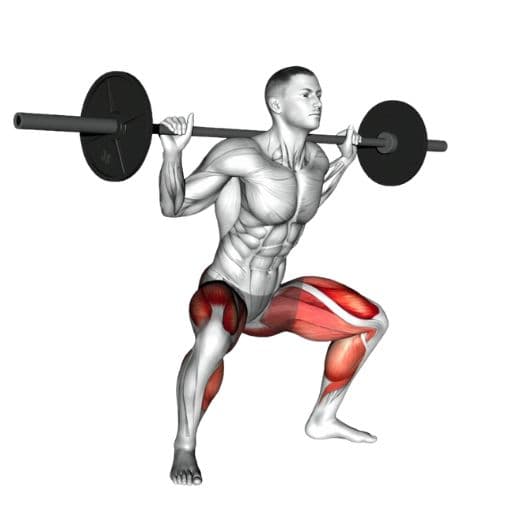
The barbell sumo squat is a wide-stance squat variation performed with the barbell on the upper back, feet set approximately 1.5–2× shoulder width apart, and toes pointed outward 30–45 degrees. The lifter descends until the hip crease passes below the kneecap, then drives to full lockout. The wider stance increases adductor and outer quadriceps demand compared to the conventional back squat. EMG research (Coratella et al. 2021) found significantly greater vastus lateralis and adductor longus activation in the sumo stance compared to the conventional squat during the ascending phase.
All benchmarks on this page represent total barbell weight (bar + plates). For a valid comparison, use a wide stance (1.5–2× shoulder width), toes pointed 30–45° out, and descend until the hip crease passes below the kneecap before standing to full lockout.
Sumo Squat vs. Conventional Back Squat — Understanding Your Numbers
Do not convert between sumo squat and conventional back squat standards. The wider stance changes leverage, moment arms, and muscle emphasis — the sumo squat shifts load toward the adductors and outer quadriceps while reducing the effective load on the erector spinae. Most lifters squat less in the sumo stance. Individual anatomy (femur length, hip socket depth, ankle mobility) determines the exact relationship, and there is no reliable universal conversion factor.
Use each exercise’s standards independently. The StrengthRegimen Barbell Back Squat page uses conventional-squat-specific benchmarks (0.65×–2.50× BW for men). These Sumo Squat standards use sumo-specific data derived from StrengthLevel.com community data (112K lifts), cross-validated against FitnessVolt and Shiba Muscle. Do not cross-reference or convert between them.
Sumo Squat FAQ
Sumo squat vs. conventional back squat — what’s the difference?
Both use a barbell on the upper back, but the stance width changes the movement significantly. The sumo squat uses a wide stance (1.5–2× shoulder width) with toes pointed 30–45° outward. The conventional squat uses a shoulder-width or slightly wider stance with less toe-out.
EMG research by Coratella et al. (2021, IJERPH 18(2):772) found that the sumo stance produced significantly greater vastus lateralis and adductor longus activation during the ascending phase compared to the conventional squat in 10 competitive bodybuilders at 80% 1RM. No significant difference was found for gluteus maximus or gluteus medius between the two stances. Most lifters squat less in the sumo stance. There is no reliable conversion factor between them — use each exercise’s standards independently.
How wide should my sumo squat stance be?
A starting point is 1.5–2× shoulder width with toes pointed 30–45 degrees outward. Your knees should track directly over your toes throughout the entire movement — at the bottom of the squat, your shins should be roughly vertical or angled outward, never caving inward.
The correct width depends on your individual hip anatomy (femur length, acetabular depth and angle), ankle mobility, and adductor flexibility. Too wide limits your ability to reach parallel depth and places excessive strain on the knee and groin. Too narrow is essentially a conventional squat. Experiment with small adjustments (1–2 inches at a time) until you find a width where you can reach full depth with knees tracking over toes and no groin discomfort.
Sumo squat vs. sumo deadlift — are the standards comparable?
No. Despite sharing the “sumo” wide stance, these are completely different movements. The sumo squat is a squat (barbell on upper back, knee-dominant, descending into a deep bend). The sumo deadlift is a hip hinge (barbell in hands, hip-dominant, pulling from the floor).
The sumo deadlift typically allows much heavier loads than the sumo squat because the bar starts on the floor and the range of motion is shorter. StrengthLevel data shows the sumo deadlift intermediate at ~363 lb vs sumo squat intermediate at ~225 lb for the average male lifter. Do not cross-reference or convert between them — they measure different physical capacities.
Does the sumo squat target glutes more than the conventional squat?
Contrary to popular belief, no. The same Coratella et al. (2021) EMG study found no significant difference in gluteus maximus or gluteus medius activation between sumo-stance and conventional back squats. The sumo stance primarily increases adductor longus and vastus lateralis (outer quad) activation.
Interestingly, the front squat showed the highest gluteal activation during the descending (eccentric) phase in the same study. If your primary goal is maximal glute activation, front squats and hip thrusts may be more effective choices than switching from conventional to sumo stance. The sumo squat’s unique advantage is its adductor and inner thigh emphasis, not glute targeting.
How accurate is the Epley 1RM estimate for sumo squats?
The Epley formula (1RM = weight × (1 + reps / 30)) was originally validated for the bench press but is widely used for all barbell exercises, including squat variations. No separate validation study exists specifically for the barbell sumo squat, but the formula should behave similarly to conventional squat estimates given the comparable compound movement pattern.
For the most reliable estimate, use a weight you can complete for 10 reps or fewer with strict form and full depth. Accuracy decreases substantially above 10–12 reps as muscular endurance and cardiovascular fatigue increasingly affect the result. Always test inside a power rack with safety bars set at an appropriate height for your wide stance.
What Each Sumo Squat Strength Level Means
What each sumo squat classification means and what it takes to reach the next tier.
Beginner
1–6 Months TrainingYou have learned the sumo squat stance — wide feet, toes pointed out — and can descend to at least parallel depth with a loaded barbell while keeping your knees tracking over your toes.
Training Focus: Early gains come from developing hip abductor and adductor coordination, improving hip external rotation mobility, learning to distribute force evenly through a wide base, and building core bracing stability in the wider stance.
Novice
6–12 Months TrainingYou have built a solid foundation in the wide-stance squat pattern. Your hip mobility supports consistent depth, and you can maintain upright posture under moderate loads across multiple sets.
Training Focus: Linear progression (adding 5 lb or 2.5 kg per session) is still effective. Your adductors and inner thigh musculature are adapting to the increased stretch-under-load demands specific to the sumo stance.
Intermediate
1–3 Years TrainingThe community benchmark for a dedicated lifter using the sumo squat. You demonstrate consistent depth and controlled knee tracking under heavy loads, with well-developed adductor and quadriceps strength.
Training Focus: Structured periodization becomes necessary — cycling between heavier intensity phases and higher-volume hypertrophy blocks. Your stance width and toe angle are dialed in for your individual anatomy.
Advanced
3–5+ Years TrainingStandout wide-stance squat strength. Your adductor and hip strength are highly developed, and you can handle loads that exceed bodyweight (women) or approach double bodyweight (men) with controlled form throughout the full range of motion.
Training Focus: Progress is measured over multi-week training blocks. Managing adductor strain risk, optimizing stance width for maximal leverage, and programming hip mobility work alongside heavy loading all become critical factors.
Elite
5+ Years Dedicated TrainingExceptional sumo squat strength requiring years of dedicated training. Your hip structure, adductor development, and wide-stance technique have been refined through extensive practice and programming.
Training Focus: This level demands specialized programming with carefully managed volume, meticulous hip and groin health maintenance, and optimized stance biomechanics. Most lifters at this level have experimented extensively with stance width, bar position, and descent tempo to find their strongest configuration.
Disclaimer
These are training benchmarks for self-assessment, not clinical standards. All values represent total barbell weight (bar + plates) with strict form and full depth to at least parallel. Standards are derived from StrengthLevel.com community data (112,642 lifts, 9,049 qualifying) with a graduated strict-form discount and cross-validation against FitnessVolt and Shiba Muscle; individual results will vary with stance width, hip anatomy, and training background. The sumo squat is not a standardized competition lift — depth, stance, and form are self-judged. Consult a qualified professional before attempting maximum-effort lifts. Always squat inside a power rack with safety bars set at an appropriate height for your wide stance.