Bulgarian Split Squat Strength Standards
The Intermediate barbell Bulgarian split squat standard is 119 lb (54 kg) for men and 74 lb (34 kg) for women (estimated 1RM at 180 / 140 lb bodyweight). Compare your lift by bodyweight and age below.
Configure Your Bodyweight & Unit
Male Bulgarian Split Squat Standards (lb)
StrengthRegimen standards for 180 lb bodyweight — total barbell weight
| Strength Level | Total Barbell (180 lb BW) | BW Ratio |
|---|---|---|
| Beginner | 40 lb | 0.22x |
| NoviceYou | 79 lb | 0.44x |
| Intermediate | 119 lb | 0.66x |
| Advanced | 191 lb | 1.06x |
| Elite | 270 lb | 1.50x |
How much should I Bulgarian Split Squat? (lb)
Assess Your Bulgarian Split Squat
Enter the total barbell weight and reps per leg to estimate your 1RM and strength level
Enter the total barbell weight (bar + plates) — same as a barbell squat
Squatting 95 lb × 5 reps/leg equals an estimated 1RM of 111 lb (total barbell).
At 180 lb (Male), that is 0.62× your bodyweight, which falls within the Novice range. Epley-based estimate; accuracy is highest when reps ≤ 10.
Shareable Bulgarian Split Squat Strength Card
Where Your Bulgarian Split Squat Ranks
Normalized against male lifters at 180 lb bodyweight
Bulgarian Split Squat Strength Spectrum
Rep-Max & Training Zone Table (LB)
Working loads based on your 111 lb estimated 1RM — reps are per leg
| Target | % of 1RM | Total Barbell | Programming |
|---|---|---|---|
| 1RM (Max) (1 rep/leg) | 100% | 111 lb | 1 × 1 rep/leg (Max Test) |
| 3RM (3 reps/leg) | 90.9% | 101 lb | 3–4 × 3 reps/leg |
| 5RM (5 reps/leg) | 85.7% | 95 lb | 3–4 × 5 reps/leg |
| 8RM (8 reps/leg) | 78.9% | 88 lb | 3–4 × 8 reps/leg |
| 10RM (10 reps/leg) | 75% | 83 lb | 3–4 × 10 reps/leg |
| 12RM (12 reps/leg) | 71.4% | 79 lb | 3 × 12 reps/leg |
| 15RM (15 reps/leg) | 66.7% | 74 lb | 2–3 × 15 reps/leg |
Complete Bulgarian Split Squat Reference Chart (LB)
Standards across bodyweights for Male lifters in lb
| BW (lb) | Beginner | Novice | Intermediate | Advanced | Elite |
|---|---|---|---|---|---|
| 120 | 26 | 53 | 79 | 127 | 180 |
| 130 | 29 | 57 | 86 | 138 | 195 |
| 140 | 31 | 62 | 92 | 148 | 210 |
| 150 | 33 | 66 | 99 | 159 | 225 |
| 160 | 35 | 70 | 106 | 170 | 240 |
| 170 | 37 | 75 | 112 | 180 | 255 |
| 180 | 40 | 79 | 119 | 191 | 270 |
| 190 | 42 | 84 | 125 | 201 | 285 |
| 200 | 44 | 88 | 132 | 212 | 300 |
| 210 | 46 | 92 | 139 | 223 | 315 |
| 220 | 48 | 97 | 145 | 233 | 330 |
| 230 | 51 | 101 | 152 | 244 | 345 |
| 240 | 53 | 106 | 158 | 254 | 360 |
| 250 | 55 | 110 | 165 | 265 | 375 |
| 260 | 57 | 114 | 172 | 276 | 390 |
| 270 | 59 | 119 | 178 | 286 | 405 |
| 280 | 62 | 123 | 185 | 297 | 420 |
| 290 | 64 | 128 | 191 | 307 | 435 |
| 300 | 66 | 132 | 198 | 318 | 450 |
What Is the Bulgarian Split Squat?
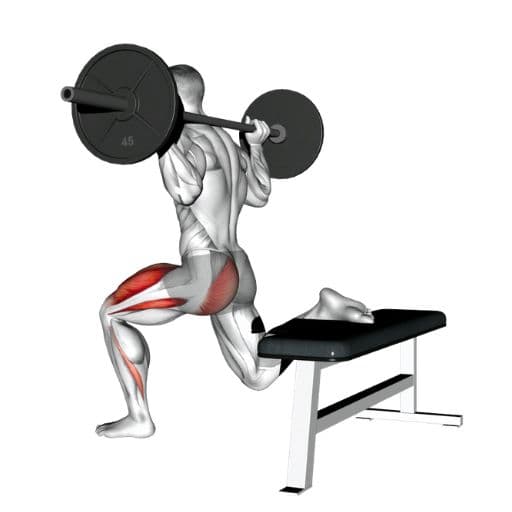
The Bulgarian split squat (also called the rear-foot-elevated split squat) is a unilateral compound lower-body exercise. The lifter places one foot behind them on a bench, holds a barbell across the upper back, descends until the rear knee is near the floor, and drives up through the front foot to full lockout. It targets the quadriceps, glutes, and hamstrings of the front leg while demanding significant core stability and balance.
Unlike the bilateral barbell squat, the BSS trains each leg independently. This makes it highly effective for identifying and correcting left-right strength imbalances, reducing spinal load (lighter barbell for equivalent per-leg work), and building the single-leg stability used in running, cutting, and jumping sports.
All benchmarks on this page are total barbell weight (bar + plates). If your barbell weighs 95 lb, enter 95 lb — the same convention used for the barbell squat, bench press, and deadlift.
Why BSS Standards Have More Variability Than Bilateral Squats
The Bulgarian split squat is balance-limited at higher loads. Holding a barbell on one leg demands proprioception and stability that the bilateral squat does not require. At advanced and elite levels, balance fatigue can end a set before the quadriceps and glutes reach muscular failure.
How does BSS compare to the barbell squat?
For men, the intermediate BSS standard is 0.66× BW vs. the male barbell squat intermediate of 1.50× BW — roughly 44% of the barbell squat. For women, it is 0.53× BW vs. 1.00× BW — roughly 53%. Both ratios are consistent with the expected range for a strict unilateral squat under a barbell.
Bench height matters
Bench height (14–18 inches) and foot distance from the bench directly affect range of motion and muscle emphasis. There is no universal depth standard for the BSS — “rear knee near the floor” is the practical benchmark used by most coaches and community data sources.
Bulgarian Split Squat Strength Levels Explained
What each strength level means for the barbell Bulgarian split squat — from your first week on the bench to elite-level single-leg strength. All values represent total barbell weight relative to bodyweight.
Beginner
Male 0.22× BW • Female 0.13× BWCan complete a full-depth Bulgarian split squat with an empty or lightly loaded barbell while maintaining balance on one leg. Strength at this stage comes primarily from learning the split-squat stance, building single-leg stability, and adapting to the rear-foot-elevated position. Balance is the primary challenge — not leg strength.
Focus: Focus on balance and depth with 8–12 reps per leg. Use a fixed bench (14–16 inches) and keep the front shin roughly vertical. Start with bodyweight or an empty barbell until the movement feels stable.
0–6 months of consistent unilateral training
Novice
Male 0.44× BW • Female 0.31× BWConsistent full-depth reps with a moderate barbell load on both legs. Can maintain an upright torso, controlled descent (rear knee near the floor), and a stable front foot without excessive wobble across multiple sets. Left-right strength differences are noticeable but manageable.
Focus: Linear progression in 5–10 lb barbell jumps. Work primarily in the 6–10 rep range per leg. Pair with bilateral squats and hip-hinge movements. Prioritize equal rep quality on both legs.
6–12 months of structured lower-body training
Intermediate
Male 0.66× BW • Female 0.53× BWSolid single-leg strength with a meaningful barbell load and consistent depth on every rep. Represents roughly 1–2 years of dedicated lower-body training that includes the BSS or similar unilateral work. Balance is well-developed but still demands concentration under load. For men, this is roughly 44% of the barbell squat intermediate (1.50× BW); for women, roughly 53% (vs. 1.00× BW barbell squat) — consistent with the expected unilateral-to-bilateral ratio.
Focus: Periodize rep ranges across 5–10 reps per leg. Progress requires intentional overload: add reps before adding weight. If one leg falls behind, start each set with the weaker side. Consider elevating the front foot on a low plate for extra range of motion.
1–2+ years of consistent training
Advanced
Male 1.06× BW • Female 0.77× BWUpper-tier barbell BSS strength. At this load, the balance demand is significant — each rep requires deliberate bracing and controlled tempo. The barbell must track directly over the front foot to avoid lateral drift. Most lifters at this level treat the BSS as a primary accessory to the bilateral squat rather than a standalone max-effort exercise.
Focus: Structured mesocycles with planned intensity peaks in the 3–6 rep range per leg. Use a consistent bench height and foot placement session to session. Belt usage is common at this level for intra-abdominal pressure support.
3–5+ years of dedicated training
Elite
Male 1.50× BW • Female 0.98× BWExceptional barbell BSS strength seen in competitive strength athletes and advanced bodybuilders with years of specific unilateral training. Maintaining strict depth and balance with this load requires outstanding proprioception, ankle mobility, and core stability. The limiting factor shifts from leg strength to full-body coordination under heavy load.
Focus: Prioritize joint health (especially knees and ankles) and manage training volume carefully. Very small, calculated increases over multi-month blocks. The BSS at this level is typically programmed as a high-intensity accessory, not a daily max-effort lift.
5+ years of serious strength training
Bulgarian Split Squat FAQ
How does the Bulgarian split squat compare to the barbell back squat?
Both train the quadriceps, glutes, and hamstrings through hip and knee extension. The barbell back squat loads both legs simultaneously and allows substantially heavier absolute loads. The BSS trains one leg at a time, which means each leg handles most of the load individually, and the balance demand further limits the weight.
For men, the StrengthRegimen intermediate BSS standard (0.66× BW) is roughly 44% of the barbell squat intermediate (1.50× BW). For women, the BSS intermediate (0.53× BW) is roughly 53% of the female barbell squat intermediate (1.00× BW). These ratios are consistent across multiple data sources and reflect the inherent limitations of single-leg barbell loading. The BSS is best used as a unilateral accessory to the bilateral squat, not as a direct replacement for maximal leg strength development.
What bench height should I use for the Bulgarian split squat?
Most lifters use a bench or box between 14 and 18 inches high. A standard weight bench (about 17–18 inches) works for most people. Shorter lifters (under 5’4”) may benefit from a lower surface (14–15 inches) to avoid excessive hip flexor stretch on the rear leg.
Higher benches increase the range of motion and stretch on the rear hip flexor, which can bias the movement toward the glutes. Lower benches reduce rear-leg stretch and keep the exercise more quad-dominant. For consistent tracking, use the same bench height between sessions.
How do I improve balance during the Bulgarian split squat?
Balance is the most common limiting factor in the BSS, especially for beginners. Start with a lighter load and focus on three things: consistent foot placement (front foot 2–3 feet from the bench), a fixed gaze point (straight ahead, not down), and a deliberate descent tempo (2–3 seconds down).
As balance improves, proprioception adapts and the movement feels more stable. Most lifters see significant balance improvement within 4–6 weeks of training the BSS 2–3 times per week. If balance still limits you after that, check your stance width — a slightly wider lateral stance (hip-width rather than inline) provides more stability without changing the muscle emphasis.
When is the Bulgarian split squat better than bilateral squats?
The BSS is particularly useful for: addressing left-right strength imbalances (each leg works independently), reducing spinal load (lighter barbell for equivalent per-leg work), and building single-leg stability for sports that involve running, cutting, and jumping.
Athletes in running-based sports, field sports, and combat sports often prioritize the BSS because their performance depends on single-leg force production. For pure maximal strength and muscle mass development, the bilateral barbell squat remains more efficient due to higher absolute loading. Most well-designed programs include both.
How should I program the BSS for strength vs. hypertrophy?
For strength: Use heavier loads in the 3–6 rep range per leg with 2–3 minutes rest between sets and 60–120 seconds rest between legs. Focus on controlled tempo and consistent depth. Typically 3–4 working sets, 2× per week.
For hypertrophy: Use moderate loads in the 8–12 rep range per leg with shorter rest (60–90 seconds between sets). Slower eccentrics (3–4 seconds) and a brief pause at the bottom increase time under tension. Typically 3–4 sets, 2–3× per week with at least 48 hours between sessions.
Disclaimer
These are StrengthRegimen training benchmarks for self-assessment, not clinical standards. All values represent total barbell weight (bar + plates). Multi-rep sets are converted to an estimated 1RM using the Epley formula; accuracy is highest at 10 reps or fewer per leg and decreases at higher rep counts due to balance fatigue. Standards are derived from community datasets and adjusted for strict form; individual results vary based on balance ability, bench height, ankle mobility, training history, and left-right strength asymmetries.