Hip Thrust Strength Standards
The Intermediate barbell hip thrust standard is 279 lb (127 kg) for men and 196 lb (89 kg) for women (estimated 1RM at 180 / 140 lb bodyweight, total barbell weight). Compare your lift by bodyweight and age below.
Configure Your Bodyweight & Unit
Male Hip Thrust Standards (lb)
StrengthRegimen standards for 180 lb bodyweight — total barbell weight
| Strength Level | Total Barbell (180 lb BW) | BW Ratio |
|---|---|---|
| Beginner | 108 lb | 0.60x |
| NoviceYou | 189 lb | 1.05x |
| Intermediate | 279 lb | 1.55x |
| Advanced | 405 lb | 2.25x |
| Elite | 540 lb | 3.00x |
How much should I Hip Thrust? (lb)
Assess Your Hip Thrust
Enter your barbell weight and reps completed to estimate your 1RM and strength level
Enter the total loaded barbell weight (bar + all plates)
Hip thrusting 225 lb × 5 reps equals an estimated 1RM of 263 lb.
At 180 lb (Male), that is 1.46× your bodyweight, which falls within the Novice range. Epley-based estimate; accuracy is highest when reps ≤ 10.
Shareable Hip Thrust Strength Card
Hip Thrust Strength Spectrum
Rep-Max & Training Zone Table (LB)
Working loads based on your 263 lb estimated 1RM
| Target | % of 1RM | Barbell Weight | Programming |
|---|---|---|---|
| 1RM (Max) (1 rep) | 100% | 263 lb | 1 × 1 rep (Max Test) |
| 3RM (3 reps) | 90.9% | 239 lb | 3–4 × 3 reps |
| 5RM (5 reps) | 85.7% | 225 lb | 3–4 × 5 reps |
| 8RM (8 reps) | 78.9% | 208 lb | 3–4 × 8 reps |
| 10RM (10 reps) | 75% | 197 lb | 3–4 × 10 reps |
| 12RM (12 reps) | 71.4% | 188 lb | 3 × 12 reps |
| 15RM (15 reps) | 66.7% | 175 lb | 2–3 × 15 reps |
Complete Hip Thrust Reference Chart (LB)
Standards across bodyweights for Male lifters in lb
| BW (lb) | Beginner | Novice | Intermediate | Advanced | Elite |
|---|---|---|---|---|---|
| 120 | 72 | 126 | 186 | 270 | 360 |
| 130 | 78 | 137 | 202 | 293 | 390 |
| 140 | 84 | 147 | 217 | 315 | 420 |
| 150 | 90 | 158 | 233 | 338 | 450 |
| 160 | 96 | 168 | 248 | 360 | 480 |
| 170 | 102 | 179 | 264 | 383 | 510 |
| 180 | 108 | 189 | 279 | 405 | 540 |
| 190 | 114 | 200 | 295 | 428 | 570 |
| 200 | 120 | 210 | 310 | 450 | 600 |
| 210 | 126 | 221 | 326 | 473 | 630 |
| 220 | 132 | 231 | 341 | 495 | 660 |
| 230 | 138 | 242 | 357 | 518 | 690 |
| 240 | 144 | 252 | 372 | 540 | 720 |
| 250 | 150 | 263 | 388 | 563 | 750 |
| 260 | 156 | 273 | 403 | 585 | 780 |
| 270 | 162 | 284 | 419 | 608 | 810 |
| 280 | 168 | 294 | 434 | 630 | 840 |
| 290 | 174 | 305 | 450 | 653 | 870 |
| 300 | 180 | 315 | 465 | 675 | 900 |
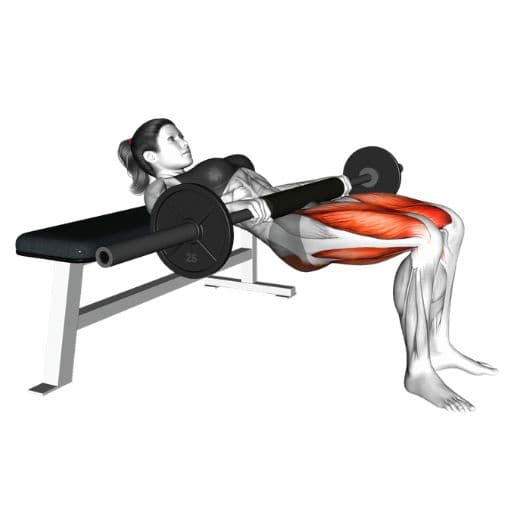
About the Hip Thrust
The barbell hip thrust is a compound posterior-chain exercise performed with the upper back braced against a bench and a loaded barbell across the hips. The lifter drives the hips upward to full extension, primarily targeting the gluteus maximus with secondary involvement from the hamstrings, quadriceps, and core stabilizers. It allows high absolute loads through a short range of motion with no axial spinal loading.
For a valid comparison against these standards, perform reps with full hip extension at the top (brief hold), controlled descent (no bouncing), and no excessive lumbar hyperextension. All weights are total barbell load (bar + plates).
Hip Thrust vs. Squat — Understanding Your Numbers
It is normal to hip thrust more than you squat. The hip thrust has a shorter range of motion, no axial spinal loading (your upper back rests on the bench), and eliminates balance as a limiting factor. For most trained lifters, the barbell hip thrust 1RM falls somewhere between the squat and deadlift 1RM.
Do not treat the hip thrust and squat as interchangeable measures of lower-body strength. They test different movement patterns, load different joints, and involve different relative muscle contributions. Use this tool’s standards directly — they are derived from hip thrust-specific community data, not converted from squat or deadlift numbers.
Hip Thrust Strength Levels Explained
What each strength level means for the barbell hip thrust — from your first session learning the setup to the point where loading the bar is the hardest part. All values are total barbell weight relative to bodyweight.
Beginner
Male 0.60× BW • Female 0.50× BWCan complete a barbell hip thrust with light weight through a full range of motion. At this stage, the main challenges are learning the setup (bench position, foot placement, barbell positioning) and achieving consistent full hip extension at the top. Most people reach this level within their first few weeks of hip thrust training.
Focus: Focus on the lockout position — driving the hips to full extension and holding briefly at the top. Work in the 10–15 rep range with a manageable load to build the movement pattern. Prioritize controlled descent over adding weight.
0–6 months of consistent training
Novice
Male 1.05× BW • Female 0.85× BWConsistent hip thrusts with bodyweight-range loads and reliable form across multiple sets. The setup and lockout feel natural. Loading and unloading the barbell is manageable. Linear progression in small increments is still effective.
Focus: Progress by adding 5–10 lb per session when all reps are completed with strict lockout. Work primarily in the 8–12 rep range. Pair hip thrusts with squats and deadlifts for balanced lower-body development.
6–12 months of structured lower-body training
Intermediate
Male 1.55× BW • Female 1.40× BWSolid hip thrust strength with strict form under meaningful load. For a 180 lb male this is roughly 279 lb (two 45 lb plates per side plus the bar). Represents the typical level of a dedicated lifter with 1–2 years of regular hip thrust training. The limiting factor is raw glute strength, not setup or technique.
Focus: Periodize across 6–12 reps. Progress requires intentional overload — adding reps before increasing barbell weight. A bar pad becomes important for comfort at these loads. Consider alternating hip thrust and deadlift emphasis across training blocks.
1–2+ years of consistent training
Advanced
Male 2.25× BW • Female 2.00× BWUpper-tier barbell hip thrust strength. Loading and unloading the barbell becomes a substantial task in itself (4+ plates per side for a 180 lb male). Setup efficiency, bench stability, and bar pad quality all become relevant limiting factors beyond raw glute strength.
Focus: Structured mesocycles with planned intensity peaks. Ensure the bench is secured against a wall or rack to prevent sliding. Consider using a hip thrust bench or dedicated platform for consistent setup. Joint health (lower back, knees) and recovery become priorities.
3–5+ years of dedicated training
Elite
Male 3.00× BW • Female 2.65× BWExceptional barbell hip thrust strength. At this load the barbell setup, bench stability, and comfort management are significant challenges beyond raw power. This level represents years of dedicated posterior-chain training with well-developed glute, hamstring, and stabilizer musculature.
Focus: Prioritize lower-back health, hip joint mobility, and recovery. Very small, calculated increases over multi-month training blocks. A dedicated hip thrust bench or platform is nearly essential at these loads. Consider using deadlift and squat as primary strength builders with heavy hip thrusts as a targeted accessory.
5+ years of serious strength training
Hip Thrust FAQ
Why can I hip thrust more than I squat?
This is normal and expected. The barbell hip thrust has a shorter range of motion than a full-depth squat, places no axial load on the spine (the bench supports your upper back), eliminates balance as a limiting factor, and has no sticking point comparable to the bottom of a squat.
For most trained lifters, the strict-form barbell hip thrust 1RM is roughly similar to or slightly below the deadlift 1RM, and above the squat 1RM. A 180 lb male with a 315 lb squat might strict-form hip thrust 280–350 lb, depending on training emphasis. The two exercises are not interchangeable measures of lower-body strength — they test different movement patterns and muscle contributions.
What counts as a valid rep?
These standards assume strict form: full hip extension at the top (a straight line from shoulders to knees), a brief hold at lockout (~1 second), and a controlled descent. No bouncing the barbell off the hips or floor.
Excessive lumbar hyperextension (arching the lower back past neutral at the top) does not count as a valid lockout. The extension should come from the hips, not the lumbar spine. Partial reps that stop short of full hip extension are not valid for comparison against these standards.
Many people hip thrust with bouncing and partial ROM in the gym — which is why you may see higher numbers online. These standards are deliberately conservative to reflect strict, controlled performance.
Can I compare barbell and Smith machine hip thrust numbers?
No. The Smith machine eliminates horizontal bar control and changes the bar path, which typically allows higher loads than the free-barbell version. The Smith bar also has a variable starting resistance depending on the counterbalance mechanism (anywhere from 15 to 45 lb depending on the machine).
If you train on a Smith machine, you can still use this tool to track progress — but your numbers will not be directly comparable to barbell standards, and your assessed level may be inflated. For the most accurate assessment, test with a free barbell and enter the total loaded weight.
Do I need a bar pad?
A bar pad (hip thrust pad or squat pad) does not change the load being moved, but it significantly reduces discomfort on the hip crease. At heavier loads, the barbell pressing into the hip bones without a pad can limit your performance more than actual glute strength.
A very thick pad can slightly reduce effective range of motion by increasing the distance between the bar and the hip joint. Standard-thickness pads (1–2 inches) have minimal impact. Whichever you choose, be consistent — always test and train with the same pad (or without) for meaningful comparisons.
How accurate is the 1RM estimate for hip thrusts?
The Epley formula (1RM = weight × (1 + reps / 30)) was validated for barbell compound lifts — not hip thrusts specifically. The barbell hip thrust is a compound barbell movement, so prediction accuracy is expected to be reasonable but somewhat lower than for bench press or squat.
Hip thrusts are especially prone to form degradation at higher rep counts — bouncing, partial lockout, and tempo changes creep in as fatigue builds, which inflates the estimate. For the most reliable 1RM estimate, use a weight you can lift for 10 reps or fewer with strict form (full lockout, controlled descent, no bounce).
Disclaimer
These are training benchmarks for self-assessment, not clinical standards. All values represent total barbell weight (bar + plates). Standards are derived from StrengthLevel.com community data (1.22M lifts, 383K qualifying results) with a strict-form discount; individual results will vary with technique, bench setup, and training background. Consult a qualified professional before attempting maximum-effort lifts.