Cable Kickback Strength Standards
The average Cable Kickback is 54 lb for men and 39 lb for women (1RM per leg). Compare your one-rep max lift by bodyweight and age below.
Configure Your Bodyweight & Unit
Male Cable Kickback Standards (lb/leg)
StrengthRegimen standards for 180 lb bodyweight — per leg
| Strength Level | Per Leg (180 lb BW) | BW Ratio |
|---|---|---|
| Beginner | 14 lb | 0.08x |
| NoviceYou | 32 lb | 0.18x |
| Intermediate | 54 lb | 0.30x |
| Advanced | 86 lb | 0.48x |
| Elite | 122 lb | 0.68x |
How much should I Cable Kickback? (lb/leg)
Assess Your Cable Kickback
Enter the cable stack weight per leg and reps completed to estimate your 1RM and strength level
Enter the stack weight used for one leg. On 2:1 pulley machines, divide the displayed weight by 2.
Kicking 30 lb/leg × 10 reps equals an estimated 1RM of 40 lb per leg.
At 180 lb (Male), that is 0.22× your bodyweight per leg, which falls within the Novice range. Epley-based estimate; accuracy is highest when reps ≤ 12.
Shareable Cable Kickback Strength Card
Where Your Cable Kickback Ranks
Normalized against male lifters at 180 lb bodyweight
Rep-Max & Training Zone Table (LB/leg)
Per-leg loads based on your 40 lb estimated 1RM
| Target | % of 1RM | Per Leg | Programming |
|---|---|---|---|
| 1RM (Max) (1 rep) | 100% | 40 lb | 1 × 1 rep (Max Test) |
| 3RM (3 reps) | 90.9% | 36 lb | 3–4 × 3 reps |
| 5RM (5 reps) | 85.7% | 34 lb | 3–4 × 5 reps |
| 8RM (8 reps) | 78.9% | 32 lb | 3–4 × 8 reps |
| 10RM (10 reps) | 75% | 30 lb | 3–4 × 10 reps |
| 12RM (12 reps) | 71.4% | 29 lb | 3 × 12 reps |
| 15RM (15 reps) | 66.7% | 27 lb | 2–3 × 15 reps |
Complete Cable Kickback Reference Chart (LB/leg)
Per-leg standards across bodyweights for Male lifters in lb
| BW (lb) | Beginner | Novice | Intermediate | Advanced | Elite |
|---|---|---|---|---|---|
| 120 | 10 | 22 | 36 | 58 | 82 |
| 130 | 10 | 23 | 39 | 62 | 88 |
| 140 | 11 | 25 | 42 | 67 | 95 |
| 150 | 12 | 27 | 45 | 72 | 102 |
| 160 | 13 | 29 | 48 | 77 | 109 |
| 170 | 14 | 31 | 51 | 82 | 116 |
| 180 | 14 | 32 | 54 | 86 | 122 |
| 190 | 15 | 34 | 57 | 91 | 129 |
| 200 | 16 | 36 | 60 | 96 | 136 |
| 210 | 17 | 38 | 63 | 101 | 143 |
| 220 | 18 | 40 | 66 | 106 | 150 |
| 230 | 18 | 41 | 69 | 110 | 156 |
| 240 | 19 | 43 | 72 | 115 | 163 |
| 250 | 20 | 45 | 75 | 120 | 170 |
| 260 | 21 | 47 | 78 | 125 | 177 |
| 270 | 22 | 49 | 81 | 130 | 184 |
| 280 | 22 | 50 | 84 | 134 | 190 |
| 290 | 23 | 52 | 87 | 139 | 197 |
| 300 | 24 | 54 | 90 | 144 | 204 |
About the Cable Kickback
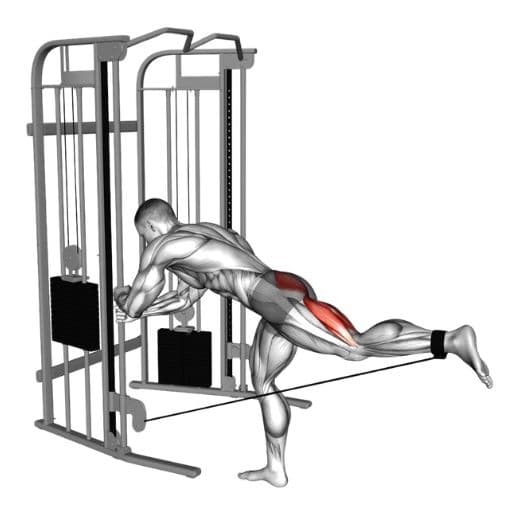
The standing cable kickback is a unilateral hip-extension isolation exercise. The lifter faces a low-pulley cable station, attaches an ankle strap to the working leg, and extends the hip backward against cable resistance while the support leg remains planted. Each leg is trained independently. It is one of the most popular isolation exercises for targeted glute development and addressing left-right imbalances.
All benchmarks on this page represent the cable stack weight for one leg. If you set the cable to 40 lb for your kickbacks, enter 40 lb.
Cable Machine Variability — Read Before Comparing
Cable machines differ in pulley ratio (1:1 vs. 2:1), cable routing, friction, and weight-stack calibration. “40 lb” on one machine may not equal “40 lb” on another. If the cable loops through a second pulley before reaching the ankle strap, your machine likely uses a 2:1 ratio — divide the displayed weight by 2 before entering it here. Track progress on the same machine for meaningful comparisons. See our central Methodology page for details.
Standing Cable Kickback Protocol
These standards assume a standing cable kickback with an ankle strap on a low-pulley cable station. Follow this protocol for consistent, comparable results.
Ankle Strap & Setup
Set the pulley to the lowest position. Attach the ankle strap securely to the working leg just above the ankle bone. Face the weight stack and grip the frame or handle for balance. Stand roughly one step back so there is light cable tension when the working foot is directly beneath you.
Hip Extension
Keep a slight bend in the working knee and a neutral spine. Drive the working leg straight back by extending the hip, squeezing the glute at full contraction. The movement should come entirely from the hip joint — avoid arching the lower back or swinging the leg. Pause briefly at peak contraction.
Controlled Return
Lower the working leg forward under control, resisting the cable’s pull. Return until the foot is roughly beneath or slightly in front of you — do not let the weight stack rest between reps. The support leg stays firm with a slight knee bend throughout. Complete all reps on one side before switching legs.
Valid Counted Rep
- • Full hip extension with glute squeeze at the top
- • Controlled eccentric — no swinging or dropping the weight
- • Neutral spine maintained throughout (no lumbar hyperextension)
- • Movement driven by the hip, not momentum
- • Weight stack does not rest between reps
Invalid / Disallowed
- • Swinging the leg using momentum rather than muscle contraction
- • Excessive lumbar arching to increase range of motion
- • Bending the torso forward to “cheat” the weight up
- • Using a straight leg (knee locked) — a slight bend is required
- • Letting the weight stack slam down between reps
Strength Level Benchmarks
Per-leg benchmarks for the standing cable kickback relative to bodyweight.
Beginner
Male 0.08× BW • Female 0.07× BWCan perform a controlled cable kickback through a full range of motion with light resistance. Strength at this stage comes primarily from learning the hip-extension pattern and activating the glute against cable resistance.
Focus: Focus on mind-muscle connection with 12–15 reps per set. Prioritize feeling the glute contract at peak extension. Keep the support leg stable and the torso upright.
0–6 months of consistent training
Novice
Male 0.18× BW • Female 0.16× BWReliable glute activation with moderate cable loads. Can maintain a neutral spine, controlled tempo, and consistent range of motion across multiple reps without compensating through the lower back.
Focus: Linear progression in small increments (2.5–5 lb jumps). Work primarily in the 10–15 rep range. Begin pairing kickbacks with compound hip-extension movements like hip thrusts or Romanian deadlifts.
6–12 months of structured glute training
Intermediate
Male 0.30× BW • Female 0.28× BWSolid cable kickback strength maintained with strict form under meaningful load. Represents the typical level of a dedicated gym-goer with 1–2 years of regular glute-focused training.
Focus: Periodize rep ranges across 8–15 reps. Progress requires intentional overload — adding reps before increasing weight, or manipulating tempo and pause duration at peak contraction.
1–2+ years of consistent training
Advanced
Male 0.48× BW • Female 0.43× BWUpper-tier cable kickback strength. Maintaining strict form at this load demands strong glute activation and hip-extension control. Requires years of dedicated glute training and careful progressive overload.
Focus: Structured mesocycles with planned intensity peaks. Balance isolation volume with compound hip-extension work. Consider using different cable heights and attachment angles for variety.
3–5+ years of dedicated training
Elite
Male 0.68× BW • Female 0.60× BWExceptional cable kickback strength, typically seen in athletes with extensive glute-focused training history. Maintaining strict hip-extension form at this load per leg without compensatory movement requires outstanding neuromuscular control.
Focus: Prioritize hip and lower-back health. Very small, calculated increases over multi-month blocks. At this level, cable machine friction and setup become significant factors — track progress on the same machine.
5+ years of serious strength training
How to Program Cable Kickbacks by Training Goal
The cable kickback is a single-joint isolation movement that excels when programmed with controlled tempos and moderate-to-high rep ranges. Choose the loading protocol tailored to your goal.
Glute Hypertrophy & Shape
The gold-standard hypertrophy scheme for the cable kickback. Best performed after heavy compound hip-extension movements (like barbell hip thrusts or Romanian deadlifts) to thoroughly fatigue the gluteus maximus without loading the spine.
Glute Activation & Pre-Exhaust
Use a lighter pin setting to establish a strong mind-muscle connection before compound lifts. Waking up dormant glute fibers helps ensure the glutes contribute maximally during squats, lunges, or leg presses rather than relying solely on quadriceps.
Left-Right Imbalance Correction
Because each leg works independently, always begin with your weaker or non-dominant leg. Strictly match the exact reps and load on the dominant side — do not do extra reps on the stronger side even if you have capacity remaining.
Practical Tips for Consistent Progression:
- Slight forward torso lean: Bracing your torso at approximately 15–20° forward helps lock your pelvis in neutral, preventing compensatory lower-back arching.
- Double progression: Focus on increasing repetitions (e.g., from 10 up to 15 reps) before moving the pin up to the next weight increment.
- Track on the same station: Because cable friction and pulley ratios (1:1 vs. 2:1) vary across gym equipment, measure progress over time on the same cable machine.
Cable Kickback Training Insights
Cable kickback vs. hip thrust — how do they compare?
Both target the gluteus maximus, but they differ fundamentally. The hip thrust is a bilateral compound movement that allows heavy absolute loading (often 1.5–2× bodyweight or more). The cable kickback is a unilateral isolation exercise with much lower loads per leg.
Cable kickbacks are best used as an accessory for targeted glute activation, mind-muscle connection, and addressing left-right imbalances. Hip thrusts are better suited for building maximal glute strength and power. Most glute-focused programs benefit from including both.
How do I progress with cable kickbacks?
Cable machines typically allow small weight increments (2.5–5 lb jumps), which makes progression more granular than dumbbells. The most effective approach for cable kickbacks is double progression: add reps at a given weight until you reach the top of your rep range (e.g., 3×15), then increase the weight and drop back to the bottom (e.g., 3×10).
You can also manipulate tempo (slower eccentrics), add pauses at peak contraction (1–2 seconds), or increase total sets per week. All of these provide progressive overload without changing the pin weight.
How do I address left-right glute imbalances?
Cable kickbacks are one of the best exercises for identifying and correcting unilateral glute imbalances because each leg works independently against the same resistance. If one side is noticeably weaker, start each set with the weaker leg and match the reps and weight on the stronger side — do not exceed what the weaker side can do.
A difference of 1–2 reps or roughly 5 lb between legs is common and usually self-corrects over 4–8 weeks of consistent unilateral training. If the imbalance is greater than 15–20% or persists despite targeted work, consider consulting a physical therapist.
Why does the same weight feel different on different cable machines?
Cable machines vary in pulley ratio (1:1 vs. 2:1), cable routing length, bearing friction, and weight-stack calibration. A “40 lb” pin setting on one machine may deliver 40 lb of actual resistance, while the same setting on another delivers 20 lb (2:1 ratio) or slightly more than 40 lb (due to friction).
For consistent tracking, always use the same machine at your gym. If you switch gyms or machines, expect a recalibration period. The standards on this page assume a standard 1:1 pulley ratio — the most common configuration in commercial gym cable stations.
How reliable is a cable kickback 1RM estimate?
The Epley formula used here was validated on barbell compound lifts (LeSuer et al., 1997). Its accuracy has not been independently studied on cable isolation exercises. Cable kickbacks are a single-joint hip extension, similar in mechanics to exercises where submaximal estimation is standard (hamstring curl, leg extension).
For the most reliable estimate, use sets of 8–12 reps. Cable kickbacks are rarely trained as heavy singles, so a moderate-rep estimate is both more practical and closer to how the exercise is actually performed. Estimates from sets above 15 reps carry meaningfully more error.
Disclaimer
These are training benchmarks for self-assessment, not clinical standards. All values represent the cable stack weight for one leg. Standards are derived from community datasets; cable machine variability means absolute comparisons across machines are approximate.