Romanian Deadlift Strength Standards
The Intermediate Romanian Deadlift is 252 lb (114 kg) for men and 133 lb (60 kg) for women (est. 1RM, total barbell). Compare your RDL strength by bodyweight and age below.
Configure Your Bodyweight & Unit
Male Romanian Deadlift Standards (lb)
StrengthRegimen standards for 180 lb bodyweight — total barbell (bar + plates)
| Strength Level | Total Barbell (180 lb BW) | BW Ratio |
|---|---|---|
| Beginner | 117 lb | 0.65x |
| NoviceYou | 180 lb | 1.00x |
| Intermediate | 252 lb | 1.40x |
| Advanced | 324 lb | 1.80x |
| Elite | 423 lb | 2.35x |
Enter Your Romanian Deadlift Set
Enter the total barbell weight (bar + plates) and repetitions from a recent controlled RDL set. The tool estimates your 1RM using the Epley formula and classifies your strength level.
Based on 185 lb \u00d7 8 reps — Male @ 180 lb
Rep-Max Training Zones
Based on your estimated 1RM of 234 lb — total barbell weight
| Rep-Max | Target (lb) | Prescription | Training Zone |
|---|---|---|---|
| 1RM (Max) | 234 lb | 1 × 1 rep (Max Test) | Max Strength |
| 3RM | 213 lb | 3–5 × 3 reps | Strength |
| 5RM | 201 lb | 3–4 × 5 reps | Strength |
| 8RM | 185 lb | 3–4 × 8 reps | Hypertrophy |
| 10RM | 176 lb | 3–4 × 10 reps | Hypertrophy |
| 12RM | 167 lb | 3 × 12 reps | Muscle & Volume |
| 15RM | 156 lb | 2–3 × 15 reps | Volume & Endurance |
The RDL is predominantly trained in the 5–12 rep range (SL workout data shows 3×10 is most popular at 17%, followed by 3×8 at 16%). The 1RM is an estimate for comparison — most lifters should prioritize the 5–12 rep hypertrophy/strength zone. Values are total barbell weight (bar + plates).
Male RDL Standards by Bodyweight
Total barbell weight (lb) — all bodyweights
| BW (lb) | Beginner | Novice | Intermediate | Advanced | Elite |
|---|---|---|---|---|---|
| 120 | 78 | 120 | 168 | 216 | 282 |
| 130 | 85 | 130 | 182 | 234 | 306 |
| 140 | 91 | 140 | 196 | 252 | 329 |
| 150 | 98 | 150 | 210 | 270 | 353 |
| 160 | 104 | 160 | 224 | 288 | 376 |
| 170 | 111 | 170 | 238 | 306 | 400 |
| 180 | 117 | 180 | 252 | 324 | 423 |
| 190 | 124 | 190 | 266 | 342 | 447 |
| 200 | 130 | 200 | 280 | 360 | 470 |
| 210 | 137 | 210 | 294 | 378 | 494 |
| 220 | 143 | 220 | 308 | 396 | 517 |
| 230 | 150 | 230 | 322 | 414 | 541 |
| 240 | 156 | 240 | 336 | 432 | 564 |
| 250 | 163 | 250 | 350 | 450 | 588 |
| 260 | 169 | 260 | 364 | 468 | 611 |
| 270 | 176 | 270 | 378 | 486 | 635 |
| 280 | 182 | 280 | 392 | 504 | 658 |
| 290 | 189 | 290 | 406 | 522 | 682 |
| 300 | 195 | 300 | 420 | 540 | 705 |
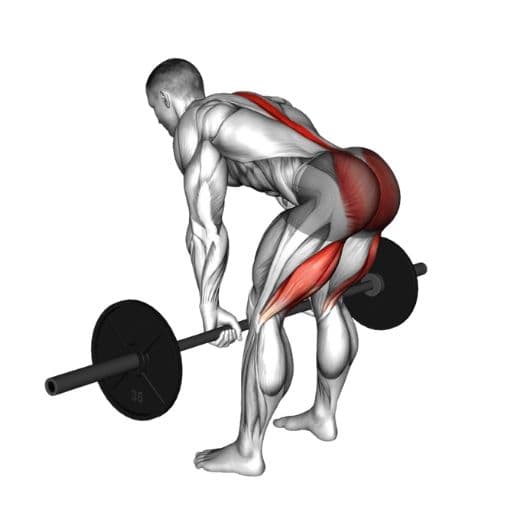
About the Romanian Deadlift
The barbell Romanian Deadlift (RDL) is a hip-hinge exercise emphasizing the hamstrings and posterior chain. Starting from a standing position with the bar at hip height, the lifter hinges at the hips while maintaining a slight knee bend, lowering the bar along the legs under control until a strong hamstring stretch is felt, then drives the hips forward to return to standing. The bar does not touch the floor between repetitions. It is one of the most effective exercises for developing hamstring strength, hip extension power, and posterior chain resilience.
All benchmarks on this page represent total barbell weight (bar + plates). A standard Olympic bar weighs 45 lb / 20 kg. If you use 135 lb total, enter 135 lb. This matches the convention for all barbell exercises on StrengthRegimen, including the Conventional Deadlift.
RDL vs. Conventional Deadlift — Understanding the Difference
The conventional deadlift is a concentric-dominant pull from the floor with significant quadriceps involvement. The Romanian Deadlift is an eccentric-dominant hip hinge from standing that emphasizes the hamstrings and glutes while minimizing quadriceps contribution. StrengthLevel.com comparison data (1.15M RDL lifts vs 22.9M conventional deadlift lifts) shows the RDL is approximately 73–83% of the conventional deadlift for men (increasing with experience level) and approximately 75% for women across all levels. At the StrengthRegimen intermediate level for a 180 lb male: RDL 252 lb vs CDL 315 lb (80%).
Do not use these standards interchangeably. If your RDL approaches your conventional deadlift, you are likely using excessive quadriceps drive or pulling from the floor rather than performing a true hip-hinge RDL. The knees should maintain a slight, consistent bend, the bar should stay on or very close to the legs, and it should not touch the floor between repetitions.
Romanian Deadlift Strength Levels Explained
What each strength level means for the barbell Romanian Deadlift with strict hip-hinge form — controlled eccentric, consistent knee bend, bar close to the body, no floor contact between reps. All values are total barbell weight (bar + plates) relative to bodyweight.
Beginner
Male 0.65× BW • Female 0.40× BWCan perform the Romanian Deadlift with light to moderate load while learning the hip-hinge pattern. For a 180 lb male this is approximately 117 lb total barbell. The primary challenge is learning to hinge at the hips rather than squatting, keeping the bar close to the body, and maintaining a slight consistent knee bend. Many beginners round the lower back or straighten the legs excessively.
Focus: Focus on mastering the hip-hinge pattern with a dowel or empty bar before adding load. Practice hinging by pushing the hips back as if closing a car door with your glutes. Keep the barbell in contact with the thighs throughout. Aim for 3 × 10–12 reps with a controlled 2–3 second eccentric. Prioritize consistent form over weight.
0–6 months of consistent training
Novice
Male 1.00× BW • Female 0.65× BWThe hip-hinge pattern is consistent and repeatable under moderate load. For a 180 lb male this is approximately 180 lb total barbell — bodyweight on the bar. The lifter maintains a flat or slightly arched lower back, consistent knee bend, and controlled bar path from hip to mid-shin. Hamstring stretch awareness is developing.
Focus: Progress by adding 5–10 lb when all prescribed reps are completed with strict form. Work primarily in the 5–10 rep range. Focus on the mind-muscle connection with the hamstrings during the eccentric phase. Consider pausing briefly at the bottom to reinforce the stretch position.
6–12 months of structured posterior chain training
Intermediate
Male 1.40× BW • Female 0.95× BWStrong hip-hinge mechanics with meaningful load. For a 180 lb male this is approximately 252 lb total barbell. Represents the typical level of a dedicated lifter with 1–2 years of consistent posterior chain training who includes the RDL as a regular accessory. The lifter can maintain a rigid torso and smooth bar path at this load.
Focus: Periodize across 5–12 reps. Consider tempo variations (3-second eccentric, pause at stretch) for continued development. Grip may begin to be a limiting factor — address with mixed grip, straps, or dedicated grip training. Monitor lower back fatigue and program volume carefully alongside conventional deadlift and squat work.
1–2+ years of consistent training
Advanced
Male 1.80× BW • Female 1.30× BWStrong posterior chain development. For a 180 lb male this is approximately 324 lb total barbell. The lifter maintains strict RDL form — no rounding, no bouncing, consistent ROM — at a load that would cause many lifters to revert to a conventional deadlift pattern. Requires both hamstring strength and excellent hip-hinge motor control under heavy load.
Focus: Structured mesocycles with planned intensity variations. Balance RDL volume with conventional deadlift and squat training. Consider deficit RDLs or banded RDLs for targeted overload. Prioritize lower back and hamstring health with adequate recovery between heavy sessions.
3–5+ years of dedicated posterior chain training
Elite
Male 2.35× BW • Female 1.75× BWExceptional RDL strength. For a 180 lb male this is approximately 423 lb total barbell with strict hip-hinge form throughout. Maintaining a true Romanian Deadlift pattern (no floor touch, consistent knee bend, controlled eccentric) at this load requires years of dedicated development. Grip strength, hamstring resilience, and lower back endurance are all highly developed.
Focus: Calculated long-term progression with multi-month training blocks. Strategic deloads are essential. Many elite lifters use the RDL as a primary posterior chain developer alongside competition deadlifts. Consider periodizing between heavy RDLs (3–5 reps) and moderate-load RDLs (8–12 reps) across mesocycles.
5+ years of serious strength training
Romanian Deadlift FAQ
How is the Romanian Deadlift different from a conventional deadlift?
The conventional deadlift starts from the floor, uses a concentric pull with significant quadriceps involvement, and returns the bar to the floor each rep. The Romanian Deadlift (RDL) starts from standing, emphasizes the eccentric (lowering) phase, maintains a slight knee bend throughout, and reverses at the point of maximal hamstring stretch \u2014 typically mid-shin to just below the knee. The bar does not touch the floor between reps.
Because of the reduced quadriceps contribution and the emphasis on eccentric control, the RDL typically uses 73\u201383% of conventional deadlift load for men (increasing with experience level) and approximately 75% for women. StrengthLevel.com comparison data (1.15M RDL lifts vs 22.9M CDL lifts) confirms these ratios. Do not use these standards interchangeably.
How far down should I lower the bar?
Lower the bar until you feel a strong stretch in the hamstrings, typically somewhere between mid-shin and just below the knee. There is no single correct depth for everyone \u2014 hamstring flexibility, femur length, and hip anatomy all affect range of motion.
The key indicators of appropriate depth are: (1) you feel a distinct hamstring stretch, (2) your lower back remains flat or slightly arched (no rounding), and (3) the bar stays in contact with the legs throughout. Forcing the bar lower than your flexibility allows leads to lumbar flexion, which changes the exercise into a stiff-leg deadlift and increases spinal load. Consistent range of motion across sets is more important than absolute depth.
Is the RDL different from the stiff-leg deadlift?
Yes, though many people use the terms interchangeably. In the Romanian Deadlift, the knees maintain a slight, consistent bend (approximately 15\u201320\u00b0), the hips push back, and the bar stays very close to the legs. The range of motion is limited by the hamstring stretch. In the stiff-leg deadlift (SLDL), the knees are nearly locked, the bar may drift forward away from the body, and the range of motion often extends further toward the floor, placing greater stress on the lower back and less emphasis on hip-hinge mechanics.
McAllister et al. (2014, J Strength Cond Res 28(6):1573\u20131580) demonstrated that the RDL and SLDL activate the hamstrings similarly but the RDL places less demand on the erector spinae due to the more posterior weight distribution and hip-dominant mechanics. These standards apply to the RDL specifically \u2014 results from a stiff-leg deadlift are not directly comparable.
Should I use straps for the Romanian Deadlift?
Grip can become the limiting factor before the posterior chain is fully challenged, especially at the intermediate level and above. Using lifting straps or a mixed (over-under) grip is a practical option when the goal is to maximize hamstring and glute loading.
If you use straps, your effective hamstring loading will be higher than with a double-overhand grip. For these standards, use whichever grip allows you to complete the set with strict RDL form. Be consistent across assessments \u2014 switching grip method between tests reduces comparability.
How does the RDL compare to the hip thrust for posterior chain development?
The RDL and hip thrust are complementary, not interchangeable. The RDL emphasizes the hamstrings in a lengthened (stretched) position and trains the hip-hinge pattern under axial load. The hip thrust emphasizes the glutes at peak hip extension with a shorter range of motion and allows heavier loading due to the mechanical advantage.
At the intermediate level for a 180 lb male, the StrengthRegimen RDL standard is 252 lb while the hip thrust standard is 279 lb. The hip thrust is higher because its short ROM and supported back position allow greater absolute load. Both exercises are valuable for posterior chain development, and most strength programs benefit from including both.
Disclaimer
These are training benchmarks for self-assessment, not clinical standards. All values represent total barbell weight (bar + plates). Standards are derived from StrengthLevel.com community data (1.15M lifts, 360K qualifying) with a strict-form discount, cross-validated against FitnessVolt model estimates and hierarchy-validated against conventional deadlift and hip thrust standards. Range of motion, hamstring flexibility, grip method, and technique consistency all affect individual results. The 1RM is estimated from multi-rep sets using the Epley formula — accuracy is best with sets of 3–10 reps with consistent RDL form. Consult a qualified professional before attempting high-intensity resistance training.