Incline Bench Press Strength Standards
The Intermediate incline bench press standard is 171 lb (78 kg) for men and 81 lb (37 kg) for women (estimated 1RM at 180 / 140 lb bodyweight, total barbell weight). Bench angle: 30°. Compare your lift by bodyweight and age below.
Configure Your Bodyweight & Unit
Male Incline Bench Press Standards (lb)
StrengthRegimen standards for 180 lb bodyweight — total barbell weight · 30° incline
| Strength Level | Total Barbell (180 lb BW) | BW Ratio |
|---|---|---|
| Beginner | 76 lb | 0.42x |
| Novice | 135 lb | 0.75x |
| IntermediateYou | 171 lb | 0.95x |
| Advanced | 216 lb | 1.20x |
| Elite | 279 lb | 1.55x |
How much should I Incline Bench Press? (lb)
Assess Your Incline Bench Press
Enter your barbell weight and reps completed to estimate your 1RM and strength level
Enter the total loaded barbell weight (bar + all plates)
Incline pressing 175 lb × 5 reps equals an estimated 1RM of 204 lb.
At 180 lb (Male), that is 1.13× your bodyweight, which falls within the Intermediate range on a 30° incline. Epley-based estimate.
Shareable Incline Bench Press Strength Card
Incline Bench Press Strength Spectrum
Rep-Max & Training Zone Table (LB)
Working loads based on your 204 lb estimated 1RM
| Target | % of 1RM | Barbell Weight | Programming |
|---|---|---|---|
| 1RM (Max) (1 rep) | 100% | 204 lb | 1 × 1 rep (Max Test) |
| 3RM (3 reps) | 90.9% | 185 lb | 3–4 × 3 reps |
| 5RM (5 reps) | 85.7% | 175 lb | 3–4 × 5 reps |
| 8RM (8 reps) | 78.9% | 161 lb | 3–4 × 8 reps |
| 10RM (10 reps) | 75% | 153 lb | 3–4 × 10 reps |
| 12RM (12 reps) | 71.4% | 146 lb | 3 × 12 reps |
| 15RM (15 reps) | 66.7% | 136 lb | 2–3 × 15 reps |
Complete Incline Bench Press Reference Chart (LB)
Standards across bodyweights for Male lifters in lb
| BW (lb) | Beginner | Novice | Intermediate | Advanced | Elite |
|---|---|---|---|---|---|
| 120 | 50 | 90 | 114 | 144 | 186 |
| 130 | 55 | 98 | 124 | 156 | 202 |
| 140 | 59 | 105 | 133 | 168 | 217 |
| 150 | 63 | 113 | 143 | 180 | 233 |
| 160 | 67 | 120 | 152 | 192 | 248 |
| 170 | 71 | 128 | 162 | 204 | 264 |
| 180 | 76 | 135 | 171 | 216 | 279 |
| 190 | 80 | 143 | 181 | 228 | 295 |
| 200 | 84 | 150 | 190 | 240 | 310 |
| 210 | 88 | 158 | 200 | 252 | 326 |
| 220 | 92 | 165 | 209 | 264 | 341 |
| 230 | 97 | 173 | 219 | 276 | 357 |
| 240 | 101 | 180 | 228 | 288 | 372 |
| 250 | 105 | 188 | 238 | 300 | 388 |
| 260 | 109 | 195 | 247 | 312 | 403 |
| 270 | 113 | 203 | 257 | 324 | 419 |
| 280 | 118 | 210 | 266 | 336 | 434 |
| 290 | 122 | 218 | 276 | 348 | 450 |
| 300 | 126 | 225 | 285 | 360 | 465 |
About the Incline Bench Press
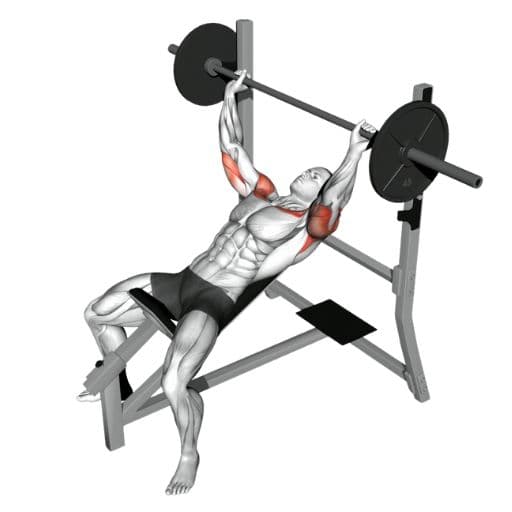
The barbell incline bench press is a compound upper-body pressing movement performed on a bench set to approximately 30 degrees. The lifter unracks a loaded barbell, lowers it under control to the upper chest (clavicle line), and presses it to full arm extension. The incline angle shifts emphasis to the clavicular (upper) head of the pectoralis major and the anterior deltoids compared to the flat bench press, while reducing load capacity by approximately 20–25%.
For a valid comparison against these standards, set the bench to 30° (±5°), touch the bar to the upper chest (clavicle line), press through a full range of motion, and use controlled tempo (no bouncing). All weights are total barbell load (bar + plates).
Incline vs. Flat Bench Press — Understanding Your Numbers
It is normal for your incline bench press to be lower than your flat bench. The 30° incline shifts demand from the larger sternal pectoral fibers to the smaller clavicular (upper) pec and anterior deltoid fibers. Peer-reviewed research (Rodríguez-Ridao et al. 2020; Kim & Kang 2006) consistently shows the incline barbell 1RM is approximately 75–80% of the flat bench 1RM at this angle.
Do not compare your incline bench directly to flat bench standards. These incline-specific standards are derived from StrengthLevel.com incline bench data (2.17M lifts, 594K qualifying) with a strict-form discount, not converted from flat bench numbers. The two exercises test overlapping but distinct strength qualities.
How to Test Your Incline Bench Press
Setup: Set an adjustable bench inside a power rack (or use a dedicated incline bench station) at 30°. Position the J-hooks so the bar is at locked-arm height when your back is pressed into the bench. Use a standard Olympic barbell (45 lb / 20 kg).
Execution: Unrack the bar with a grip slightly wider than shoulder-width. Lower the bar to the upper chest (just below the collarbones) under control. Press upward through full elbow extension. The bar path will be slightly more vertical than a flat bench press.
Validity: Do not use excessive arch, hip lift, or bouncing off the chest. Keep your feet flat on the floor and your hips on the bench throughout the lift. If you don’t test a true 1RM, enter the weight and reps you completed — the tool estimates your 1RM using the Epley formula.
Incline Bench Press Strength Levels Explained
What each strength level means for the barbell incline bench press at 30° — from learning the bar path to the upper chest to pressing well above bodyweight at a steep disadvantage. All values are total barbell weight relative to bodyweight.
Beginner
Male 0.42× BW • Female 0.22× BWCan complete an incline barbell press with light weight through a full range of motion. At this stage, the main challenges are setting the bench to 30°, unracking the bar safely at the incline angle, finding the correct bar path to the upper chest (clavicle line), and controlling the longer bar travel compared to the flat bench. Most people reach this level within their first few weeks of incline pressing.
Focus: Focus on the bar path — the bar should touch the upper chest just below the collarbones, not the lower chest. Work in the 8–12 rep range with a light, controlled load to build the movement pattern. Keep the bench angle at 30° and avoid flaring the elbows excessively.
0–6 months of consistent training
Novice
Male 0.75× BW • Female 0.38× BWConsistent incline pressing with reliable bar path and upper-chest contact across multiple sets. For a 180 lb male this is approximately 135 lb — one 45 lb plate per side plus the bar. The unrack and rerack at the incline angle feel manageable, and the bar naturally tracks to the upper chest without constant correction.
Focus: Progress by adding 5 lb per session when all prescribed reps are completed with strict form. Work primarily in the 5–8 rep range. Begin pairing incline pressing with flat bench and overhead pressing for balanced shoulder and chest development.
6–12 months of structured pressing training
Intermediate
Male 0.95× BW • Female 0.58× BWSolid incline bench strength approaching bodyweight. For a 180 lb male this is roughly 171 lb. The bar path to the upper chest is grooved and consistent, and the limiting factor is pressing strength rather than setup or technique. This represents roughly 75–80% of a typical flat bench 1RM at this level, consistent with the biomechanical disadvantage of the incline angle.
Focus: Periodize across 3–8 reps. Progress requires intentional overload — adding reps before increasing weight. Ensure the bench angle stays at 30° between sessions for consistent tracking. Consider alternating incline and flat bench emphasis across training blocks.
1–2+ years of consistent pressing training
Advanced
Male 1.20× BW • Female 0.85× BWAbove-bodyweight incline pressing strength. For a 180 lb male this is approximately 216 lb. Unracking and reracking at this load on an incline becomes a genuine challenge — a spotter or quality J-hooks at the correct height become important. The upper pectorals and anterior deltoids are well developed, and the incline press is a genuine strength movement, not just a light accessory.
Focus: Structured mesocycles with planned intensity peaks. Ensure the bench is inside a power rack or has reliable safeties — failing an incline press is harder to manage than a flat bench. Shoulder health (rotator cuff, anterior capsule) and recovery between pressing sessions become priorities.
3–5+ years of dedicated pressing training
Elite
Male 1.55× BW • Female 1.12× BWExceptional incline bench press strength. For a 180 lb male this is roughly 279 lb — about two 45 lb plates and a 25 per side. The unrack alone requires a spotter or a precisely adjusted rack at this load. This level represents years of dedicated upper-body pressing training with outstanding upper pectoral and anterior deltoid development.
Focus: Prioritize shoulder health, scapular stability, and gradual load management. Very small, calculated increases over multi-month training blocks. Safeties and a reliable spotter are essential. Consider using flat bench and overhead press as primary strength drivers with heavy incline pressing as a targeted secondary lift.
5+ years of serious strength training
Incline Bench Press FAQ
Why is my incline bench press lower than my flat bench?
This is expected and well-documented in peer-reviewed research. The 30° incline shifts mechanical demand from the larger sternal (lower) pectoralis major fibers to the smaller clavicular (upper) pectoralis major and anterior deltoid fibers. These muscles produce less total force in this position.
Research consistently shows the incline barbell bench press 1RM at 30° is approximately 75–80% of the flat bench 1RM (Rodríguez-Ridao et al. 2020; Kim & Kang 2006). The longer bar path and different pressing angle also reduce the effectiveness of the leg drive that contributes to flat bench performance. If your flat bench 1RM is 225 lb, an incline 1RM in the 170–180 lb range is consistent with normal biomechanics.
What bench angle should I use?
These standards are based on a 30° incline (±5°). This is the most commonly studied angle and the one that produces the highest upper pec (clavicular) activation while still allowing meaningful load (Rodríguez-Ridao et al. 2020).
A steeper incline (45°+) shifts more demand to the anterior deltoids and reduces total load capacity, making it closer to an overhead press variation. A shallower incline (15°) is closer to a flat bench in muscle recruitment. Whatever angle you choose, keep it consistent — comparing a set at 30° to a set at 45° is not a valid progress comparison. Most adjustable benches have a 30° setting; if yours does not, the notch closest to 30° is acceptable.
Where should the bar touch on an incline press?
On a 30° incline, the bar should touch the upper chest at or just below the clavicle line — roughly 2–4 inches higher than a flat bench touch point. This is not the same touch point as a flat bench press (mid-sternum / nipple line).
Touching too low (at the nipple line) turns the movement into a flat bench with a tilted seat and reduces upper pec recruitment. Touching too high (at the neck) places excessive stress on the anterior shoulder capsule. The correct touch point should feel natural for your shoulder anatomy — the forearms should be roughly vertical (perpendicular to the floor) at the bottom of the rep when viewed from the side.
How accurate is the 1RM estimate for the incline bench?
The Epley formula (1RM = weight × (1 + reps / 30)) was validated primarily on barbell bench press and squat data. The incline barbell bench press is biomechanically similar to the flat bench, so prediction accuracy is expected to be comparable for sets of 10 reps or fewer.
At higher rep counts (>10), estimation error increases because shoulder fatigue, grip shifts, and loss of scapular position on the incline bench compound faster than on the flat bench. The incline position also makes it harder to maintain a consistent bar path under fatigue, which further reduces prediction reliability. For the most accurate assessment, use a weight you can lift for 10 reps or fewer with strict form (paused at the upper chest, controlled tempo, no bouncing).
When and why should I train the incline bench press?
The incline bench press is the primary barbell exercise for developing the upper (clavicular) portion of the pectoralis major and the anterior deltoids. If your flat bench press is strong but your upper chest appears underdeveloped, the incline press directly addresses that imbalance.
Most intermediate and advanced pressing programs include both flat and incline barbell work. A common approach is to alternate emphasis across training blocks — for example, flat bench as the primary press for one mesocycle, then incline as the primary press for the next. The incline press also serves as a useful diagnostic lift: if your incline 1RM drops below 70% of your flat bench, it may indicate a relative weakness in the upper pec and anterior deltoid that could limit overall pressing progress.
Disclaimer
These are training benchmarks for self-assessment, not clinical standards. All values represent total barbell weight (bar + plates) at a 30° incline. Standards are derived from StrengthLevel.com community data (2.17M lifts, 594K qualifying results) cross-validated against peer-reviewed incline-to-flat ratios, with a strict-form discount; individual results will vary with technique, bench angle, and training background. Consult a qualified professional before attempting maximum-effort lifts.