Power Clean Strength Standards
The Intermediate power clean standard is 171 lb (78 kg) for men and 98 lb (44 kg) for women (estimated 1RM at 180 / 140 lb bodyweight, total barbell weight). Compare your lift by bodyweight and age below.
Configure Your Bodyweight & Unit
Male Power Clean Standards (lb)
StrengthRegimen standards for 180 lb bodyweight — total barbell weight
| Strength Level | Total Barbell (180 lb BW) | BW Ratio |
|---|---|---|
| Beginner | 90 lb | 0.50x |
| Novice | 130 lb | 0.72x |
| IntermediateYou | 171 lb | 0.95x |
| Advanced | 220 lb | 1.22x |
| Elite | 270 lb | 1.50x |
How much should I Power Clean? (lb)
Assess Your Power Clean
Enter your barbell weight and reps completed to estimate your 1RM and strength level
Enter the total loaded barbell weight (bar + all plates)
Explosive lift notice: The Epley formula was validated on grinding strength movements (bench, squat), not explosive lifts. Power clean technique degrades faster than strength under fatigue, so 1RM estimates from sets above 5 reps are substantially less accurate. For the best result, enter a 1–5 rep max.
Power cleaning 155 lb × 3 reps equals an estimated 1RM of 171 lb.
At 180 lb (Male), that is 0.95× your bodyweight, which falls within the Intermediate range. Epley-based estimate; accuracy is highest when reps ≤ 5 for explosive lifts.
Shareable Power Clean Strength Card
Power Clean Strength Spectrum
Rep-Max & Training Zone Table (LB)
Working loads based on your 171 lb estimated 1RM
| Target | % of 1RM | Barbell Weight | Programming |
|---|---|---|---|
| 1RM (Max) (1 rep) | 100% | 171 lb | Work to max single |
| 2RM (2 reps) | 93.8% | 160 lb | 3–5 × 2 reps |
| 3RM (3 reps) | 90.9% | 155 lb | 3–5 × 3 reps |
| 5RM (5 reps) | 85.7% | 147 lb | 3–5 × 5 reps |
| 8RM (8 reps) | 78.9% | 135 lb | 3 × 8 reps |
Complete Power Clean Reference Chart (LB)
Standards across bodyweights for Male lifters in lb
| BW (lb) | Beginner | Novice | Intermediate | Advanced | Elite |
|---|---|---|---|---|---|
| 120 | 60 | 86 | 114 | 146 | 180 |
| 130 | 65 | 94 | 124 | 159 | 195 |
| 140 | 70 | 101 | 133 | 171 | 210 |
| 150 | 75 | 108 | 143 | 183 | 225 |
| 160 | 80 | 115 | 152 | 195 | 240 |
| 170 | 85 | 122 | 162 | 207 | 255 |
| 180 | 90 | 130 | 171 | 220 | 270 |
| 190 | 95 | 137 | 181 | 232 | 285 |
| 200 | 100 | 144 | 190 | 244 | 300 |
| 210 | 105 | 151 | 200 | 256 | 315 |
| 220 | 110 | 158 | 209 | 268 | 330 |
| 230 | 115 | 166 | 219 | 281 | 345 |
| 240 | 120 | 173 | 228 | 293 | 360 |
| 250 | 125 | 180 | 238 | 305 | 375 |
| 260 | 130 | 187 | 247 | 317 | 390 |
| 270 | 135 | 194 | 257 | 329 | 405 |
| 280 | 140 | 202 | 266 | 342 | 420 |
| 290 | 145 | 209 | 276 | 354 | 435 |
| 300 | 150 | 216 | 285 | 366 | 450 |
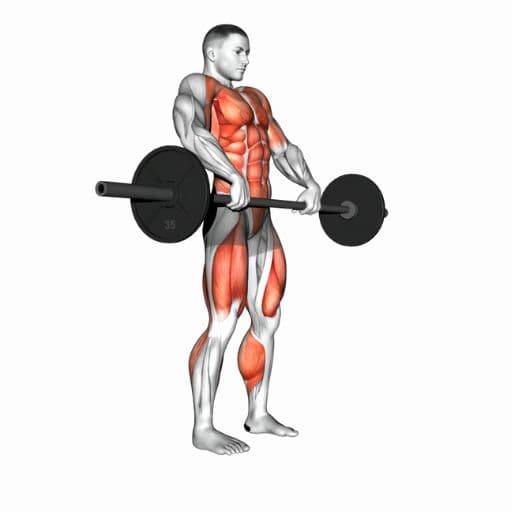
About the Power Clean
The barbell power clean is an explosive full-body lift performed from the floor. The lifter pulls the barbell using a coordinated first pull (floor to knees) and second pull (triple extension of ankles, knees, and hips), then catches the bar on the front of the shoulders in a front-rack position while receiving it above parallel squat depth. It demands both strength and speed — the bar must move fast enough to reach the shoulders, making it technique-limited rather than purely strength-limited.
For a valid comparison against these standards, the bar must start on the floor, be pulled with a triple extension, and caught in the front-rack position above parallel. All weights are total barbell load (bar + plates).
How to Test Your Power Clean 1RM
Warm up thoroughly before attempting a heavy single. Start with 2–3 sets of 3 reps at 50–60% of your estimated max, then 1–2 reps at 70%, 80%, and 90%. Rest 3–5 minutes between heavy attempts. A proper warm-up is critical for explosive lifts — cold attempts are both less accurate and more injury-prone.
Use bumper plates on a platform or rubberized floor. The power clean involves dropping the bar from the shoulders — standard iron plates and bare concrete floors are not appropriate. If bumper plates are unavailable, test with a heavy 3RM and use the calculator above to estimate your 1RM.
Record your attempt from the side. Video review helps confirm catch depth (above parallel), bar path, and technique quality. A clean that dips below parallel on the catch is a full clean, not a power clean.
Power Clean vs. Full (Squat) Clean — Understanding the Difference
The pull is identical in both lifts. The difference is the receiving position. In a power clean, the bar is caught with hips and knees above parallel. In a full clean (squat clean), the lifter drops into a deep front squat below parallel to receive the bar. Because you don’t need to pull the bar as high in a full clean, the full clean 1RM is typically 10–20% higher than the power clean 1RM.
These standards apply to the power clean only. Do not enter your full clean numbers — they are not interchangeable. If you primarily train the full clean, your power clean will be lower, and that is expected. The power clean tests pulling power and bar speed rather than receiving-position depth and front squat mobility.
Power Clean Strength Levels Explained
What each strength level means for the barbell power clean — from learning the pull to competing with explosive precision. All values are total barbell weight relative to bodyweight. The bar must be caught above parallel.
Beginner
Male 0.50× BW • Female 0.35× BWCan complete a barbell power clean from the floor with light weight, catching it in the front-rack position above parallel. The main challenges at this stage are learning the first pull (floor to knees), the second pull (triple extension), and the turnover into the catch. Most people at this level are working with just the bar or very light plates while building the movement pattern.
Focus: Drill the positions in sequence: first pull, scoop/transition, second pull, catch. Hang power cleans and muscle cleans at light loads help build timing. Work in sets of 3–5 reps with weight you can catch cleanly every rep. Film yourself from the side to check bar path.
0–6 months of power clean practice
Novice
Male 0.72× BW • Female 0.50× BWThe basic power clean movement pattern is established — the bar travels close to the body, triple extension is recognizable, and the catch consistently lands above parallel with elbows forward. Loading is still relatively light, but the lift looks and feels like a power clean rather than a reverse curl. Linear progression (adding 5 lb per session) is still effective.
Focus: Progress by adding 5 lb per session when all reps are completed with clean catches. Use 3–5 sets of 3 reps as the primary scheme. Front squats and Romanian deadlifts build the positions that carry over to the clean. Address mobility if wrist or shoulder tightness limits the front-rack catch.
6–12 months of consistent power clean training
Intermediate
Male 0.95× BW • Female 0.70× BWSolid power clean strength with competent technique under meaningful load. For a 180 lb male, this is roughly 171 lb — a 45 lb plate and a 10 per side plus the bar. The bar path is consistent, the catch is secure, and the lifter can sustain quality reps across multiple sets. This represents 1–2 years of deliberate power clean training. The limiting factor is a mix of pulling power and technique refinement.
Focus: Periodize between heavier singles/doubles (85–95% 1RM) and technique volume at 70–80%. Include complexes like clean pull + power clean. Address specific weaknesses: if the first pull is slow, add clean deadlifts; if the catch is loose, add tall cleans and front squats.
1–2+ years of dedicated training
Advanced
Male 1.22× BW • Female 0.95× BWUpper-tier power clean strength with efficient, repeatable technique. Triple extension is aggressive, the bar stays close, and the catch is tight with high elbows. At this level the difference between a power clean and a full clean becomes a conscious choice, not a limitation. The lifter has the timing, speed, and positional strength to handle substantial loads above parallel.
Focus: Structured mesocycles with planned intensity peaks. Heavy singles and doubles with back-off sets at moderate intensity. Complexes (clean pull + power clean + front squat) build carryover. Recovery, joint health (wrists, elbows, shoulders), and consistent mobility work become essential for sustained progress.
3–5+ years of serious training
Elite
Male 1.50× BW • Female 1.20× BWExceptional power clean strength. The bar speed and timing are refined to the point where technique is nearly automatic under maximal loads. This level typically corresponds to competitive weightlifters or elite strength athletes. Reaching this standard requires years of dedicated Olympic lifting training with expert coaching.
Focus: Competition-style programming with long-term periodization (annual or multi-year cycles). Very small calculated increases. Training revolves around the classic lifts and close variations. Injury prevention and recovery management are the primary challenges alongside incremental strength gains.
5+ years of dedicated Olympic-style training
Power Clean FAQ
What is the difference between a power clean and a full (squat) clean?
The pull is identical — both start from the floor with the same first pull, transition, and second pull (triple extension). The difference is the receiving position. In a power clean, the bar is caught in the front rack with hips and knees above parallel. In a full clean (squat clean), the lifter drops into a deep front squat below parallel to receive the bar.
The full clean allows you to lift more weight because you don’t need to pull the bar as high — you drop under it instead. A lifter’s full clean 1RM is typically 10–20% higher than their power clean 1RM. These standards apply only to the power clean (caught above parallel). Full clean numbers are not interchangeable.
What counts as a valid power clean rep?
These standards assume the following form: the bar starts on the floor (not the hang), is pulled using a double-knee-bend / triple-extension technique, and is caught in the front-rack position (bar on the front of the shoulders, elbows forward) with hips and knees above parallel.
Not valid for these standards: hang cleans (bar starts above the knees), muscle cleans (no re-bend of the knees in the catch), reverse curls or barbell cheat curls disguised as cleans, catching with a very wide “starfish” foot position and deep knee bend (that’s a full clean), or any variation where the bar does not reach the front-rack position.
Each rep should be a distinct effort from the floor — touch-and-go reps are acceptable in training sets, but bouncing the bar or using momentum from the previous rep significantly inflates effective load.
Why is my power clean so much lower than my deadlift?
This is completely expected. The deadlift is a maximal-grind movement — you can slowly fight through a sticking point and still complete the rep. The power clean is an explosive, technique-limited movement — if the bar isn’t moving fast enough at the right positions, you simply cannot catch it, regardless of your raw strength.
For most trained lifters, the power clean 1RM is roughly 50–60% of the deadlift 1RM and 60–75% of the squat 1RM. A 180 lb male who deadlifts 400 lb might power clean 200–240 lb depending on technique and training experience. The gap is largest for lifters who are strong but untrained in Olympic-style movements.
How accurate is the 1RM estimate for explosive lifts?
The Epley formula (1RM = weight × (1 + reps / 30)) was developed and validated for grinding strength movements like the bench press and squat. It has not been specifically validated for explosive, technique-dependent lifts like the power clean.
The core issue is that technique degrades faster than strength under fatigue in the power clean. By rep 6 or 7 of a moderately heavy set, bar path, timing, and catch position have usually deteriorated enough that you fail for technical reasons, not muscular ones. This makes the Epley formula overestimate your true 1RM when derived from higher-rep sets.
For the most reliable estimate, enter a 1–5 rep max. A true 1RM or a heavy triple will give substantially better accuracy than a set of 8+. We display a warning when reps exceed 5.
Should I train power cleans at high reps?
Generally no — at least not for strength or power development. The power clean is designed to train explosive force production and fast-twitch motor unit recruitment. These adaptations are best developed with heavy loads for low reps (1–5 per set) with full recovery between sets.
High-rep power cleans (8+) shift the training stimulus toward metabolic conditioning rather than power development. Technique breaks down as fatigue accumulates, increasing injury risk to the wrists, elbows, and lower back. The most popular power clean training scheme on StrengthLevel is 5 × 3 (five sets of three), which accounts for 23% of all logged workouts.
If your goal is conditioning, consider other implements (kettlebell swings, sled pushes, rowing) that are designed for sustained high-rep efforts rather than adapting an explosive barbell movement to a role it was not designed for.
Disclaimer
These are training benchmarks for self-assessment, not clinical standards. All values represent total barbell weight (bar + plates). Standards are derived from StrengthLevel.com community data (1.07M lifts, 368K qualifying results) with a strict-form discount; individual results will vary with technique, training background, and coaching quality. The Epley 1RM formula was not validated for explosive lifts — estimates from sets above 5 reps are substantially less accurate. Consult a qualified professional before attempting maximum-effort lifts.