Goblet Squat Strength Standards
The Intermediate goblet squat standard is 79 lb (36 kg) for men and 50 lb (23 kg) for women (estimated 1RM, single implement weight at 180 / 140 lb bodyweight). These values assume a standard dumbbell or kettlebell. Compare your lift by bodyweight and age below.
Configure Your Bodyweight & Unit
Male Goblet Squat Standards (lb)
StrengthRegimen standards for 180 lb bodyweight — single implement weight — strict form (parallel depth, upright torso)
| Strength Level | Implement Weight (180 lb BW) | BW Ratio |
|---|---|---|
| Beginner | 31 lb | 0.17x |
| NoviceYou | 52 lb | 0.29x |
| Intermediate | 79 lb | 0.44x |
| Advanced | 113 lb | 0.63x |
| Elite | 151 lb | 0.84x |
How much should I Goblet Squat? (lb)
Assess Your Goblet Squat
Enter the implement weight and reps completed to estimate your 1RM and strength level
Enter the weight of the single dumbbell or kettlebell held at your chest
Squatting 50 lb × 10 reps with strict form equals an estimated 1RM of 67 lb.
At 180 lb (Male), that is 0.37× your bodyweight, which falls within the Novice range. Epley-based estimate — at higher loads, holding position may limit before legs do.
Shareable Goblet Squat Strength Card
Goblet Squat Strength Spectrum
Rep-Max & Training Zone Table (LB)
Implement loads based on your 67 lb estimated 1RM — strict form, parallel depth
| Target | % of 1RM | Implement | Programming |
|---|---|---|---|
| 1RM (Max) (1 rep) | 100% | 67 lb | Uncommon — holding position limits |
| 3RM (3 reps) | 90.9% | 61 lb | 3–5 × 3 reps |
| 5RM (5 reps) | 85.7% | 57 lb | 3–4 × 5 reps |
| 8RM (8 reps) | 78.9% | 53 lb | 3–4 × 8 reps |
| 10RM (10 reps) | 75% | 50 lb | 3–4 × 10 reps |
| 12RM (12 reps) | 71.4% | 48 lb | 3 × 12 reps |
| 15RM (15 reps) | 66.7% | 45 lb | 2–3 × 15 reps |
Complete Goblet Squat Reference Chart (LB)
Implement weight standards across bodyweights for Male lifters in lb
| BW (lb) | Beginner | Novice | Intermediate | Advanced | Elite |
|---|---|---|---|---|---|
| 120 | 20 | 35 | 53 | 76 | 101 |
| 130 | 22 | 38 | 57 | 82 | 109 |
| 140 | 24 | 41 | 62 | 88 | 118 |
| 150 | 26 | 44 | 66 | 95 | 126 |
| 160 | 27 | 46 | 70 | 101 | 134 |
| 170 | 29 | 49 | 75 | 107 | 143 |
| 180 | 31 | 52 | 79 | 113 | 151 |
| 190 | 32 | 55 | 84 | 120 | 160 |
| 200 | 34 | 58 | 88 | 126 | 168 |
| 210 | 36 | 61 | 92 | 132 | 176 |
| 220 | 37 | 64 | 97 | 139 | 185 |
| 230 | 39 | 67 | 101 | 145 | 193 |
| 240 | 41 | 70 | 106 | 151 | 202 |
| 250 | 43 | 73 | 110 | 158 | 210 |
| 260 | 44 | 75 | 114 | 164 | 218 |
| 270 | 46 | 78 | 119 | 170 | 227 |
| 280 | 48 | 81 | 123 | 176 | 235 |
| 290 | 49 | 84 | 128 | 183 | 244 |
| 300 | 51 | 87 | 132 | 189 | 252 |
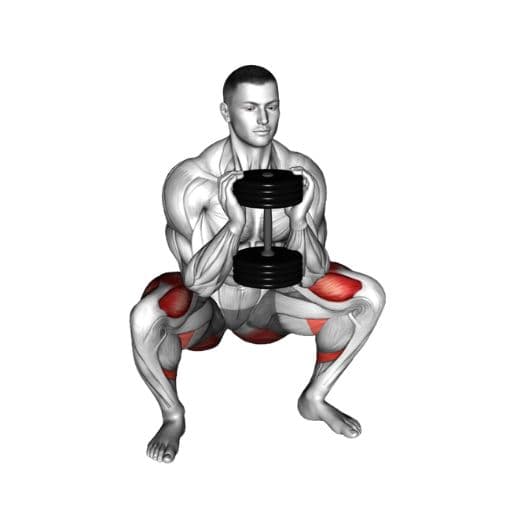
About the Goblet Squat
The goblet squat is a compound lower-body exercise performed by holding a single dumbbell or kettlebell at the chest in a “goblet” position — both hands cupping the implement, elbows pointing down, weight tight against the sternum. The lifter descends to at least parallel depth with an upright torso and stands to full lockout. The front-loaded position naturally promotes upright posture and deep squat depth, making it an excellent teaching tool and standalone strength exercise. All benchmarks use the weight of the single implement held.
The image shows a dumbbell goblet squat. These standards are implement-agnostic — they apply equally to dumbbells and kettlebells of the same weight. Be consistent with your implement choice when tracking progress, as grip comfort and loading position differ slightly between the two.
Equipment Ceiling — The Goblet Squat's Defining Constraint
Unlike barbell exercises, the goblet squat is limited by available equipment. Most commercial gyms stock dumbbells up to 100–120 lb and kettlebells up to 32–48 kg (70–106 lb). An intermediate male at 180 lb needs 79 lb — well within range. But an advanced male at the same bodyweight needs 113 lb, and the elite standard of 151 lb exceeds most gym racks entirely.
When you consistently hit the heaviest dumbbell in your gym for sets of 8–10, it's a strong signal that the goblet squat has served its purpose and transitioning to a barbell front or back squat is the natural next step. The goblet squat then shifts to a warm-up, volume accessory, or technique refinement tool within a barbell-primary program.
What Do Goblet Squat Strength Levels Mean?
Each tier reflects the weight of the single dumbbell or kettlebell held at the chest with strict goblet form — parallel depth, controlled descent, and upright torso. Standards are shown as bodyweight multipliers so they scale with your size. Because the goblet squat is implement-limited (holding position fails before legs do), these multipliers are substantially lower than barbell squat standards. At higher tiers, available gym equipment may become the practical ceiling.
Beginner
Learning the goblet position and basic squat pattern. The primary challenge at this level is holding the implement securely at the chest while coordinating a full-depth squat. Grip endurance and upper-back positioning are common limiters before leg strength becomes a factor.
- Can hold a light dumbbell or kettlebell at the chest for multiple reps
- Working toward consistent parallel depth with upright torso
- Grip and upper-back fatigue may limit sets before legs tire
- Typically within the first 1–3 months of structured lower-body training
Novice
Reliable goblet position with consistent depth. Lifters at this level can perform multiple sets to parallel or below without the implement slipping or posture breaking down. The counterbalance effect of the chest-held weight starts to improve squat mechanics noticeably versus an unloaded squat.
- Consistent parallel depth with a stable upright torso throughout the set
- Comfortable with both dumbbell and kettlebell grips for goblet position
- Can perform 3–4 sets of 10 at this weight without significant form breakdown
- Typically represents 3–6 months of consistent lower-body training
Intermediate
Strong goblet position with loads approaching equipment limits for lighter lifters. The holding position becomes a meaningful challenge — forearms, biceps, and upper back must work hard to maintain the chest-held position through full sets. Many lifters at this level begin supplementing with barbell front or back squats to continue progression beyond dumbbell availability.
- Holding challenge is noticeable but manageable for sets of 8–10
- Full depth (parallel or below) with controlled eccentric on every rep
- Using 50–80 lb dumbbells or 24–32 kg kettlebells regularly
- Typically represents 1–2 years of consistent lower-body training
Advanced
At this level, the goblet squat is typically an accessory movement rather than a primary leg exercise. Lifters are often bumping against the heaviest dumbbells in their gym. The holding position is now the clear limiter — the legs could handle more weight than the arms and torso can maintain in the goblet position. Most advanced lifters also train barbell squats as their primary squat pattern.
- Regularly using the heaviest dumbbells in most commercial gyms (90–120 lb)
- Grip and upper-back endurance limits the set before legs reach failure
- Goblet squat serves as a warm-up, volume accessory, or technique exercise
- Barbell front or back squat is the primary leg strength movement
Elite
Exceptional goblet squat strength that exceeds the available equipment in most commercial gyms. At 151 lb for a 180-lb male, this requires dumbbells or kettlebells that many facilities do not carry. This level demands extraordinary grip strength, upper-back endurance, and leg power simultaneously. Very few lifters pursue the goblet squat to this level — barbell movements are universally the primary leg exercise at this tier.
- Implement weight exceeds most gym dumbbell racks (100–120 lb max typical)
- May require specialty heavy kettlebells (48+ kg) or adjustable dumbbells
- Extraordinary grip, forearm, and upper-back endurance alongside leg strength
- Represents top ~5% of all goblet squat practitioners
Goblet Squat Training Insights & FAQ
Common questions about goblet squat standards, equipment limitations, and how the goblet squat fits into a complete lower-body program.
Disclaimer
These are training benchmarks for self-assessment, not clinical standards. All values represent the weight of a single dumbbell or kettlebell held at the chest with strict goblet form — parallel depth, upright torso, controlled descent. Standards are derived from StrengthLevel.com community data (386K lifts, 71K qualifying) with a strict-form discount of 11–16%, cross-validated against FitnessVolt model estimates. The 1RM prediction formula is less accurate for the goblet squat than for barbell compound lifts because the holding position typically fails before leg capacity — accuracy degrades above 12 reps. Equipment availability (gym dumbbell/kettlebell maximum) may be the practical limiter at advanced and elite levels. Individual results will vary with technique, implement type, depth consistency, and training background. Consult a qualified professional before attempting high-intensity resistance training.