Dumbbell Front Squat Strength Standards
The Intermediate dumbbell front squat standard is 61 lb (28 kg) per dumbbell for men and 36 lb (16 kg) for women (estimated 1RM at 180 / 140 lb bodyweight, per dumbbell). Compare your lift by bodyweight and age below.
Configure Your Bodyweight & Unit
Male Dumbbell Front Squat Standards (lb/dumbbell)
StrengthRegimen standards for 180 lb bodyweight — per dumbbell, front-rack position
| Strength Level | Per Dumbbell (180 lb BW) | BW Ratio |
|---|---|---|
| Beginner | 18 lb | 0.10x |
| NoviceYou | 36 lb | 0.20x |
| Intermediate | 61 lb | 0.34x |
| Advanced | 90 lb | 0.50x |
| Elite | 122 lb | 0.68x |
How much should I DB Front Squat? (lb/dumbbell)
Assess Your DB Front Squat
Enter the weight per dumbbell and reps completed to estimate your 1RM and strength level
Enter the weight of one dumbbell held at the shoulder — not the combined weight of both
Front squatting 45 lb/dumbbell × 5 reps equals an estimated 1RM of 53 lb per dumbbell.
At 180 lb (Male), that is 0.29× your bodyweight per dumbbell, which falls within the Novice range. Epley-based estimate; accuracy is highest when reps ≤ 10.
Shareable DB Front Squat Strength Card
DB Front Squat Strength Spectrum
Rep-Max & Training Zone Table (LB/dumbbell)
Per-dumbbell loads based on your 53 lb estimated 1RM
| Target | % of 1RM | Per Dumbbell | Programming |
|---|---|---|---|
| 1RM (Max) (1 rep) | 100% | 53 lb | 1 × 1 rep (Max Test) |
| 3RM (3 reps) | 90.9% | 48 lb | 3–4 × 3 reps |
| 5RM (5 reps) | 85.7% | 45 lb | 3–4 × 5 reps |
| 8RM (8 reps) | 78.9% | 42 lb | 3–4 × 8 reps |
| 10RM (10 reps) | 75% | 40 lb | 3–4 × 10 reps |
| 12RM (12 reps) | 71.4% | 38 lb | 3 × 12 reps |
| 15RM (15 reps) | 66.7% | 35 lb | 2–3 × 15 reps |
Complete DB Front Squat Reference Chart (LB/dumbbell)
Per-dumbbell standards across bodyweights for Male lifters in lb
| BW (lb) | Beginner | Novice | Intermediate | Advanced | Elite |
|---|---|---|---|---|---|
| 120 | 12 | 24 | 41 | 60 | 82 |
| 130 | 13 | 26 | 44 | 65 | 88 |
| 140 | 14 | 28 | 48 | 70 | 95 |
| 150 | 15 | 30 | 51 | 75 | 102 |
| 160 | 16 | 32 | 54 | 80 | 109 |
| 170 | 17 | 34 | 58 | 85 | 116 |
| 180 | 18 | 36 | 61 | 90 | 122 |
| 190 | 19 | 38 | 65 | 95 | 129 |
| 200 | 20 | 40 | 68 | 100 | 136 |
| 210 | 21 | 42 | 71 | 105 | 143 |
| 220 | 22 | 44 | 75 | 110 | 150 |
| 230 | 23 | 46 | 78 | 115 | 156 |
| 240 | 24 | 48 | 82 | 120 | 163 |
| 250 | 25 | 50 | 85 | 125 | 170 |
| 260 | 26 | 52 | 88 | 130 | 177 |
| 270 | 27 | 54 | 92 | 135 | 184 |
| 280 | 28 | 56 | 95 | 140 | 190 |
| 290 | 29 | 58 | 99 | 145 | 197 |
| 300 | 30 | 60 | 102 | 150 | 204 |
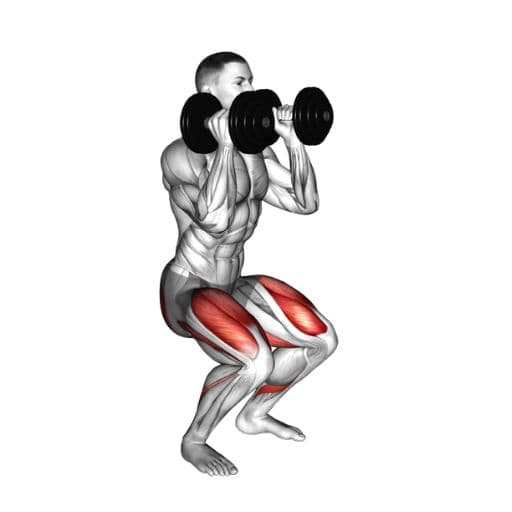
About the Dumbbell Front Squat
The dumbbell front squat is a compound lower-body exercise performed with two dumbbells held at shoulder height in a front-rack position. The lifter descends to at least parallel depth while maintaining an upright torso, then stands to full lockout. The front-loaded position demands significantly more upper back and core stability than holding dumbbells at the sides, and the shoulders become a secondary limiting factor.
For a valid comparison against these standards, descend to at least parallel depth (hip crease at or below the knee), maintain an upright torso throughout, and stand to full lockout. All weights are per dumbbell (one hand).
DB Front Squat vs. DB Squat — Why the Numbers Differ
The dumbbell front squat places the dumbbells at shoulder height in a front-rack position, which demands significantly more from the upper back, core, and anterior deltoids compared to holding dumbbells at your sides. This makes the shoulders and core a secondary limiting factor — your legs may be strong enough, but the front-rack position fails first.
In the standard dumbbell squat (arms at sides), grip endurance is the primary non-leg limiter instead. Because the front-rack position is more demanding than simply holding dumbbells by your sides, front squat loads are typically 8–15% lower at every strength level. Both exercises are valuable — the front squat emphasizes quad engagement and core stability, while the arms-at-sides squat allows heavier absolute loads.
Dumbbell Front Squat Strength Levels Explained
What each strength level means for the dumbbell front squat — from learning the front-rack position to handling heavy dumbbells at shoulder height with a perfectly upright torso. All values are per-dumbbell weight relative to bodyweight.
Beginner
Male 0.10× BW • Female 0.07× BWCan perform a dumbbell front squat with very light dumbbells held at the shoulders through a full range of motion. At this stage the main challenge is learning the front-rack position — keeping the elbows up, upper arms roughly parallel to the floor, and the torso upright while descending to parallel depth. Most people reach this level within a few weeks of practice.
Focus: Focus on mastering the front-rack hold with light dumbbells. Practice keeping the elbows high and the torso vertical. Work in the 10–15 rep range to build familiarity with the position before adding weight.
0–6 months of consistent training
Novice
Male 0.20× BW • Female 0.15× BWConsistent dumbbell front squats with moderate loads and a stable front-rack position across multiple sets. The torso stays upright throughout the movement and depth is reliable. Linear progression in small dumbbell increments is still effective.
Focus: Progress by moving to the next dumbbell pair when all reps are completed with strict depth and an upright torso. Work primarily in the 8–12 rep range. Pair with other lower-body movements like dumbbell squats or lunges for balanced development.
6–12 months of structured lower-body training
Intermediate
Male 0.34× BW • Female 0.26× BWSolid dumbbell front squat strength with strict form under meaningful load. For a 180 lb male this is roughly 61 lb per dumbbell. The front-rack position is stable enough that the shoulders no longer fail before the legs. Represents 1–2 years of regular lower-body training.
Focus: Periodize across 6–10 reps. At this load the front-rack position becomes the rate limiter — actively cue “elbows up, chest tall” throughout each rep. Consider wrist wraps if wrist extension under load becomes uncomfortable. Alternate emphasis between front squats and conventional dumbbell squats across training blocks.
1–2+ years of consistent training
Advanced
Male 0.50× BW • Female 0.38× BWUpper-tier dumbbell front squat strength. At 90 lb per dumbbell (for a 180 lb male), the challenge extends beyond leg strength — stabilizing heavy dumbbells at shoulder height taxes the anterior deltoids, upper back, and core substantially. Getting the dumbbells into position becomes a meaningful component of each set.
Focus: Structured mesocycles with planned intensity peaks. Practice a reliable clean-to-shoulders technique to get the dumbbells into position safely. Shoulder prehab and thoracic mobility work become important accessories. Core stability (front planks, Pallof presses) directly supports front squat performance.
3–5+ years of dedicated training
Elite
Male 0.68× BW • Female 0.50× BWExceptional dumbbell front squat strength. At this load (122 lb per dumbbell for a 180 lb male) the front-rack position places enormous demands on the shoulders, upper back, and core. Getting dumbbells of this size into position and maintaining an upright torso throughout the set requires years of dedicated training and exceptional full-body stability.
Focus: Prioritize shoulder health, thoracic mobility, and recovery. Very small, calculated increases over multi-month training blocks. At this level most lifters also train the barbell front squat or back squat as a primary strength builder, using heavy dumbbell front squats as a targeted stability and unilateral accessory.
5+ years of serious strength training
Dumbbell Front Squat FAQ
How does the dumbbell front squat compare to the dumbbell squat (arms at sides)?
The two exercises target the same primary muscles (quadriceps and glutes) but differ in their secondary limiting factors. In the dumbbell squat with arms at sides, grip endurance is the primary non-leg limiter — your hands must hold the dumbbells for the entire set without straps. In the dumbbell front squat, the shoulders, upper back, and core are the secondary limiters because they must stabilize the dumbbells in the front-rack position throughout the set.
In practice, dumbbell front squat loads are typically 8–15% lower than dumbbell squat loads at the same strength level. The front-rack position also demands a more upright torso, which shifts quad emphasis forward compared to the slightly more hip-dominant arms-at-sides variation.
How do I hold the dumbbells in the correct front-rack position?
Hold one dumbbell in each hand at shoulder height. The ends of the dumbbells can rest lightly on the front of the shoulders or just above them. Keep your elbows pointed forward and up so your upper arms are roughly parallel to the floor. This is the front-rack position.
Common mistakes include letting the elbows drop (which causes the torso to lean forward), holding the dumbbells too far from the body, and gripping too tightly (which causes forearm fatigue before shoulder or leg fatigue). The dumbbells should be supported primarily by the shoulders, with the hands providing guidance and light control.
If you find the front-rack position uncomfortable, thoracic mobility work (foam rolling the upper back, wall slides) and front-rack stretches can help. Wrist flexibility is also a factor — wrist wraps can reduce discomfort if wrist extension is the limiting factor.
What counts as proper depth for a dumbbell front squat?
These standards assume at least parallel depth: the hip crease descends to the same level as the top of the kneecap (or below). The torso must remain upright throughout — if you need to lean forward significantly to reach depth, the weight is too heavy for strict-form assessment.
The front-rack position naturally encourages a more upright torso compared to holding dumbbells at the sides. If you cannot maintain an upright torso at parallel depth, ankle mobility (try elevating your heels on small plates) and hip mobility are usually the limiting factors — not the weight itself.
Half-squats and quarter-squats are not valid for comparison against these standards. If you test with limited depth, your assessed level will be inflated.
How accurate is the 1RM estimate for dumbbell front squats?
The Epley formula (1RM = weight × (1 + reps / 30)) was validated primarily on barbell compound lifts. The dumbbell front squat uses the same primary muscles but introduces shoulder and upper-back fatigue as a secondary failure point, especially in longer sets.
During high-rep sets (above 10), the front-rack position fails before the legs in many lifters — the elbows drop, the torso leans forward, and the set ends due to positional breakdown rather than leg fatigue. This inflates the 1RM estimate. For the most reliable prediction, use a weight you can lift for 10 reps or fewer with strict form (upright torso, elbows high, full depth throughout).
Why does the front-rack position feel so demanding on my upper body?
The front-rack position requires isometric endurance from multiple upper-body muscle groups simultaneously: the anterior deltoids hold the dumbbells at shoulder height, the upper back (rhomboids, middle traps) keeps the thoracic spine extended, and the core braces to prevent forward collapse under load.
Unlike the arms-at-sides dumbbell squat (where the arms hang passively and only grip is challenged), the front squat position actively fatigues the shoulders throughout every rep. This is why the dumbbell front squat is considered a more full-body exercise than other dumbbell squat variations, even though the legs do the primary work.
If upper-body endurance is your primary limiter, front-rack holds (holding the dumbbells at shoulder height for 20–30 seconds without squatting) and overhead pressing work can directly improve your front squat capacity by building the shoulders and upper back to match your leg strength.
Disclaimer
These are training benchmarks for self-assessment, not clinical standards. All values represent per-dumbbell weight (one hand). Standards are derived from StrengthLevel.com community data (51K lifts, 4.5K qualifying results) with a strict-form discount; individual results will vary with technique, front-rack mobility, and training background. The dataset is substantially smaller than other exercises — treat these standards as directional estimates, not population norms. Consult a qualified professional before attempting maximum-effort lifts.