Dumbbell Bulgarian Split Squat Strength Standards
The Intermediate dumbbell Bulgarian split squat standard is 63 lb (29 kg) per dumbbell for men and 42 lb (19 kg) per dumbbell for women (estimated 1RM at 180 / 140 lb bodyweight). Compare your lift by bodyweight and age below.
Configure Your Bodyweight & Unit
Male Dumbbell Bulgarian Split Squat Standards (lb/dumbbell)
StrengthRegimen standards for 180 lb bodyweight — per dumbbell
| Strength Level | Per Dumbbell (180 lb BW) | BW Ratio |
|---|---|---|
| Beginner | 23 lb | 0.13x |
| NoviceYou | 40 lb | 0.22x |
| Intermediate | 63 lb | 0.35x |
| Advanced | 90 lb | 0.50x |
| Elite | 122 lb | 0.68x |
How much should I Dumbbell Bulgarian Split Squat? (lb/dumbbell)
Assess Your Dumbbell Bulgarian Split Squat
Enter the weight per dumbbell and reps completed per leg to estimate your 1RM
Enter the weight of one dumbbell — not the combined weight of both hands
40 lb/dumbbell × 8 reps per leg = estimated 1RM of 51 lb per dumbbell.
At 180 lb (Male), that is 0.28× your bodyweight per dumbbell, which falls within the Novice range. Epley-based estimate; accuracy is highest when reps ≤ 10 for this exercise.
Shareable Strength Card
Where Your Dumbbell Bulgarian Split Squat Ranks
Normalized against male lifters at 180 lb bodyweight
Dumbbell Bulgarian Split Squat Strength Spectrum
Rep-Max & Training Zone Table (LB/dumbbell)
Per-dumbbell loads based on your 51 lb estimated 1RM
| Target | % of 1RM | Per Dumbbell | Programming |
|---|---|---|---|
| 1RM (Max) (1 rep) | 100% | 51 lb | 1 × 1 rep (Max Test) |
| 3RM (3 reps) | 90.9% | 46 lb | 3–4 × 3 reps |
| 5RM (5 reps) | 85.7% | 44 lb | 3–4 × 5 reps |
| 8RM (8 reps) | 78.9% | 40 lb | 3–4 × 8 reps |
| 10RM (10 reps) | 75% | 38 lb | 3–4 × 10 reps |
| 12RM (12 reps) | 71.4% | 36 lb | 3 × 12 reps |
| 15RM (15 reps) | 66.7% | 34 lb | 2–3 × 15 reps |
Complete Dumbbell Bulgarian Split Squat Reference Chart (LB/dumbbell)
Per-dumbbell standards across bodyweights for Male lifters in lb
| BW (lb) | Beginner | Novice | Intermediate | Advanced | Elite |
|---|---|---|---|---|---|
| 120 | 16 | 26 | 42 | 60 | 82 |
| 130 | 17 | 29 | 46 | 65 | 88 |
| 140 | 18 | 31 | 49 | 70 | 95 |
| 150 | 20 | 33 | 53 | 75 | 102 |
| 160 | 21 | 35 | 56 | 80 | 109 |
| 170 | 22 | 37 | 59 | 85 | 116 |
| 180 | 23 | 40 | 63 | 90 | 122 |
| 190 | 25 | 42 | 67 | 95 | 129 |
| 200 | 26 | 44 | 70 | 100 | 136 |
| 210 | 27 | 46 | 74 | 105 | 143 |
| 220 | 29 | 48 | 77 | 110 | 150 |
| 230 | 30 | 51 | 81 | 115 | 156 |
| 240 | 31 | 53 | 84 | 120 | 163 |
| 250 | 33 | 55 | 88 | 125 | 170 |
| 260 | 34 | 57 | 91 | 130 | 177 |
| 270 | 35 | 59 | 95 | 135 | 184 |
| 280 | 36 | 62 | 98 | 140 | 190 |
| 290 | 38 | 64 | 102 | 145 | 197 |
| 300 | 39 | 66 | 105 | 150 | 204 |
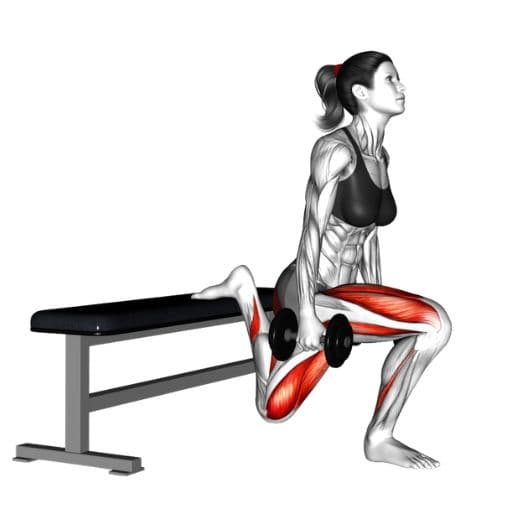
What Is the Dumbbell Bulgarian Split Squat?
The dumbbell Bulgarian split squat (rear-foot-elevated split squat) is performed by placing one foot behind you on a bench (14–18 inches high), holding one dumbbell in each hand at arm’s length, and descending until the rear knee approaches the floor. It targets the quadriceps, glutes, and hamstrings of the front leg while also loading the core for single-leg stability.
Compared to the barbell variant, dumbbells lower the center of gravity (slightly easier to balance) but add grip as a secondary limiting factor at heavier loads. The dumbbell BSS is ideal for home gyms without a squat rack, for lifters learning the split-squat pattern, and as an accessory exercise in programs built around barbell work.
All benchmarks on this page are per dumbbell. If you hold 40 lb dumbbells in each hand, enter 40 lb — not 80 lb.
Unilateral Balance: Why Single-Leg Standards Differ
The dumbbell Bulgarian split squat is a unilateral exercise — each leg works independently while the other provides balance on the bench. This introduces balance and coordination demands that bilateral exercises (squats, leg presses) do not have.
Balance as a limiter
At higher loads, maintaining a stable front foot while managing two heavy dumbbells requires significant core and hip stability. Balance variability introduces more noise into performance than bilateral lifts, which is why single-leg standards are evaluated more conservatively.
Grip + balance combined
Unlike the barbell BSS (where only balance is the secondary factor), the dumbbell variant adds grip endurance as a third limiting factor. At advanced loads, you may find grip, balance, or leg strength failing in unpredictable order depending on fatigue and setup.
Per-Dumbbell Load Convention
All standards, charts, and share cards on this page use the per-dumbbell convention: the weight of one dumbbell held in one hand. If you hold 40 lb dumbbells in each hand, enter 40 lb — not the combined 80 lb. This convention matches StrengthRegimen’s dumbbell bench press, dumbbell squat, dumbbell curl, and dumbbell calf raise standards.
Why per dumbbell? Gym dumbbells are labeled per unit. Entering “40 lb” when you pick up a pair of 40 lb dumbbells is more intuitive than calculating a combined total. It also makes comparing across exercises and sources consistent — StrengthLevel.com, FitnessVolt, and most gym trackers all use per-dumbbell values.
Dumbbell Bulgarian Split Squat Strength Levels Explained
What each strength level means for the dumbbell Bulgarian split squat — from your first week with rear-foot-elevated split squats to the practical ceiling where grip limits the exercise. All values are per dumbbell relative to bodyweight.
Beginner
Male 0.13× BW • Female 0.09× BWCan complete a dumbbell Bulgarian split squat with light dumbbells while maintaining balance on the front leg. Strength at this stage comes primarily from learning the rear-foot-elevated position, finding proper foot distance from the bench, and building baseline single-leg stability. Grip and balance are minimal factors at these loads.
Focus: Focus on balance and depth with 8–12 reps per leg. Place the rear foot laces-down on a bench at knee height. Keep the dumbbells steady at your sides and descend until the rear knee approaches the floor. Master the stance before adding weight.
0–6 months of consistent training
Novice
Male 0.22× BW • Female 0.17× BWConsistent rear-foot-elevated split squats with moderate dumbbell loads. Can maintain an upright torso, controlled descent to depth, and a strong drive-up through the front heel across multiple sets per leg. Balance is reliable enough to focus on progressive overload rather than stability.
Focus: Linear progression in 5–10 lb dumbbell jumps. Work primarily in the 6–10 rep range per leg. Ensure both legs receive equal volume and loading. Pair with bilateral leg exercises like squats or leg press for complete development.
6–12 months of structured lower-body training
Intermediate
Male 0.35× BW • Female 0.30× BWSolid dumbbell BSS strength with strict form under meaningful per-dumbbell load. Represents the typical level of a dedicated lifter with 1–2 years of regular unilateral leg training. Grip starts to become noticeable during heavier sets, and balance is well-practiced but still requires concentration at working loads.
Focus: Periodize rep ranges across 5–10 reps per leg. Progress requires intentional overload — adding reps before increasing dumbbell weight. Monitor whether grip, balance, or leg strength is the first to limit the set. If grip consistently fails first, consider chalk or straps for working sets.
1–2+ years of consistent training
Advanced
Male 0.50× BW • Female 0.42× BWUpper-tier dumbbell BSS strength. At this per-dumbbell load, grip endurance is a significant limiting factor — the front leg can likely handle more load than the hands can hold for a full set per leg. Requires years of dedicated unilateral training and well-developed forearm and core stability.
Focus: Structured mesocycles with planned intensity peaks. Consider whether the dumbbell BSS is still the optimal tool for single-leg overload, or if transitioning to a barbell Bulgarian split squat would better target the quadriceps and glutes without the grip bottleneck.
3–5+ years of dedicated training
Elite
Male 0.68× BW • Female 0.52× BWExceptional dumbbell BSS strength, typically seen only in athletes with both extensive unilateral leg training and above-average grip strength. Maintaining strict depth with this per-dumbbell load on a single leg requires outstanding balance, core control, and forearm endurance. Most lifters at this level have already transitioned to the barbell variant for primary single-leg development.
Focus: Prioritize joint health (knees, hips) and grip recovery. Very small, calculated increases over multi-month blocks. Dumbbell availability at your gym may become a practical ceiling — many facilities stock dumbbells only up to 100–120 lb.
5+ years of serious strength training
Dumbbell Bulgarian Split Squat FAQ
How does the dumbbell BSS compare to the barbell BSS?
Both train the quadriceps, glutes, and hamstrings unilaterally with the rear foot elevated on a bench. The barbell variant places the load on your upper back, bypassing grip entirely and allowing heavier loading for maximal single-leg strength. The dumbbell variant holds the load at the sides, which lowers the center of gravity (slightly easier to balance) but adds grip as a secondary limiting factor.
Dumbbells are the better choice for lifters who lack a squat rack, are newer to the BSS pattern and benefit from the lower center of gravity, or who use the BSS as an accessory exercise. The barbell variant is preferred when maximal single-leg overload and continuous progressive loading are the primary goals.
How do I set up the rear foot and bench?
Use a flat bench at roughly knee height (14–18 inches / 35–45 cm). Place the top of the rear foot (laces down) on the bench. Stand far enough from the bench that your front shin stays roughly vertical when at the bottom of the rep. Too close shifts excessive load to the rear leg; too far creates an uncomfortable stretch at the hip flexor.
A good starting position: from standing, take roughly 2 foot-lengths forward from the bench, then place the rear foot. Adjust based on comfort and depth. Some lifters prefer a slightly higher surface for increased range of motion, but this also increases balance demand.
How do I handle grip at heavier loads?
Grip typically becomes noticeable around the intermediate level — roughly 0.30–0.40× bodyweight per dumbbell for men and 0.25–0.35× for women. At these loads, the forearms start fatiguing before the front leg during longer sets.
Chalk is the first line of defense. If grip continues to limit your sets, lifting straps can remove the bottleneck, but note that strapped dumbbell BSS performance does not directly compare to bare-hands standards. If grip consistently fails first, this is a signal that you may be reaching the practical ceiling of the dumbbell variant for leg development.
How deep should I go?
The StrengthRegimen standard requires the rear knee to approach the floor (within 1–2 inches) with a controlled descent. There is no universally standardized depth marker for the BSS, unlike the barbell squat where “hip crease below knee” is common.
Depth depends on hip mobility, bench height, and limb proportions. A taller lifter on a lower bench may need to stop slightly higher. The key is consistent depth across all reps — if you cannot reach the same depth on every rep, the dumbbell is too heavy for that set.
When should I switch to a barbell Bulgarian split squat?
Consider switching when you consistently reach the advanced range (roughly 0.45–0.55× bodyweight per dumbbell for men, 0.38–0.45× for women) and grip or dumbbell availability is your primary limiter. At that point, your legs can handle significantly more load than your hands can support.
The barbell removes grip as the bottleneck and allows loading in smaller increments (2.5–5 lb plates vs. 5–10 lb dumbbell jumps). However, the barbell variant demands more upper-back stability and increases the balance challenge by raising the center of gravity. There is no mandatory transition point — the dumbbell BSS remains a valid training tool at any level.
Disclaimer
These are StrengthRegimen training benchmarks for self-assessment, not clinical standards. All values represent the weight of one dumbbell (per hand). Multi-rep sets are converted to an estimated 1RM using the Epley formula; accuracy is highest at 10 reps or fewer for this unilateral exercise and decreases at higher rep counts. Standards are derived from community datasets and adjusted for strict form; individual results vary based on grip strength, balance, limb proportions, training history, and dumbbell availability at your gym.