Barbell Curl Strength Standards
The average Barbell Curl is 103 lb (47 kg) for men and 53 lb (24 kg) for women (1RM). Compare your one-rep max lift by bodyweight and age below.
Configure Your Bodyweight & Unit
Male Barbell Curl Standards (lb)
StrengthRegimen standards for 180 lb bodyweight — total barbell weight · strict form
| Strength Level | Total Barbell (180 lb BW) | BW Ratio |
|---|---|---|
| Beginner | 40 lb | 0.22x |
| NoviceYou | 65 lb | 0.36x |
| Intermediate | 103 lb | 0.57x |
| Advanced | 140 lb | 0.78x |
| Elite | 182 lb | 1.01x |
How much should I Barbell Curl? (lb)
Assess Your Barbell Curl
Enter your total barbell weight and reps completed to estimate your 1RM and strength level
Enter the total weight (bar + all plates). Include the bar itself.
Curling 65 lb × 8 reps equals an estimated 1RM of 82 lb (total barbell).
At 180 lb (Male), that is 0.46× your bodyweight, which falls within the Novice range. Epley-based estimate — less precise for single-joint exercises.
Shareable Barbell Curl Strength Card
Barbell Curl Strength Spectrum
Rep-Max & Training Zone Table (LB)
Working loads based on your 82 lb estimated 1RM
| Target | % of 1RM | Barbell Weight | Programming |
|---|---|---|---|
| 1RM (Max) (1 rep) | 100% | 82 lb | 1 × 1 rep (Max Test) |
| 3RM (3 reps) | 90.9% | 75 lb | 3–4 × 3 reps |
| 5RM (5 reps) | 85.7% | 70 lb | 3–4 × 5 reps |
| 8RM (8 reps) | 78.9% | 65 lb | 3–4 × 8 reps |
| 10RM (10 reps) | 75% | 62 lb | 3–4 × 10 reps |
| 12RM (12 reps) | 71.4% | 59 lb | 3 × 12 reps |
| 15RM (15 reps) | 66.7% | 55 lb | 2–3 × 15 reps |
Complete Barbell Curl Reference Chart (LB)
Standards across bodyweights for Male lifters in lb
| BW (lb) | Beginner | Novice | Intermediate | Advanced | Elite |
|---|---|---|---|---|---|
| 120 | 26 | 43 | 68 | 94 | 121 |
| 130 | 29 | 47 | 74 | 101 | 131 |
| 140 | 31 | 50 | 80 | 109 | 141 |
| 150 | 33 | 54 | 85 | 117 | 152 |
| 160 | 35 | 58 | 91 | 125 | 162 |
| 170 | 37 | 61 | 97 | 133 | 172 |
| 180 | 40 | 65 | 103 | 140 | 182 |
| 190 | 42 | 68 | 108 | 148 | 192 |
| 200 | 44 | 72 | 114 | 156 | 202 |
| 210 | 46 | 76 | 120 | 164 | 212 |
| 220 | 48 | 79 | 125 | 172 | 222 |
| 230 | 51 | 83 | 131 | 179 | 232 |
| 240 | 53 | 86 | 137 | 187 | 242 |
| 250 | 55 | 90 | 143 | 195 | 253 |
| 260 | 57 | 94 | 148 | 203 | 263 |
| 270 | 59 | 97 | 154 | 211 | 273 |
| 280 | 62 | 101 | 160 | 218 | 283 |
| 290 | 64 | 104 | 165 | 226 | 293 |
| 300 | 66 | 108 | 171 | 234 | 303 |
About the Barbell Curl
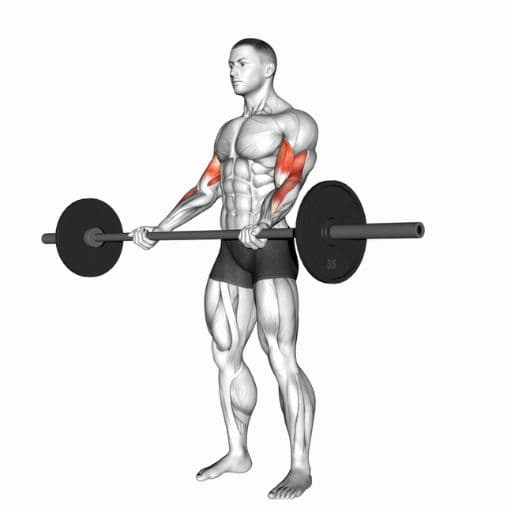
The standing barbell curl is a single-joint isolation exercise targeting the elbow flexors. The lifter stands upright gripping a straight barbell with a fully supinated (palms-up) grip and curls through full elbow flexion with strict form — no torso swing, no hip drive, and upper arms pinned at the sides throughout. These standards are specific to the straight barbell. For the EZ bar (cambered curl bar), see the dedicated EZ Bar Curl Standards page, which uses separate community data and multipliers.
All benchmarks on this page represent total barbell weight (bar + plates). If you curl a 45 lb Olympic bar with a 10 lb plate on each side, enter 65 lb — not 20 lb.
Barbell Curl vs. Dumbbell Curl — Understanding Your Numbers
Do not convert between barbell curl and dumbbell curl loads. The barbell fixes both hands on a single bar, allowing bilateral force production and a more stable bar path. Two 35 lb dumbbells does not equal a 70 lb barbell curl — the stabilization, grip mechanics, and wrist position differ. Research on bilateral deficit for the biceps curl (Minchew et al.) found no significant difference in total repetitions between bilateral and unilateral conditions, but the exercises are still not interchangeable as strength tests.
Use each exercise’s standards independently. The StrengthRegimen Dumbbell Curl page uses per-dumbbell standards derived from separate community data (3.63M lifts). These Barbell Curl standards use total barbell weight derived from barbell-specific data (2.57M lifts). Do not cross-reference or convert between them.
Barbell Curl Strength Levels Explained
What each strength level means for the standing barbell curl with strict form — from learning to curl without momentum to curling bodyweight or more with no torso swing. All values are total barbell weight relative to bodyweight.
Beginner
Male 0.22× BW • Female 0.13× BWCan perform a standing barbell curl with light weight through a full range of elbow flexion. For a 180 lb male this is approximately 40 lb total — below a standard Olympic barbell. At this stage, most lifters will use an EZ-bar (15–25 lb) or a fixed barbell. The main challenges are curling without torso swing and controlling the eccentric.
Focus: Focus on strict form with 8–12 reps per set. Use an EZ-bar or lightweight fixed barbell if you cannot curl a standard 45 lb Olympic bar with strict form. Prioritize full elbow extension at the bottom and a controlled 2-second eccentric over adding weight.
0–6 months of consistent training
Novice
Male 0.36× BW • Female 0.23× BWReliable strict curl form with moderate loads. For a 180 lb male this is approximately 65 lb total — the Olympic bar plus a 10 lb plate per side. The upper arms stay pinned at the sides naturally, and each rep reaches full elbow flexion at the top without compensating with the shoulders or torso.
Focus: Progress by adding 5 lb per session when all prescribed reps are completed with strict form. Work primarily in the 6–10 rep range. Begin incorporating dumbbell curls or hammer curls as accessories for balanced elbow-flexor development.
6–12 months of structured arm training
Intermediate
Male 0.57× BW • Female 0.38× BWSolid elbow-flexor strength maintained with strict technique. For a 180 lb male this is roughly 103 lb total — the bar plus a 25 lb plate and a small plate per side. Represents the typical level of a dedicated gym-goer with 1–2 years of consistent arm training. The limiting factor is biceps strength, not technique or momentum.
Focus: Periodize across 6–12 reps. Progress requires intentional overload — small plate increments, drop sets, or tempo manipulation. Wrist comfort may become a factor at these loads; an EZ-bar can reduce forearm strain.
1–2+ years of consistent training
Advanced
Male 0.78× BW • Female 0.56× BWUpper-tier strict barbell curl strength. For a 180 lb male this is approximately 140 lb total. Maintaining strict form at this load is genuinely difficult — the temptation to use torso momentum is significant. Loading and unloading the bar with fractional plates becomes part of the programming challenge.
Focus: Structured mesocycles with planned intensity peaks. Balance direct biceps volume with compound pulling (rows, pull-ups, chin-ups). Prioritize biceps tendon and elbow joint recovery between heavy curl sessions. Wrist wraps may help on straight bar at these loads.
3–5+ years of dedicated arm training
Elite
Male 1.01× BW • Female 0.74× BWExceptional strict barbell curl strength. For a 180 lb male this is approximately 182 lb total — curling more than bodyweight with no torso swing. This level represents years of dedicated elbow-flexor training and is competitive at strict curl events. At this load, biceps tendon integrity is the primary limiting factor beyond raw strength.
Focus: Prioritize biceps tendon health, elbow joint integrity, and calculated long-term progression. Very small increases over multi-month training blocks. Consider using competition-style strict curl protocols (back against wall) to validate form at maximal loads. Strategic deloads are essential.
5+ years of serious strength training
Barbell Curl FAQ
What is the difference between a strict curl and a cheat curl?
A strict curl isolates the elbow flexors: the upper arms stay pinned at the sides, the torso remains upright, and the knees stay straight throughout the rep. A cheat curl uses torso swing, hip drive, knee flexion, or lean-back to generate momentum and move heavier weight past the sticking point.
These are not interchangeable tests. A lifter who cheat-curls 135 lb may only strict-curl 95–110 lb. The USAWA (lift D10) and RPS both recognize the strict curl as a separate competition event requiring upper back and glutes against a vertical platform with heels within 12 inches. These standards assume strict form — if you use torso momentum, your assessed level will be inflated.
Should I use a straight bar or an EZ-bar?
These standards are for the straight barbell. If you train with an EZ bar (cambered curl bar), use the dedicated EZ Bar Curl Standards page instead, which has separate community data and multipliers. Marcolin et al. (2018) found minimal EMG difference between straight bar and EZ-bar for biceps brachii activation. The EZ-bar showed slightly higher brachioradialis activation in the eccentric phase.
StrengthLevel.com tracks the two as separate exercises with distinct performance distributions: EZ bar users are slightly stronger at beginner/novice levels (lighter bar, wrist comfort), while straight bar users are slightly stronger at advanced/elite levels (full supination advantage). Be consistent — always test with the same bar type. Do not mix results between the two standards pages.
The standard Olympic bar is too heavy for me to curl. What should I use?
This is completely normal, especially for beginners and lighter lifters. A standard Olympic barbell weighs 45 lb (20 kg), which already exceeds the beginner standard for many bodyweights. You do not need a full-size Olympic bar for barbell curls.
Options: An EZ-bar (15–25 lb / 7–11 kg), a fixed barbell (preset weights like 20, 30, or 40 lb), or a lighter training barbell (15 lb women’s Olympic bar, 25 lb technique bar). Enter the total loaded weight (bar + plates) into the tool regardless of which bar you use. The tool does not assume a specific bar weight.
How accurate is the 1RM estimate for barbell curls?
The Epley formula (1RM = weight × (1 + reps / 30)) was validated primarily on compound barbell lifts. Research on biceps curl 1RM prediction shows lower correlations (r = .84–.91) compared to the bench press (r = .97–.98), with total prediction errors of 5.25–6.92 kg in 27 recreationally trained males. The formulas can rank-order individuals, but absolute accuracy is lower than for compound lifts.
A separate study on 49 older adults across 10 exercises (including biceps curl) found that Epley and Wathan formulas had the lowest average error, but accuracy improved substantially when reps-to-failure were 10 or fewer. For the most reliable estimate, use a weight you can curl for 10 reps or fewer with strict form. The tool displays a warning above 10 reps.
Can I convert my dumbbell curl to a barbell curl equivalent?
No. The barbell curl and dumbbell curl are different exercises with different loading mechanics. The barbell fixes both hands on a single bar, allowing bilateral force production and a more stable bar path. The dumbbell curl allows independent arm movement, requires more stabilization, and uses a different wrist/forearm position.
Two 35 lb dumbbells does not equal a 70 lb barbell curl. Research on bilateral deficit for biceps curl (Minchew et al.) found no significant difference in total repetitions between bilateral and unilateral conditions, but the exercises are still not interchangeable as strength tests. Use each exercise’s standards independently — the StrengthRegimen Dumbbell Curl and Barbell Curl pages have separate, exercise-specific benchmarks.
Disclaimer
These are training benchmarks for self-assessment, not clinical standards. All values represent total barbell weight (bar + plates) with strict form. Standards are derived from StrengthLevel.com community data (2.57M lifts) with a strict-form discount and internal hierarchy validation; individual results will vary with technique, bar type, and training background. The 1RM prediction formula is less accurate for single-joint exercises than for compound lifts. Consult a qualified professional before attempting maximum-effort lifts.